
 English

Views: 0 Author: Site Editor Publish Time: 2026-04-15 Origin: Site


If you have ever worked in a busy workshop, factory maintenance room, automotive garage, or assembly area, you already know that a good Tool Cabinet is not just a box with drawers. It affects how quickly technicians find what they need, how safely tools are stored, how clean the workspace stays, and even how professional the whole operation feels on a daily basis.
A poor cabinet choice usually looks acceptable at first. It may seem sturdy enough in photos, the drawers may look spacious, and the price may appear attractive. But after a few months of real use, the weak points start showing up: drawers begin to sag, slides stop moving smoothly, the lock becomes unreliable, the finish scratches easily, and the layout no longer matches the tools actually being used. That is when buyers realize that selecting an industrial cabinet should never be based on appearance alone.
Before purchasing a Tool Cabinet, it helps to step back and think like an end user rather than just a buyer. Who will use it? What kinds of tools will it store? How often will it be moved? How heavy will the drawers be? Does the cabinet need to fit into an existing storage system? Questions like these can save a lot of trouble later.
Below are ten key parameters worth evaluating carefully before making a final decision.
This is one of the most overlooked factors, and honestly, it is often the one that causes problems the fastest.
An industrial Tool Cabinet should be able to handle not only the total cabinet load, but also the weight inside each individual drawer. Many buyers check the overall dimensions and drawer count, but forget to ask a very practical question: how much weight will each drawer actually carry in daily use?
In real working environments, technicians do not store just lightweight hand tools. Drawers often hold socket sets, power tools, pneumatic accessories, measuring instruments, spare parts, and heavy repair items. If the drawer slides are not rated properly, performance drops quickly. What starts as a smooth pull can turn into sticking, wobbling, or even rail failure.
A cabinet used in an industrial setting is rarely treated gently. Drawers are opened dozens of times a day. Tools are returned in a hurry. Weight is not always distributed perfectly. If the cabinet is underbuilt, it will show.
Ask for both the overall static load capacity and the dynamic load capacity of each drawer. A reliable supplier should be able to provide clear figures rather than vague descriptions like “heavy-duty” or “strong enough for industrial use.” Those phrases sound good, but they do not tell you much.
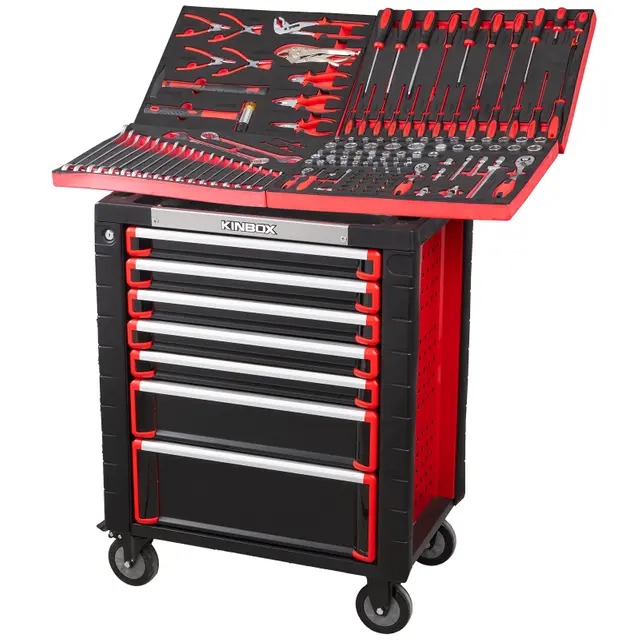
At a glance, many cabinets look similar. The real difference often comes down to the steel thickness and the strength of the cabinet structure.
A proper industrial Tool Cabinet should use robust steel construction that can hold up under constant use. Thicker steel generally means better resistance to dents, warping, and deformation, especially when drawers are fully loaded. Reinforced cabinet frames, stronger drawer fronts, and well-designed support points all contribute to long-term durability.
This is especially important if the cabinet will be placed in a busy garage or workshop where impacts, vibration, and constant movement are part of normal operation.
A cabinet can have a clean powder-coated finish and still be structurally weak underneath. Some lower-cost products look impressive in pictures but feel noticeably lighter and less stable in person. Once loaded with tools, the difference becomes obvious.
Check whether the manufacturer specifies the steel gauge or thickness for the frame, drawers, and top panel. It is a small detail, but it usually tells you a lot about product quality.
Not every tool setup is the same, so not every cabinet layout should be either.
One of the most important things to consider before buying a Tool Cabinet is how the drawers are arranged. Some users need multiple shallow drawers for hand tools, sockets, and measuring tools. Others need deeper drawers for bulkier items such as power tools, larger parts, or boxed components. If the drawer layout does not match the tools being stored, the cabinet becomes inconvenient no matter how strong it is.
A practical storage layout makes daily work easier. Frequently used tools should be stored in the most accessible drawers. Larger or less frequently used items can go into deeper lower drawers. A smart cabinet design supports how people actually work, rather than forcing them to adapt to a poor layout.
Before ordering, make a quick list of the tools or equipment you plan to store. This simple step often reveals whether you need more shallow drawers, more deep drawers, or a mixed layout.
Drawer slides are one of the hardest-working parts of any industrial cabinet, yet they do not always get the attention they deserve.
A strong cabinet body means very little if the drawers do not open smoothly under load. High-quality ball-bearing slides make a big difference in daily use. They improve efficiency, reduce user frustration, and help the cabinet maintain consistent performance over time.
Full-extension slides are especially valuable because they allow users to access the entire drawer space, including the back. Without full extension, tools stored at the rear are harder to reach, which often leads to clutter and wasted storage space.
In industrial settings, time matters. Technicians should not have to tug at drawers, fight resistance, or carefully balance weight every time they need a tool. Smooth drawer action may seem like a small detail, but over time it affects both efficiency and user satisfaction.
Look for ball-bearing slides, full-extension function, and clear load ratings per drawer. Soft-close features can also be useful in some environments, although for industrial applications, strength and reliability usually matter more than luxury-style motion.
If the cabinet needs to move, mobility becomes a key buying factor rather than a bonus feature.
Many industrial users prefer roller-style cabinets because they allow tools to be moved directly to the point of work. This saves time, reduces unnecessary walking, and keeps essential equipment close at hand. But not all mobile cabinets perform equally well.
The quality of the casters, wheel material, braking system, and cabinet balance all affect how well the unit moves under load. A fully loaded cabinet can become difficult to control if the wheels are too small, poorly mounted, or not suited to the floor surface.
Smooth warehouse floors, rough workshop floors, garage surfaces, and factory aisles all create different demands. A cabinet that rolls well in a showroom may behave very differently in a real industrial environment.
Check wheel size, material, locking brake design, and whether the cabinet is tested when fully loaded. If mobility is important, do not treat the wheels as a minor accessory. They are a major part of the product.
Tool storage is not just about organization. It is also about safety.
A good industrial Tool Cabinet should protect both the tools and the people using the cabinet. Safety features can include central locking systems, anti-tip mechanisms, drawer retention systems, and stable cabinet construction. These features help prevent accidents, unauthorized access, and damage caused by drawers opening unexpectedly.
This matters even more in shared workspaces where multiple people use the same storage units. Expensive tools, calibrated instruments, and specialized components should not be left unprotected.
When several heavy drawers are opened at once, a poorly designed cabinet can become unstable. Anti-tip systems reduce this risk by limiting how drawers open or by improving cabinet balance. In industrial environments, this is not just a nice extra. It is something worth taking seriously.
Does the cabinet include a reliable locking mechanism? Can it prevent multiple drawers from being pulled out at the same time? Is the lock durable enough for repeated use? These are the kinds of details buyers should verify before placing an order.
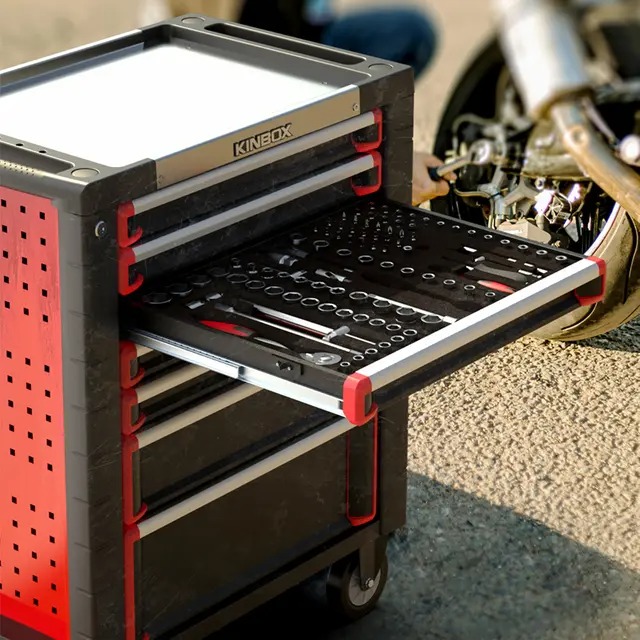
The finish on a Tool Cabinet does more than make it look good. It also plays a major role in protecting the cabinet from wear, chemicals, moisture, and corrosion.
In workshops and industrial facilities, cabinets may be exposed to oil, grease, cleaning fluids, humidity, dust, and occasional impacts. A weak surface treatment can wear down surprisingly fast. Once the coating starts to chip or rust develops, the cabinet not only looks worn but may also lose long-term structural reliability.
Powder-coated steel is widely used in industrial storage because it offers a durable finish with good resistance to scratches and corrosion. That said, not all powder coating processes are equal. The preparation, coating quality, and curing process all affect the final result.
Ask whether the cabinet uses powder-coated steel, whether the finish has been tested for corrosion resistance, and whether it is suitable for the intended work environment. A cabinet used in a dry assembly room has different needs than one used in a humid garage or heavy-duty repair area.
Even a high-quality cabinet can become a poor choice if it does not fit the workspace properly.
Before purchasing, buyers should consider the cabinet’s dimensions, height, width, depth, and how it will fit within the overall layout. Will it go under a workbench? Next to other storage units? Inside a service vehicle area? Against a wall where drawer clearance matters? These questions sound basic, but they are easy to overlook during procurement.
It also helps to think beyond the cabinet itself. In many professional environments, tool storage works best as part of a broader organization system rather than as a standalone unit.
If there is any chance that the storage setup will expand later, it is wise to choose a cabinet that can integrate with other workshop furniture, garage storage modules, or workstation systems. This gives the buyer more flexibility in the long run.
Some buyers focus only on current storage needs and forget future expansion. A cabinet that fits today but cannot work with future additions may create unnecessary limitations later.
Industrial buyers increasingly want storage that fits their work rather than forcing their work to fit standard storage.
That is where customization becomes important. Depending on the supplier, a Tool Cabinet may offer options such as different drawer layouts, color choices, branding, liner inserts, accessory additions, side panels, top trays, or compatibility with modular systems. For distributors and private-label buyers, customized dimensions or packaging may also be relevant.
In some industries, tool organization needs are highly specific. Automotive repair, heavy equipment maintenance, electronics assembly, and industrial servicing all use different tool mixes. A cabinet that can be adapted to those needs often delivers better day-to-day value than a one-size-fits-all product.
If you are sourcing in volume or supplying a defined customer group, ask the manufacturer what can be customized. Sometimes the most useful option is not the standard model shown first in the brochure.
This last point is easy to underestimate, but in practice it can make a huge difference.
Buying a Tool Cabinet is not only about buying a product. It is also about choosing a supplier who can support that product over time. If replacement parts are unavailable, communication is slow, or warranty handling is vague, even a decent cabinet can become a frustrating purchase.
Reliable suppliers usually provide clear technical information, responsive communication, consistent quality control, and practical after-sales support. That may include replacement parts, order support, or help with product selection for different markets and users.
Industrial storage products are expected to last, and buyers want confidence that support will still be there after delivery. This is especially important for importers, wholesalers, and project buyers who need consistency across larger orders.
Can the supplier provide spare parts? Do they respond clearly to technical questions? Can they handle repeat orders consistently? Do they understand the needs of your market? These questions can tell you a lot before you commit.
Choosing the right Tool Cabinet is really about balancing strength, usability, safety, and long-term value. Price matters, of course, but a cabinet that fails early, works poorly, or does not match the job will cost more in the long run. It is usually worth taking a little more time at the buying stage to evaluate the details that affect real performance.
The best cabinet is not always the one with the most drawers or the lowest quote. It is the one that suits your tools, your workspace, and your workflow while standing up to daily industrial use.
For buyers looking for a more dependable manufacturing partner, it also helps to work with a supplier that understands industrial storage from both a product and service perspective. Ningbo Kinbox Tools Technology Co., Ltd., established in 2013, specializes in metal tool storage products including tool trolleys, tool cabinets, tool carts, garage storage systems, and workbenches. With a modern production base in Cixi, Ningbo and extensive experience in sheet metal manufacturing, Kinbox focuses on combining durable construction, practical design, and flexible product solutions for customers in both domestic and international markets. The company also places emphasis on after-sales support and spare parts service, which can be an important advantage for buyers who value long-term cooperation rather than one-off sourcing.
The most important factor depends on how the cabinet will be used, but load capacity is usually one of the first things to check. If the cabinet cannot safely support the weight of your tools and equipment, other features will matter much less over time.
It depends on the work environment. A mobile cabinet is ideal when tools need to move with the user around a workshop or garage. A fixed cabinet may be better for dedicated workstations where movement is unnecessary.
Drawer slides directly affect usability, safety, and durability. High-quality slides allow smooth opening under heavy loads and improve access to tools, while poor slides often fail early in demanding environments.
Heavy-duty steel with a durable powder-coated finish is one of the most common and practical choices. It offers strong structural support and good resistance to wear, impact, and corrosion in industrial settings.
Yes, especially if you have specific storage needs, branding requirements, or plan to integrate the cabinet into a larger storage system. Customization can improve usability and make the product a better fit for your target market or workspace.



