
 English

Views: 0 Author: Site Editor Publish Time: 2026-04-06 Origin: Site


When people talk about a “pleasant workspace,” they often picture soft things: better lighting, cleaner walls, a tidier room, maybe a nicer color scheme. Those things do matter. But in real workshops, service bays, maintenance rooms, and production support areas, pleasantness is not mainly about decoration. It is about how the space feels to work in for eight hours a day. Does it feel calm or chaotic? Easy to move through or constantly in your way? Simple to reset or always one step from becoming a mess? A professional tool cabinet can influence all of that because it changes how tools, supplies, and work surfaces behave inside the room. And when the room behaves better, people usually feel better working in it. Clean, orderly work areas and storage spaces are also a basic expectation in workplace safety rules, not just a design preference.
That is why this question is more practical than it sounds. A professional tool cabinet does not simply store tools. It helps reduce visual clutter, supports cleaner routines, makes frequently used items easier to reach, and helps keep floors, benches, and aisles under control. Organized workplace methods are built on exactly this logic: sort what matters, set it in order, keep the space clean, standardize the setup, and make it sustainable. Those steps are not only about efficiency on paper. They are about creating a workspace that feels easier to run day after day, both physically and mentally.
In a workshop, “pleasant” does not mean delicate, fancy, or overly polished. It usually means something much more grounded. It means the space feels under control. You can find what you need without digging through three piles. You do not have to shift boxes just to open a drawer. The bench is available for actual work, not permanent storage. The room feels purposeful instead of slightly irritated all the time.
That matters because clutter is not neutral. Research and expert commentary tied to attention science have consistently noted that visual clutter competes for attention and makes it harder for the brain to stay focused on the task at hand. Even outside formal research language, most people recognize the feeling immediately: when too many unrelated things are in your field of view, the space feels heavier and more mentally noisy. A better-organized room feels calmer because it asks less from your attention.
There is also a broader well-being angle. Work stress is not only caused by deadlines or management pressure. The day-to-day environment matters too. Worker well-being is closely connected to workplace stress, and the physical setup of the space can either add friction or reduce it. A workspace that constantly forces searching, bending, clearing, and re-clearing is simply harder to live in. A well-designed tool cabinet helps remove some of that low-grade friction, and that is one reason it can make a workspace feel noticeably more pleasant.
A basic cabinet stores items. A professional tool cabinet does something more useful: it supports a workflow. That sounds like a small distinction, but it is actually the heart of the matter. The best cabinets are not just boxes with shelves or drawers. They are storage systems designed around repeated use, different categories of tools, different access needs, and the reality that real workspaces get messy fast if the storage system is too rigid or too weak.
That is why professional storage often has a surprisingly strong effect on the atmosphere of a room. Once tools have clearer homes, once the workbench stops acting like long-term parking, once heavy items sit where they are easier to retrieve, and once the cabinet itself is sturdy enough to keep that order intact, the workspace starts feeling less stressful. Not because anything magical happened, but because the room has fewer unresolved little problems. Workplace organization methods describe this clearly: a clean, uncluttered, safe, and well-organized environment reduces waste and supports productivity. A pleasant workspace is often just a well-run workspace seen from the human side.
One of the fastest ways to make a workspace feel better is to reduce how much loose stuff is visible at once. Open shelves have their place, but too much exposed storage makes a workshop feel busier than it actually is. Bits, chargers, fastener boxes, tape, gloves, adapters, manuals, spare components, measuring tools, and half-used supplies all create visual noise when they are scattered across open surfaces.
A professional tool cabinet helps because it turns scattered visibility into controlled visibility. The items are still there, still accessible, still ready to use, but they are no longer all competing for attention at the same time. That matters more than it sounds. Attention research connected to clutter suggests that when the visual field is crowded, the brain has a harder time focusing on one thing. In a practical workspace, that means an enclosed cabinet can help the room feel calmer simply by reducing how much unrelated material is constantly on display.
People often underestimate how much the first impression of a workspace shapes the tone of the work. If you walk in and immediately see a crowded bench, open boxes, loose tools, and side piles, you already feel like you are starting behind. If you walk in and the room looks reset, even if there is plenty of work ahead, the space feels more cooperative. A professional tool cabinet helps create that second feeling because it makes “reset” more realistic at the end of each shift. That is one reason organized systems are easier to sustain than messy ones: the room starts rewarding the behavior.
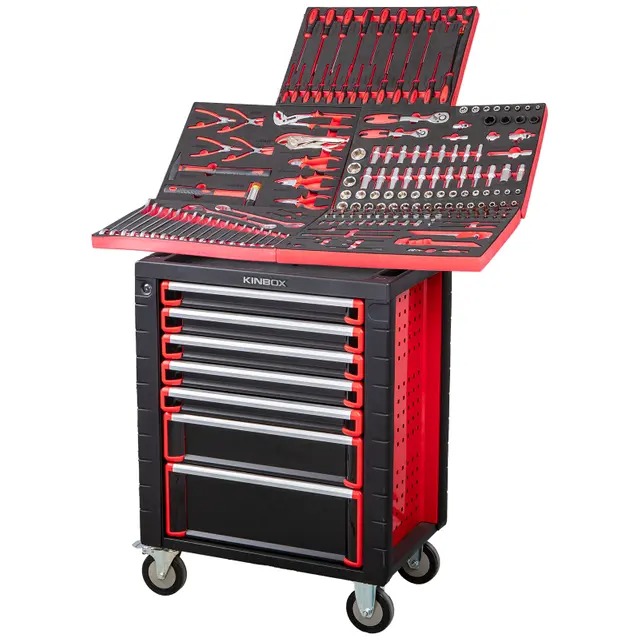
This is a surprisingly big deal. In many workshops, the workbench slowly stops being a workbench and becomes a holding area. A drill case sits there because the cabinet is inconvenient. A box of screws stays there because there was nowhere else sensible to put it. Safety glasses, gloves, tape, bits, rags, and chargers accumulate along the back edge. Before long, the work surface exists, but it is not really available.
A professional tool cabinet helps reverse that. It gives categories a real home, close enough and logical enough that tools can go back after use instead of just being “set down for now.” Once that happens, the bench clears out, and the whole room feels better. There is more room to move, more room to stage work, and less irritation before the task even begins. Since workplace rules and good housekeeping practices both emphasize keeping service areas orderly and avoiding hazardous accumulation, this kind of controlled storage supports both comfort and compliance at the same time.
Most bad workspace experiences are not caused by huge failures. They are caused by repeated small annoyances. You want to mark a part, but the marker is under a rag. You need a square meter of open bench, but half of it is taken by items that never got put away. You need to assemble something quickly, but first you have to make room. A professional tool cabinet does not eliminate work, but it removes many of these unnecessary interruptions by taking long-term storage pressure off the active work surface. That makes the space feel smoother, and smoother is usually another word for more pleasant.
Very little drains the mood of a workspace faster than constantly looking for things. Searching is one of those invisible costs that does not always show up in a report, but everyone feels it. It slows the rhythm of the job, breaks concentration, and creates that irritated sense that the room is making things harder than they need to be.
A professional tool cabinet helps because it supports fixed locations and repeatable storage logic. That is essentially the same principle behind “a place for everything and everything in its place.” When categories are clear and placement is consistent, retrieval becomes quicker and less mentally tiring. Organized systems reduce waste partly because they reduce this exact kind of non-productive motion and decision-making. That is a real contributor to a more pleasant workspace. Less hunting means less frustration, less clutter drift, and a steadier pace through the day.
There is a quiet emotional benefit to predictability in a workspace. If you know where tools live, where backup stock sits, and where used items need to go back, the room feels reliable. When storage is vague, every task begins with tiny uncertainties. Those uncertainties build up. A professional tool cabinet reduces them by making the room easier to read. That does not just improve efficiency. It improves the feeling of working there. Predictability is comforting, especially in busy environments.
Pleasantness and safety are closely related in working environments. A room that feels safe to move through usually feels better to work in. Clear aisles, stable storage, accessible exits, and fewer items on the floor do not just reduce risk; they reduce tension. You do not have to step around boxes, shift awkward piles, or twist around temporary overflow zones.
This is one reason a professional tool cabinet has such an outsized effect on the feel of a workspace. It gets materials off the floor, reduces loose side piles, and gives small and medium items a secure storage point. Safety rules repeatedly emphasize keeping aisles and passageways clear and keeping stored materials from creating hazards. When a cabinet helps maintain those conditions, it improves more than compliance. It improves how relaxed and workable the room feels in ordinary use.
Even when square footage does not change, a room with better storage often feels bigger. That is because clear floor space changes how movement works. When items are elevated, enclosed, and grouped properly, the room stops feeling pinched. Orderly elevated storage near the work area is also associated with fewer tripping hazards and easier lifting because items are not being pulled repeatedly from the floor. So yes, a cabinet can make a room feel more pleasant partly by making it physically easier to move through.
Not every unpleasant workspace is visually messy. Some are just awkward. The tools may be there, but they are stored too low, too high, too deep, or mixed with things that require extra digging and reaching. That kind of layout creates strain that people may not complain about directly, but they definitely feel it by the end of the day.
This is where a professional tool cabinet can make a real difference. When shelves, drawers, or compartments are arranged around frequency of use and item weight, the most-handled tools can stay between knee and shoulder height, and heavier items can stay lower and more stable. Ergonomic guidance consistently recommends reducing awkward lifts, storing materials off the floor, and placing items in better handling zones. A cabinet that supports that layout makes the room feel easier on the body, and that is absolutely part of a more pleasant workspace.
This is one of those things you notice only after it improves. When the right items are in the right zone, you stop constantly squatting for one box, stretching for another, and re-arranging other items just to access what you need. The day feels less physically annoying. A professional tool cabinet earns its value here not because it is glamorous, but because it helps remove repeated little body stresses that wear people down. Even small ergonomic improvements can lower physical demands and support productivity.
There is also a social side to this. A pleasant workspace is not only one that feels good to the person working alone. It is also one that gives the right impression to coworkers, supervisors, visiting clients, maintenance teams, or new staff. A room with orderly, professional storage usually feels more credible. It signals that the work matters, the tools matter, and the environment is taken seriously.
That kind of atmosphere can be hard to create when storage is improvised. A professional tool cabinet helps because it gives the room visual structure. It suggests process instead of patchwork. That matters in shared work areas, where people are more likely to return tools properly if the storage logic is obvious and the space already looks organized. Methods like 5S depend on exactly this kind of visible order and repeatable structure to sustain team habits over time.
One person can often work around a messy system because they remember where everything is. Shared spaces do not get that advantage. Once multiple people use the same bench area and the same storage, unclear systems start falling apart quickly. A professional tool cabinet helps shared spaces feel more pleasant because it reduces arguments with the room itself. Return locations are more obvious. Categories are easier to label. Missing items stand out sooner. The whole area becomes easier to share without friction.
This may be the most important point in the whole discussion. Almost any workspace can look good right after a big cleanup. The real test is whether it still feels good three weeks later. That is where professional storage matters most. A pleasant workspace is not a one-time photo. It is a condition that survives normal use.
A professional tool cabinet helps sustain that condition because it is designed for repeated, real-world use. It is easier to reset, easier to keep orderly, and more likely to support changing tool mixes without immediately collapsing into overflow clutter. That lines up with the “sustain” part of organized workplace methods, which is often the hardest part. The more the storage system supports the habit, the less effort it takes to keep the room pleasant over time.
This is worth saying out loud. A pleasant workspace does not have to look like a showroom. It can still be busy, productive, and clearly used. What makes it pleasant is lower friction. You can find things. You can move safely. You can reset without a battle. You can start work without first solving a storage problem. A professional tool cabinet helps deliver exactly that kind of everyday ease. And in real work environments, everyday ease is usually more valuable than spotless perfection.
Of course, a cabinet is not magic. If the workspace keeps too much unnecessary stock, if people never return tools, if the cabinet is placed in the wrong spot, or if the rest of the room has no basic logic, even a good tool cabinet will not fix everything. Storage supports a system; it does not replace one.
But that does not weaken the cabinet’s importance. In practice, it just means the cabinet works best as the anchor of a broader habit: sort what belongs, store it logically, keep the path in front of the cabinet clear, and review the layout when workflow changes. The reason professional cabinets matter is that they make those habits easier to maintain. They give the room a center of gravity. Without that, pleasantness usually fades fast.
That is the most honest answer. Yes, a professional tool cabinet can create a more pleasant workspace, not because it makes the room prettier in a superficial way, but because it changes how the room works. It reduces visual clutter, clears active surfaces, supports safer movement, improves retrieval, helps people move more comfortably, and makes organization easier to maintain. That combination changes the daily experience of the room, and daily experience is what pleasantness really comes down to.
A workspace feels pleasant when it stops fighting you. A good cabinet helps make that happen. And once it does, the difference tends to be obvious almost immediately. The room feels calmer, clearer, more professional, and easier to reset after use. In other words, it feels like a place designed for work rather than a place constantly recovering from it.
So yes, a professional tool cabinet can absolutely create a more pleasant workspace, because pleasantness in real working environments comes from order, ease, clarity, safety, and a smoother daily rhythm—not from decoration alone. When tools have a proper home, work surfaces stay clearer, movement becomes easier, and the whole room feels less stressful and more professional. That is exactly why choosing the right supplier matters as much as choosing the cabinet itself. At our company, we focus on tool cabinet solutions designed for real-world workshops and industrial spaces, with durable construction, practical layouts, flexible sizing, and customization support that help customers build workspaces that are not only better organized, but also more comfortable and more enjoyable to use every day.
Yes. A professional tool cabinet can change the feel of a workspace by reducing visible clutter, clearing work surfaces, improving access to tools, and making the room easier to keep orderly. Since clutter can compete for attention and orderly work areas support safer, smoother work, the emotional effect is usually very real.
A professional tool cabinet is usually designed to support repeated use, heavier workloads, and more organized storage logic. In practice, that means it does a better job supporting sustainable organization, safer storage, and more efficient access over time.
It often does. Work stress is influenced by the day-to-day work environment, and lower clutter plus better organization can make it easier to focus and move through tasks without unnecessary irritation. A workspace that requires less searching and less constant resetting usually feels calmer.
Yes. When the cabinet layout allows frequently used items to stay in accessible zones and heavier items to remain lower and more stable, it can reduce awkward lifting, bending, and reaching. That supports both comfort and efficiency.
In many small workshops, it can be especially valuable. Smaller spaces lose control faster when tools and supplies spread onto benches and floors. A professional tool cabinet helps consolidate storage, use vertical space more effectively, and keep the room feeling more open and manageable.



