
 English

Views: 0 Author: Site Editor Publish Time: 2026-04-10 Origin: Site


If you have spent any real time in a workshop, you already know the answer is not as simple as “yes, because it gives you more storage.” A tool cabinet does help with storage, of course, but that is only the surface-level benefit. The bigger value is what it does to the way the whole room works. A good workshop is not only a room full of tools. It is a place where the right item is easy to find, the bench stays usable, the floor stays clear enough to move safely, and the day does not get interrupted every ten minutes by little bits of disorder. When those things start slipping, productivity drops, frustration rises, and the space begins to feel harder to work in than it should. Good housekeeping and orderly storage are also basic workplace expectations, not just style choices.
That is why this question matters: can a tool cabinet improve your workshop organization? In practical terms, yes, it often can—and quite dramatically. Not because a cabinet is some magical cure for clutter, but because it gives the workshop something it badly needs: structure. Organized workplace methods like 5S are built around exactly this idea. You sort what belongs, set it in order, keep the space clean, standardize the layout, and then sustain the habit. A cabinet supports all of those steps in a very real, everyday way. It gives tools and supplies a defined home, reduces the spread of loose items, and makes it much easier to reset the room after each task.
Most workshops do not become messy because people do not care. They become messy because work moves faster than the storage system can keep up. A tool comes out and lands on the bench. A box of screws gets left near the vise because it will “probably be used again soon.” Gloves sit on the corner of a table. Chargers, bits, tapes, and measuring tools start drifting into whatever space is open at the moment. None of those decisions seems serious on its own, but together they create the kind of clutter that makes a workshop feel constantly halfway between working and recovering from work.
That is the real problem with poor organization: it creates friction. You lose time finding things, clearing surfaces, moving items out of the way, and mentally tracking where things ended up. Organized work environments are valuable partly because they reduce that wasted motion and help standardize the way the space is used. 5S specifically emphasizes that a well-ordered environment helps reduce waste and improve productivity, and OSHA’s storage and housekeeping rules point in the same direction by requiring orderly areas and clear aisles.
A tool cabinet improves organization because it creates a center of gravity for the room. Without that, the workshop often ends up relying on scattered storage: a little on the bench, a little on open shelves, some in plastic bins, some in drawers, some on the floor, and some “temporarily” stacked near the wall. That kind of storage may technically hold everything, but it does not create order. It just spreads the disorder out over more places.
A cabinet changes that by centralizing storage. Instead of tools and supplies living wherever there is room, they begin living where they belong. That sounds basic, but it is one of the most powerful organization upgrades a workshop can get. Once categories have a fixed home, cleanup becomes faster, retrieval becomes easier, and the whole room starts feeling more controlled. The 5S idea of “a place for everything and everything in its place” is not just a slogan—it is the principle that makes a workshop easier to run day after day.
One of the first signs of poor workshop organization is that the workbench stops functioning like a workbench. It becomes a holding area. Not because anyone planned it that way, but because there was nowhere else convenient to put things. Cases, spare parts, loose tools, accessories, safety gear, and half-used supplies slowly settle onto the bench until the actual work surface shrinks. Then every new task starts with a clearing operation.
A tool cabinet helps solve that problem because it takes long-term storage pressure off active work areas. Once the cabinet is nearby, easy to open, and sensibly arranged, tools are much more likely to go back where they belong instead of sitting on the bench “for now.” That alone can make a workshop feel far more organized. It is also tied to good housekeeping practice: orderly storage reduces accumulation in work areas and helps keep surfaces and access zones clear.
This is one of those improvements you feel almost immediately. When the bench is open, you start faster. You spread out less awkwardly. You stop moving three unrelated items just to get started. The room feels less crowded even though its dimensions have not changed at all. A cabinet does not create more square footage, but it can absolutely create more usable space, and in a workshop that often matters more.
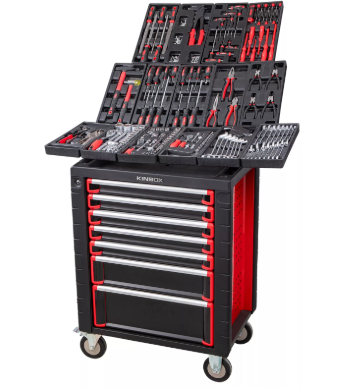
Real organization depends on categories. Not vague categories either—real ones. Hand tools here. Measuring tools there. Electrical items in one section. Fasteners in another. Safety gear separate from consumables. Backup stock apart from daily-use items. The reason many workshops feel disorganized is not that they lack storage volume. It is that they lack category discipline. Everything is technically stored, but too many unlike things are stored together.
A tool cabinet helps because it makes category-based organization more practical. Shelves, drawers, or separate zones give you a way to divide the space with intention. That supports the “set in order” part of 5S, where items are arranged based on how and how often they are used. Once categories are clear, people spend less time guessing, less time searching, and less time creating little side piles that grow into bigger ones.
A workshop stays organized more easily when people do not have to think too hard about where things go. If a storage system feels vague, people improvise. If it feels obvious, people follow it. That is one reason a good cabinet is so helpful. It gives the room a visible logic. Even if labels are simple, the structure itself guides better behavior.
Search time is one of the quietest ways a workshop loses efficiency. It rarely looks dramatic. It is thirty seconds here, two minutes there, another minute spent checking the wrong shelf, and a short pause while someone asks, “Has anyone seen the hex key set?” Over the course of a week, those little searches add up to a surprising amount of lost time and mental irritation.
A tool cabinet cuts that down when it is organized properly. Fixed storage locations reduce uncertainty. Grouped tools reduce rummaging. Separate zones for daily-use versus backup items make retrieval more intuitive. That kind of layout does not just make the room look better; it reduces waste in the lean sense of the word by cutting unnecessary motion and non-value-added activity. That is exactly why organized work methods are so strongly tied to productivity.
Organization is not only about efficiency. It is a safety issue too. When tools, bins, and materials spread onto the floor or into walk paths, the workshop becomes harder to move through and easier to trip in. OSHA requires aisles and passageways to be kept clear and in good repair, and storage areas must be kept free of material accumulation that creates hazards such as tripping or fire risk. Stored materials also need to remain stable and secure. These are very practical rules, and they connect directly to what a cabinet helps with every day.
A tool cabinet helps because it gets items off the floor and out of traffic areas. Instead of boxes living beside the bench or tools resting in walkways between jobs, they have a contained storage point. That makes the room easier to move through and easier to keep under control when the day gets busy. Good organization often feels better partly because it feels safer.
When there is no good place for something, people create a temporary place. That temporary place is often less stable, less safe, and less convenient than it should be. A cabinet reduces that tendency because it gives more items a legitimate home. The room stops relying so much on “just set it there for now.”
A lot of people think workshop organization is mostly visual, but body comfort is part of it too. Bad storage layouts force unnecessary bending, lifting, twisting, and reaching. Heavy items on the floor, frequently used items too high, or commonly needed tools buried behind slower-moving stock all create little physical stresses that wear people down over time.
This is another place where a tool cabinet can help. Ergonomic guidance for manual material handling recommends storing materials off the floor where possible and arranging them so lifting and lowering happen in better access zones. That means heavy items lower, daily-use items between knee and shoulder height, and less-used stock farther from the main “power zone.” A cabinet makes that kind of arrangement much easier to build and maintain. And when the storage layout is easier on the body, the workshop usually feels more organized because movement through the room becomes smoother and less awkward.
One reason poor organization returns so quickly is that the storage system asks too much from people. If returning a tool means bending all the way down, reaching over a pile, or opening a section that is awkward to access, people stop doing it properly. A cabinet that matches the workflow and the body’s natural reach zones makes better habits more realistic.
Many workshops are not actually short on space. They are short on usable space. That distinction matters. A room can have enough square footage in theory and still feel cramped because storage has spread into too many little zones. A tool cabinet helps consolidate those zones. It pulls storage upward and inward instead of allowing it to spread outward across benches, corners, carts, and floor edges.
That is why a cabinet can have such a strong effect on workshop organization even in a modest room. It does not need to be enormous to make a difference. It just needs to absorb the categories that are currently causing sprawl. Once that happens, the room often feels much easier to manage. Clearer walkways, freer surfaces, and fewer scattered piles make the same workshop feel more capable than it did before.
One person can often keep a messy system working because they remember where everything is. Shared workshops do not get that advantage. Once several people use the same room, memory stops being a reliable organization method. That is where structured storage becomes even more important.
A tool cabinet helps shared spaces because it makes organization visible. Return locations are easier to define. Categories are easier to label. Missing tools stand out sooner. The space becomes less dependent on one person’s private logic and more dependent on a common system everyone can follow. That fits very well with the standardization side of 5S, where the goal is not just to organize once, but to make the organization repeatable across users and over time.
In a solo workshop, you can sometimes get away with “I know it’s around here somewhere.” In a shared workshop, that phrase is usually a sign the system is already slipping. Cabinets help because they replace vague logic with physical structure.
This may be the biggest reason a tool cabinet is worth it. Almost any workshop can be cleaned once. The harder part is staying organized after three busy weeks. That is where many storage systems fail. They are good at creating a tidy starting point but not good at surviving ordinary use.
A cabinet improves that because it gives the room a routine. Open. Retrieve. Use. Return. Close. Repeat. That kind of consistent cycle is exactly what the “sustain” part of 5S is about. Unless the organization system is easy enough to keep using, the workshop slides back toward clutter. A cabinet does not guarantee discipline, but it makes discipline far easier to maintain.
It is worth being honest here. A tool cabinet will not fix every workshop problem by itself. If the room is full of obsolete stock, if people never return tools, if the cabinet is badly placed, or if the layout inside the cabinet makes no sense, then clutter can still win. Storage helps most when it is paired with basic habits: keep only what belongs in active storage, group like with like, review overflow regularly, and put things back after use.
But that does not weaken the case for the cabinet. It strengthens it. What a cabinet really does is make those good habits more realistic. It reduces friction. It makes order easier than disorder. And in everyday workshops, that is usually the turning point.
Yes, it can—and often in ways that reach beyond simple storage. A tool cabinet can improve workshop organization by centralizing tools, protecting work surfaces, supporting category-based storage, reducing search time, helping keep aisles clearer, improving ergonomics, and making everyday reset routines more sustainable. That is a long list, but in practice it all comes down to one thing: the workshop stops fighting itself.
When that happens, the room feels different. It feels calmer, more predictable, and more professional. You start work faster. You waste less motion. You spend less time clearing, hunting, and re-sorting. The tools are still the same tools, but the system around them is better. And very often, that is what organization was missing all along.
So yes, a tool cabinet can absolutely improve your workshop organization, because real organization is not just about adding storage—it is about creating a system that keeps tools accessible, work surfaces clearer, movement safer, and daily routines easier to maintain. A well-designed cabinet helps turn scattered storage into structured storage, which is exactly what workshops need if they want to stay efficient over time. For buyers looking for a dependable long-term solution, Kinbox Tools understands that a good tool cabinet should do more than hold equipment. It should support the way a real workshop operates. With durable construction, practical layouts, and flexible solutions for different working environments, Kinbox Tools helps customers build cleaner, more organized, and more efficient workshop spaces that continue working well long after installation.
Yes. Even one well-placed tool cabinet can centralize storage, reduce clutter on benches, cut down on search time, and make it easier to group tools and supplies logically. That can create a noticeable improvement, especially in smaller or medium-sized workshops.
Start with the items that currently create the most clutter or wasted searching—usually daily-use hand tools, measuring tools, fasteners, safety gear, and small accessories. Group by category, then place the most frequently used items in the easiest-to-reach zones.
For many workshops, yes. Open shelves are useful for visibility, but a tool cabinet often does a better job of containing clutter, protecting tools, and supporting fixed storage locations. Many good workshops use both, but cabinets are often the stronger organizational anchor.
Yes. By getting tools and supplies off the floor and helping keep aisles and work areas clearer, a tool cabinet can support better housekeeping and reduce storage-related hazards. Clear passageways and orderly storage are established safety expectations.
Use a simple routine: assign clear categories, keep frequently used tools in accessible places, return items after use, and review the contents regularly so overflow does not build up. That approach matches the same sort, set-in-order, and sustain principles that make organization last.



