
 English

Views: 0 Author: Site Editor Publish Time: 2026-06-18 Origin: Site


A garage rarely has just one storage problem.
At first, it is the hand tools. Then the power tools. Then the sports gear, extension cords, car cleaning products, gardening supplies, seasonal decorations, spare parts, and a few boxes nobody wants to open because nobody remembers what is inside. Before long, the garage becomes a room where everything has a place in theory, but not in daily use.
That is why a Garage Storage System works better than a few random cabinets pushed against the wall.
A system gives the garage a structure. Tools can stay near the workbench. Heavy equipment can sit low. Seasonal items can move away from the active work area. Cleaning products can stay behind doors. Small parts can be separated instead of disappearing into one mixed drawer. The floor can stay open enough to move around, park a car, or actually finish a repair job without stepping over a box.
Of course, not every garage needs a showroom-style installation. Some garages need a practical tool wall and two cabinets. Some need a full set of base cabinets, wall units, a workbench, and tall storage. Some need mobile storage more than fixed storage. The useful question is not “How big should the system be?” It is “What keeps getting in the way?”
The best garage storage ideas usually come from watching what moves often.
A socket set used every weekend should not be stored behind camping gear. Car wash towels should not sit under paint cans. Extension cords should not live on the floor because there is no hook nearby. Gloves, batteries, drill bits, and small hardware should not end up on the workbench after every project.
These small items create most of the daily mess. They may not be large, but they are handled often. If they are placed badly, the whole garage feels harder to use.
A practical Garage Storage System should give these weekly-use items the easiest positions. That usually means a workbench area for active tools, a tool cabinet for detailed hand tool storage, wall cabinets for lighter supplies, and base cabinets for items that need to stay nearby but out of sight.
A garage workbench has a bad habit of becoming a shelf.
A drill stays there because the battery is charging. A box of screws stays there because sorting it feels unnecessary. Then come the gloves, tape, cleaner, blades, and a few loose parts. Well, this is how most garages lose their working surface.
The storage around the bench should stop that from happening. A drawer-style Tool Cabinet can hold sockets, screwdrivers, wrenches, pliers, and measuring tools. A nearby garage storage cabinet can hold bottles, towels, batteries, chargers, and small bins. Wall panels or hooks can handle items that are better hung than stacked.
When these pieces work together, the bench does not need to carry everything. It can remain what it was meant to be: a surface for work.
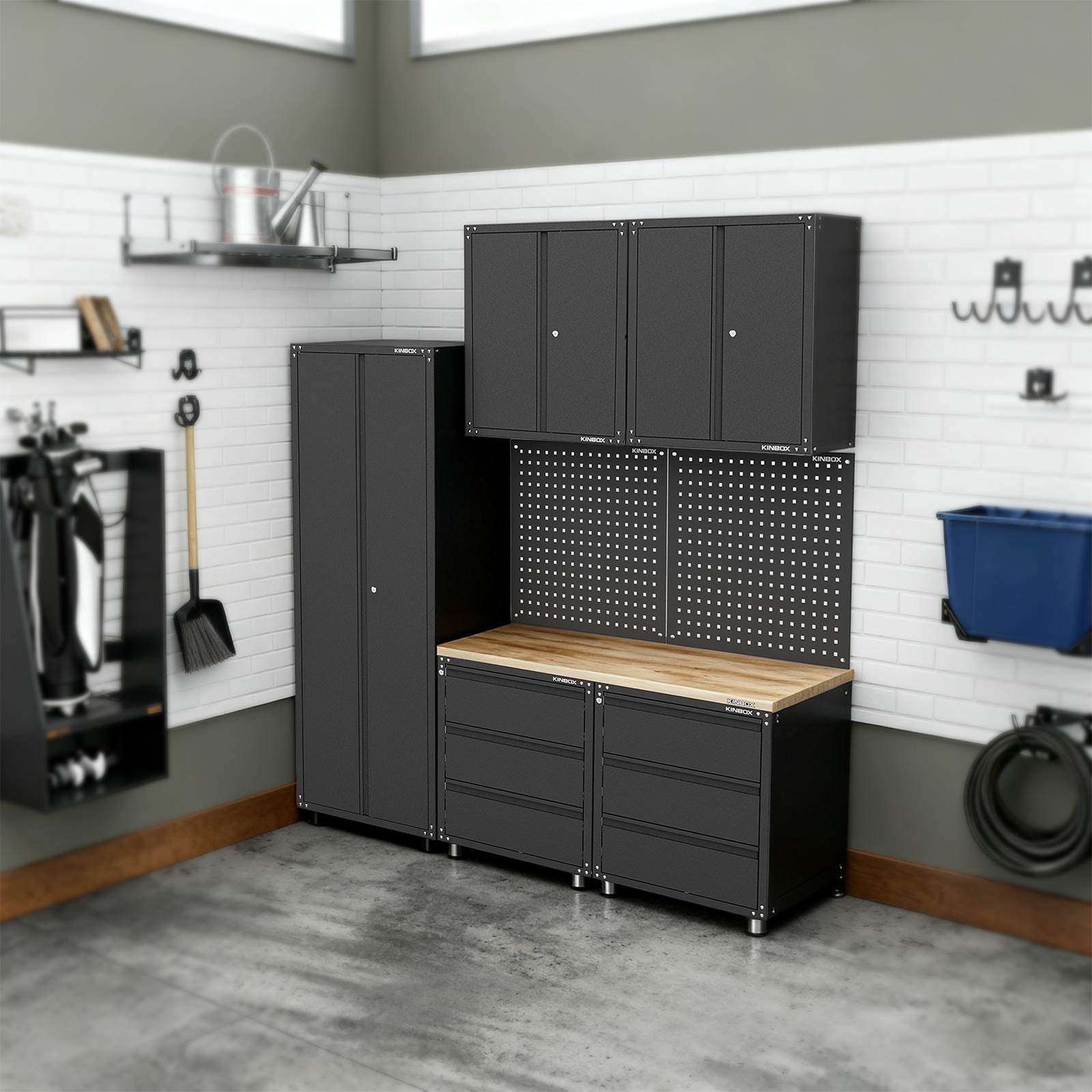
Not every tool belongs on a shelf.
Hand tools are usually easier to manage in drawers. Sockets, spanners, screwdrivers, pliers, hex keys, blades, and measuring tools all benefit from separation. If they are stored on open shelves or in one large box, they may still be “stored,” but they are not easy to find.
A Tool Cabinet is useful inside a larger Garage Storage System because it handles the detailed part of tool organization. It gives small tools fixed positions. It keeps sharp or delicate tools from being buried under heavier equipment. It also makes the garage feel more professional, especially when the cabinet sits beside a workbench or rolling tool cart.
For mechanics or serious DIY users, drawer quality matters. A socket drawer can become heavy quickly. A drawer that does not open fully makes the back row less useful. A weak slide can turn a neat cabinet into a daily annoyance. It is a small detail until the drawer is opened twenty times in one afternoon.
For tool sets, foam trays can make a real difference.
They are not only for the clean product photo. A fitted foam tray shows where every tool belongs. If a wrench is missing, the empty shape says so immediately. If a cabinet moves, the tools do not slide around as much. For workshops, racing garages, and branded tool programs, that kind of order is valuable.
Kinbox Tools offers storage products with foam tray options such as EVA, EPS, BMC, and blow molding tray designs. In a garage storage layout, these trays work best when the drawer size, tool set, and cabinet design are planned together. If the tray is treated as an afterthought, the cabinet may look customized but feel awkward in use.
Power tools are often stored badly because they are awkward shapes.
Drills, impact drivers, grinders, sanders, saw accessories, chargers, and batteries do not always fit neatly into drawers. If they are stacked too tightly, the user has to remove several items just to reach one tool. After a while, the tool that is used most often stays out on the bench.
A Garage Storage System should give power tools a zone of their own. This can be a base cabinet with adjustable shelves, a lower garage storage unit, or a section beside the workbench. Chargers should stay close to power. Batteries should be easy to see. Accessories should sit near the tool, not in a different corner of the garage.
This sounds simple, but it is often ignored.
Heavy tools should sit in lower cabinets or lower drawers. It is safer, easier to lift, and better for cabinet balance. A tall wall cabinet may look useful, but it is not the best place for bulky tool cases or heavy accessories.
Base cabinets and lower storage units are better for this job. They also help keep the system stable, especially when the garage includes mobile tool carts or rolling cabinets. In practice, the lower area is where the garage stores its weight.
Car care items can take over a garage faster than expected.
Wash soap, wax, tire cleaner, microfiber towels, brushes, oil, lubricants, funnels, battery chargers, tire gauges, and small maintenance tools all seem harmless on their own. Together, they create clutter, spills, and a lot of half-used bottles.
A good Garage Storage System should keep car care products together. It saves time and prevents dirty or oily items from mixing with clean hand tools. Liquids should stand upright. Towels and cloths should have a cleaner shelf or bin. Brushes and applicators should not be buried under bottles.
This is one of those details that seems minor until the cabinet starts feeling dirty.
Microfiber towels should not sit beside greasy parts. Measuring tools should not share a drawer with lubricants. Gloves used for car work should not end up in the same bin as clean household repair items.
A closed garage storage cabinet works well for car care products because it keeps the visual clutter down. But inside the cabinet, categories still matter. Doors hide mess. They do not organize it.
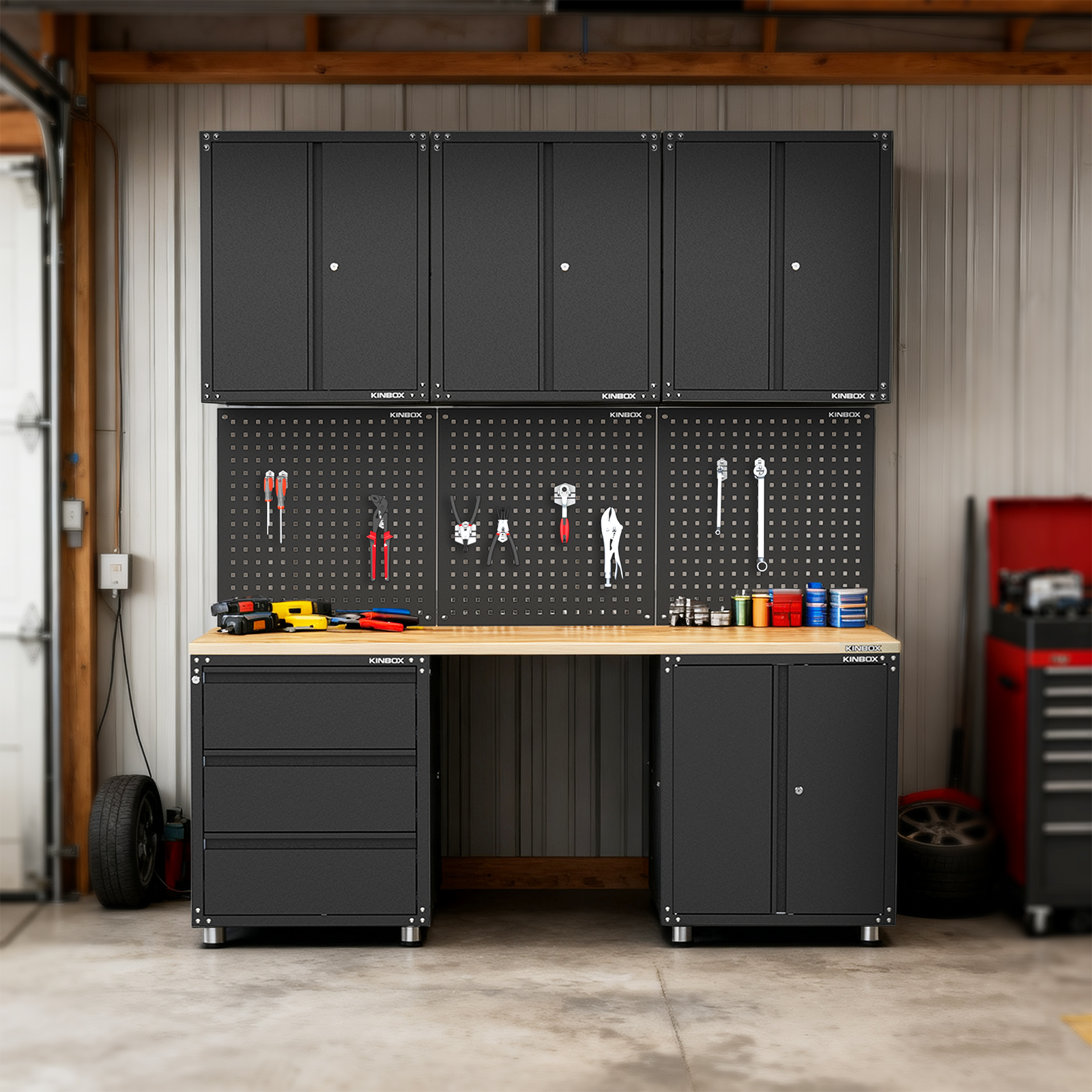
Seasonal items are usually not urgent, but they take up a lot of space.
Holiday decorations, camping gear, winter supplies, beach items, gardening products, and sports accessories often occupy the best storage areas simply because they arrived first. That is a poor trade. Items used once or twice a year should not sit where daily tools are needed.
In a Garage Storage System, seasonal items belong higher, deeper, or farther from the workbench. Tall cabinets can help. Wall cabinets can work for lighter seasonal boxes. Overhead storage may also make sense where available, though access and weight must be considered carefully.
There is a difference between putting something away and losing it.
Clear bins, labels, and grouped categories help. Winter car supplies should not be mixed with holiday lights. Camping gear should not be scattered between three cabinets. Garden products should not drift into the tool area.
A good seasonal storage plan keeps infrequent items out of the way without turning the cabinet into a mystery box.
Sports gear is hard to store because the shapes are irregular.
Balls, helmets, rackets, pads, pumps, shoes, bags, and protective gear rarely line up neatly. In a family garage, these items often end up on the floor because nobody wants to open three doors just to put away a ball.
The solution is not always more closed cabinets. Sometimes open bins inside a cabinet work better. A tall garage storage unit can hold larger gear. Wall hooks can handle rackets, helmets, or bags. A low cabinet section can work for children’s sports items because it is easier for them to use.
If a child or family member has to follow a complicated system, the gear will return to the floor.
For sports storage, the best idea is often simple: large bins, clear categories, and easy access. The goal is not to make every item look perfect. The goal is to stop gear from spreading into the workbench and tool area.
That is also why a garage storage system should separate family storage from workshop storage. The garage can serve both purposes, but not if every category is mixed together.
Tall cabinets are useful, but they should not be treated as a place for everything.
They work well for larger boxes, cleaning equipment, seasonal items, outdoor supplies, and categories that do not need to be touched during every project. They can also help keep the garage visually calm because large objects disappear behind doors.
But a tall cabinet without a purpose quickly becomes a dumping place.
One tall cabinet can be assigned to car care and cleaning. Another can hold seasonal storage. Another can handle outdoor or gardening products. This kind of category planning is more practical than simply saying, “Put big things in the big cabinet.”
Around a workbench, tall cabinets often work better at the ends of the storage layout. They frame the area without crowding the working surface.
If a tall cabinet is placed too close to the center of the workbench, the bench can feel boxed in. The user has less side movement. The space may look full but feel awkward. A Garage Storage System should give the user room to work, not just room to store.
Wall cabinets help keep the floor clear. They are useful for lighter items, small boxes, cleaning supplies, spare materials, and things that should stay out of the way but still within reach.
They are less suitable for heavy tool cases, bulky equipment, or items used constantly. If the wall cabinet is too high, users will avoid it. If it is too low above a workbench, it may block light or make the bench feel cramped.
A good wall cabinet layout usually leaves breathing room above the work area. It also considers lighting. Honestly, lighting is one of the most overlooked parts of garage storage planning. A cabinet that casts a shadow over the exact spot where small screws are sorted is not helping.
Fixed cabinets are useful, but some tools need to move.
A rolling tool cart or mobile Tool Cabinet can bring tools closer to the car, lawn equipment, motorcycle, or project area. This is especially useful in garages used for repair or maintenance. Instead of walking back to the wall every few minutes, the user brings the frequently used tools closer.
Mobile storage should be planned into the system, not added later wherever space remains. It needs a parking position. It needs room to roll. It needs a clear path. If the cart has no place to return, it becomes another obstacle.
Kinbox’s product range includes tool carts, tool cabinets, garage storage cabinets, garage storage systems, workbenches, and related storage products. For B2B buyers, this matters because a garage storage line can include both fixed and mobile storage rather than relying on one cabinet type for every job.
A garage becomes easier to use when it is divided by function.
There can be a tool zone near the workbench. A car care zone. A power tool and battery zone. A seasonal storage zone. A sports gear zone. A cleaning and household supplies zone. These zones can be built from different products: base cabinets, wall cabinets, tall cabinets, tool cabinets, workbenches, hooks, bins, and mobile carts.
This is where a Garage Storage System becomes more useful than individual cabinets. The system does not have to be complicated. It just needs to give each category a logical place.
More cabinets do not automatically create better organization.
If the user does not know what belongs in each cabinet, the system will slowly become mixed storage again. A smaller setup with clear zones can outperform a large installation with no logic. This is especially true in home garages, where the same space may serve as a workshop, storage room, sports area, and parking area.
For brands and distributors, this point also matters commercially. Customers are not only buying steel cabinets. They are buying a clearer way to use the garage.
For manufacturers and private-label buyers, a garage storage product line should not begin only with cabinet dimensions and colors.
Yes, color matters. Logo placement matters. Packaging matters. But the product will be judged by use. Cabinet height, shelf depth, drawer layout, workbench size, caster selection, surface finish, handle style, and assembly method all affect the final experience.
Kinbox Tools supports OEM orders, customized logos, and featured designs, and its garage storage products include modular, customizable, and upgradeable options. For buyers developing a storage line, that makes it possible to plan cabinets, workbenches, tool carts, and storage units as a related family rather than separate items.
A brand can offer one look across the garage while still adjusting the function of each product.
A garage storage system for light home use does not need the same specification as a professional workshop system. A cabinet sold to automotive users may need stronger tool storage, better drawers, and more durable finishes. A retail garage system may focus more on appearance, assembly, and flexible combinations.
Kinbox product pages show garage workbench and storage systems with steel structures, epoxy powder coated finishes, knock-down structures, customized colors, and OEM/ODM/OBM options. Those details are practical because garage storage products have to survive shipping, assembly, daily use, and repeat orders.
The right specification is not always the most expensive one. It is the one that matches the target user honestly.
The best storage system is not the one that looks perfect when it is new. It is the one the user can keep using after life gets messy again.
Tools have drawers. Equipment has lower storage. Car care products have a cabinet. Seasonal items have a higher or deeper place. Sports gear has bins. Chargers stay near power but off the workbench. Heavy items stay low. Delicate tools stay away from dirty supplies.
Simple, but not always easy.
A good Garage Storage System makes the correct habit the convenient habit. The user finishes a job, returns the tools, closes the cabinet, and the floor is still clear enough to move. That is when the garage starts working as a real space again.
For homeowners, mechanics, DIY users, retailers, and OEM buyers, that is the point of planning the system properly. Not more storage for the sake of storage, but a garage that is easier to use tomorrow than it was yesterday.



