
 English

Views: 0 Author: Site Editor Publish Time: 2026-06-18 Origin: Site


A heavy-duty tool cabinet usually looks simple from the outside. Several drawers, a steel body, a lock, maybe a worktop, maybe wheels. On a product page, most cabinets can appear similar enough that price becomes the first thing people compare.
That is where many buyers make the wrong call.
In a real workshop, a cabinet is not just sitting quietly against the wall. Drawers are opened dozens of times a day. Mechanics pull tools with oily hands. Heavy sockets, power tools, measuring tools, spare parts, fasteners, and consumables all end up inside the same storage system. In automotive repair shops, manufacturing plants, maintenance rooms, and home garages, a tool cabinet becomes part of the daily workflow.
A good cabinet reduces searching. A weak one creates small problems every day: drawers that sag, slides that become rough, locks that do not line up, wheels that feel unstable, or a surface finish that starts looking tired too soon. For distributors, tool brands, and professional buyers, these details matter even more because product quality affects repeat orders and customer trust.
So when comparing a heavy-duty Tool Cabinet, the question should not be “Which one looks strong?” The better question is: “Which cabinet will still work properly after months or years of ordinary abuse?”
A cabinet for a clean home garage does not face the same pressure as one used in a busy service bay. A professional workshop needs a different level of storage discipline. Tools are heavier, the working pace is faster, and more people may use the same cabinet.
Before comparing dimensions or colors, buyers should first think about the environment:
Will the cabinet stay in one fixed position, or does it need to move around the shop?
Will it store mainly hand tools, or heavier equipment and parts?
Will several users access it throughout the day?
Does the workspace need a full garage storage system, or just a single mobile cabinet?
Is the cabinet for retail, OEM branding, industrial use, or internal workshop use?
This may sound basic, but it affects almost every specification that follows. Drawer layout, slide quality, locking method, caster size, surface treatment, and worktop material should all match the way the cabinet will actually be used.
For example, a racing garage may care about fast access and mobility. A manufacturing maintenance room may care more about fixed locations, labeling, and security. A home garage user may want a clean appearance that matches garage storage cabinets and wall units. One Tool Cabinet cannot be judged properly without knowing the job it has to do.
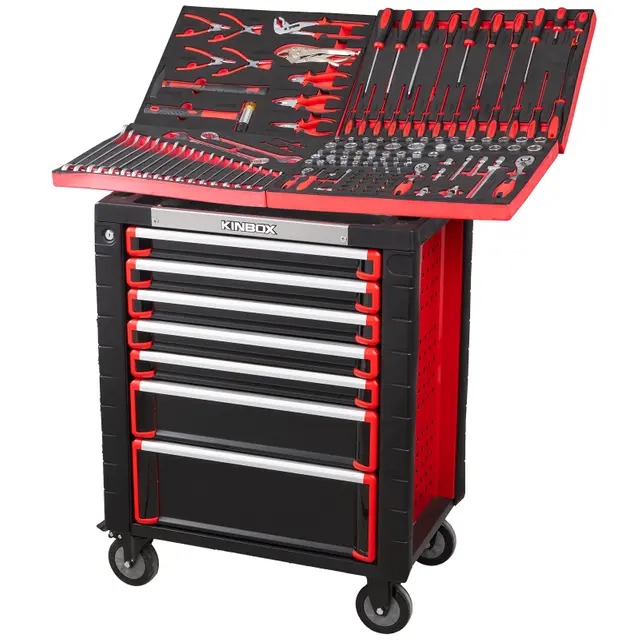
The body of a heavy-duty cabinet has to resist more than static weight. It has to handle pulling force from drawers, vibration from movement, small impacts from tools, and uneven loading over time. That is why the steel structure should be one of the first things buyers compare.
A cabinet may look straight when empty, but the real test starts when every drawer is loaded. Poorly formed panels can flex. Weak corners may lose alignment. Drawer gaps become uneven. Locks and slides start to feel less precise because the frame is no longer holding its shape cleanly.
For a professional Tool Cabinet manufacturer, sheet metal processing is not just a factory detail. It affects the consistency of the final product. Cutting, bending, forming, welding, surface preparation, and assembly all influence how well the cabinet performs.
Kinbox Tools, for example, positions itself as a manufacturer focused on iron and sheet metal products, with production covering tool trolleys, tool cabinets, tool carts, garage storage systems, and workbenches. That kind of manufacturing background is relevant for B2B buyers because a cabinet is, at its core, a sheet metal product that must stay accurate after forming and finishing.
When buyers compare suppliers, they should not only ask for product photos. They should ask about production capability, sample consistency, tolerances, and how the supplier controls cabinet alignment during assembly. A strong-looking cabinet that varies from batch to batch can create trouble for distributors and private-label brands.
Most end users do not talk about steel forming or coating thickness first. They talk about drawers.
A drawer that slides smoothly gives the impression of quality. A drawer that sticks, shakes, or drops slightly when loaded makes the entire cabinet feel cheap. This is why the drawer system deserves close attention, especially for a heavy-duty Tool Cabinet.
A cabinet with more drawers is not automatically better. What matters is whether those drawers match the tools being stored. Shallow drawers are useful for wrenches, sockets, screwdrivers, and measuring tools. Deeper drawers work better for power tools, boxes, accessories, and larger parts.
The slide system is just as important. Ball bearing slides are commonly preferred for smoother movement and better load handling. For professional use, buyers should check whether the slides feel stable when fully extended, whether the drawer remains level under load, and whether the movement stays smooth after repeated opening and closing.
A common mistake is comparing only drawer quantity. Seven drawers may look better than five in a catalog, but if the drawer height is poorly planned, the cabinet may waste space. For automotive tools, hand tool sets, and foam tray organization, drawer dimensions should be checked carefully. A well-planned 5-drawer cabinet can sometimes work better than a crowded 7-drawer layout.
For OEM and retail projects, tool organization inside the drawer is often part of the product value. Foam trays help tools stay in fixed positions, reduce movement during transport, and make missing tools easier to identify.
Kinbox highlights custom foam tray options for toolboxes and tool carts, including EVA, EPS, BMC, and blow molding tray categories. This is especially useful for brands that want to sell a cabinet or cart as a complete tool storage solution rather than an empty metal unit.
For buyers building a private-label product line, foam tray design should be discussed early. The cabinet and tool set should be planned together. Otherwise, the drawer sizes may not match the intended tool layout, and the final product can feel improvised.
A heavy-duty cabinet is often used to store tools with real value. In professional workshops, tools are shared, borrowed, misplaced, and sometimes left in the wrong place. Locking systems help control access and protect inventory.
A good lock does not need to be complicated, but it should feel consistent. The lock should align properly, engage smoothly, and work with the drawer structure rather than against it. If the cabinet body flexes or the drawers are poorly aligned, even a decent lock can become frustrating.
Handles also deserve attention. A handle is touched constantly. It should feel stable and comfortable, and it should not become loose after repeated use. On mobile cabinets, side handles help users move the unit safely. On larger garage storage units, handles also affect the visual style of the whole system.
For buyers comparing multiple cabinets, hardware quality is often where cheaper models reveal themselves. A cabinet may have acceptable steel panels but weak handles, rough edges, light-duty locks, or casters that feel undersized. These are small components, but they shape the user’s opinion quickly.
In product photos, almost every tool cabinet looks clean. Real workshops are not as kind. Cabinets face dust, oil, moisture, scratches, hand marks, and accidental contact with tools or parts. Surface finish therefore matters both visually and functionally.
Powder coating is widely used because it can provide a durable, clean finish for steel cabinets. Kinbox product pages also show epoxy powder coated finishes on garage workbench and storage products. For buyers, the important point is not only the phrase “powder coated” but the consistency of the coating, the preparation before coating, and the finish quality around edges, corners, and drawer fronts.
A poor surface finish may not fail immediately, but it can damage customer perception. If the coating chips easily or looks uneven, the cabinet feels less professional. For retail brands, finish consistency across batches is especially important because products may be displayed together in stores or online.
Color customization is another part of surface planning. Red and black may work well for automotive tools. Matte black or grey may fit modern garage storage systems. Stainless or anti-fingerprint finishes may appeal to certain premium markets. For OEM buyers, color should be treated as part of product positioning, not just decoration.
A stationary cabinet and a mobile roller cabinet live different lives. Once wheels are added, the cabinet must handle movement, turning, floor transitions, vibration, and uneven loading. Casters are not accessories in this case. They are structural components.
For a mobile Tool Cabinet, buyers should compare caster diameter, wheel material, braking function, mounting strength, and how the cabinet behaves when fully loaded. A cabinet that rolls smoothly when empty may become difficult to control when loaded with tools.
Balance also matters. Tall cabinets with many drawers need careful design to reduce tipping risk. Drawers should not encourage users to pull out too much weight at once. For workshop use, smooth mobility is useful, but stability is more important.
This is one reason buyers should not evaluate a tool cart, roller cabinet, or mobile storage cabinet only by size. A larger cabinet with weak casters can be worse than a smaller cabinet with a better base and stronger wheel system.

Some heavy-duty cabinets act only as storage. Others become part of the working surface. When a cabinet includes a worktop, buyers should think about what kind of work will happen on it.
A rubber wood worktop, steel top, or stainless work surface can each make sense depending on the application. Wood feels practical for general assembly and garage work. Metal surfaces may be easier to clean in some environments. The best choice depends on whether the user is repairing, assembling, measuring, storing, or preparing parts.
Layout is also important. A professional mechanic may need shallow drawers at the top for quick-access tools, deeper drawers below for heavier items, and a side area for accessories. A garage user may prefer a cabinet that fits under a workbench or matches wall cabinets and tall cabinets in a complete garage storage system.
Buyers should look at the cabinet as part of a workflow, not just as a storage box. The best cabinet is the one that reduces unnecessary movement. Tools used most often should be easiest to reach. Heavy tools should sit lower. Items that need protection should be stored behind closed drawers or doors.
For importers, distributors, and OEM buyers, product quality is only one part of the purchase. Packaging, shipping volume, assembly, and after-sales complaints also matter.
Some garage storage systems and storage products use a knock-down structure, which can reduce shipping volume and make transport more efficient. The trade-off is that assembly quality must be well controlled. If assembly is too difficult, instructions are unclear, or parts do not align smoothly, the customer experience suffers.
This is where a manufacturer’s experience becomes important. A tool cabinet made for B2B distribution should not only look good in the factory. It should survive packaging, loading, shipping, warehouse handling, and final assembly.
Buyers should compare:
whether the packaging protects corners and painted surfaces
whether hardware is clearly packed and labeled
whether assembly steps are realistic for the target customer
whether spare parts and accessories are available
whether the supplier can keep specifications stable across repeat orders
For brands selling in retail channels, packaging consistency can be as important as cabinet design. A scratched panel or missing screw creates a complaint before the user ever tests the product.
OEM customization often starts with logo and color, but serious buyers usually need more than that. A useful custom Tool Cabinet may involve changes to drawer layout, worktop material, foam tray design, caster selection, cabinet size, lock style, packaging, or accessory configuration.
Kinbox states that it accepts OEM orders and supports customized logo and featured design. This matters because the tool storage market is not one-size-fits-all. A distributor serving automotive repair shops may need a different cabinet from a retailer selling to home garage users. A professional tool brand may want matching cabinets, tool carts, tool chests, and workbenches under one visual system.
A cabinet for entry-level DIY buyers should not be overbuilt beyond the price point. A cabinet for professional workshops should not sacrifice structure for appearance. A cabinet for promotional tool sets may need carefully planned foam trays. A cabinet for industrial users may need stronger locks, heavier drawer capacity, and a more conservative finish.
Good customization starts with the target user. The manufacturer and buyer should discuss the sales channel, expected price range, tool load, packaging method, and application scene before confirming the final design.
This is also why factory capability matters. A supplier with experience in tool cabinets, tool carts, garage storage cabinets, workbenches, and storage systems can often help buyers avoid design decisions that look good on paper but cause issues in production or use.
Heavy-duty does not mean the cabinet has to be oversized, expensive, or filled with features. It means the cabinet is built for the pressure of its actual job.
A strong Tool Cabinet should keep its shape under load. Drawers should slide cleanly. The finish should handle normal workshop conditions. Locks and handles should feel reliable. Casters should support safe movement if the cabinet is mobile. The layout should make tool access easier, not just increase drawer count. For OEM buyers, the product should also be practical to package, ship, assemble, and reorder.
For companies comparing suppliers, the smartest approach is to look beyond the first impression. Product photos show appearance. Specifications show part of the story. Samples, factory capability, customization support, and repeat-order consistency show much more.
Kinbox Tools fits naturally into this type of buying conversation because its product range covers tool cabinets, tool trolleys, tool carts, garage storage systems, workbenches, and related storage products, supported by sheet metal processing and OEM customization experience. For buyers building a professional storage product line, those capabilities are worth comparing alongside price.
In the end, a heavy-duty tool cabinet is not judged on the day it arrives. It is judged after months of opening, closing, moving, loading, cleaning, and working. That is when the better cabinet becomes obvious.



