
 English

Views: 0 Author: Site Editor Publish Time: 2026-05-27 Origin: Site


When you manage a commercial truck repair shop, you are dealing with an entirely different beast compared to a standard passenger car garage. Everything in a heavy-duty fleet facility is magnified: the scale of the vehicles, the size of the components, the torque requirements, and, most notably, the sheer weight and cost of the tools needed to get the job done. In this high-stakes service environment, where keeping semi-trucks, logistics vans, and heavy machinery off the road means massive revenue losses for your clients, shop efficiency is everything. Yet, many fleet managers overlook a critical foundation of that efficiency: the physical infrastructure of the workspace itself.
Walk into a struggling commercial service bay, and you will likely see a familiar bottleneck. A highly paid diesel technician is crawling out from an engine bay, walking across a massive facility, and digging through a cluttered, sagging drawer just to find a specific heavy-duty impact socket or a specialized pneumatic wrench. It seems like a small inconvenience in the moment, but when multiplied across multiple bays, multiple shifts, and hundreds of work orders, this aimless searching represents a massive, silent drain on your shop's profitability. To build a highly profitable fleet maintenance operation, you have to treat your storage setup as a core piece of industrial machinery. Selecting the right industrial tool cabinet is not just about buying a steel box to house your equipment; it is about creating a structural backbone for your entire workspace that accelerates repair times, safeguards thousands of dollars in technical assets, and keeps your mechanics focused on turning wrenches rather than hunting for them.
To appreciate why a standard, consumer-grade tool storage unit completely falls apart in a commercial truck repair environment, you have to look closely at the daily realities of these facilities. Diesel and fleet maintenance work demands massive, specialized equipment. We are talking about 1-inch drive impact guns, heavy-duty torque wrenches that are several feet long, massive pullers, heavy pneumatic jacks, and complex diagnostic computers. These are not tools you can simply throw into a shallow, flimsy drawer. The weight accumulation alone is staggering, often pushing storage units way past their intended limits within a matter of months.
Furthermore, the physical environment of a truck repair facility is incredibly harsh. The floors are constantly exposed to heavy oil spills, corrosive diesel exhaust soot, thick greases, and harsh solvents like brake cleaners and degreasers. Vehicles coming into the bays often bring in mud, road salt, and moisture, which quickly find their way onto shop furniture. Standard workshop storage units that are not explicitly built for industrial abuse will rapidly rust, sag, and jam under these conditions. When a drawer track bends or a caster wheel locks up under a heavy load, it creates an immediate safety hazard and halts a technician's workflow completely.
Investing in a purpose-built, heavy-duty storage system is the only reliable way to handle these extreme demands. By providing an ultra-rugged home for massive components right at the point of repair, you eliminate unnecessary movement across vast shop floors, protect expensive diagnostic equipment from environmental contamination, and establish a highly professional workspace that shows fleet clients you possess the industrial capacity to manage their most valuable transport assets.
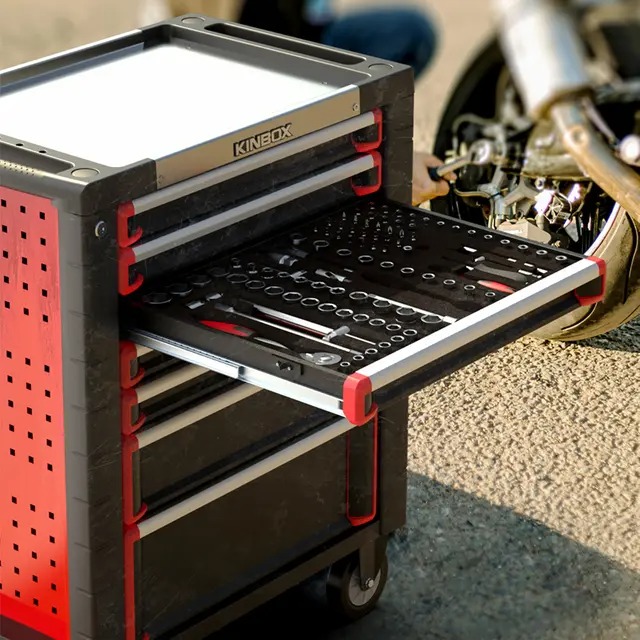
When you are shopping for a tool cabinet that can actually survive a commercial truck repair bay, you have to look past the external paint job and evaluate the raw engineering underneath. The absolute foundation of any industrial-grade cabinet is the quality and gauge of the steel used in its construction. Cheap cabinets often rely on thin, high-gauge steel that flexes under pressure and buckles under heavy impact. For a commercial fleet garage, you should accept nothing less than heavy-gauge, cold-rolled steel construction. Cold-rolling alters the grain structure of the metal, making it significantly stronger, harder, and more resilient to denting than standard hot-rolled steel.
Beyond the raw material, look closely at the structural design of the frame. The best commercial cabinets feature double-wall steel construction and reinforced corner posts. This dual-layer architecture ensures that even if an external panel takes a hard hit from a rolling jack or a heavy truck component, the internal frame remains perfectly square, allowing the drawers to open and close smoothly without catching. Furthermore, the inner walls should feature welded stiffeners to prevent the cabinet from twisting or warping when it is fully loaded to its maximum capacity.
The finish applied to that steel frame is just as critical for long-term survival. A standard liquid spray paint will quickly scratch, flake, and peel when exposed to dropped tools or spilled fluids, creating a path for rust to destroy the metal underneath. Industrial-grade cabinets must feature a high-performance, electrostatically applied powder coating. This powder is baked onto the steel at high temperatures, creating an incredibly thick, resilient, and non-porous barrier. This premium finish is highly resistant to impact chipping and completely impervious to the corrosive chemicals common in diesel shops, allowing your team to easily wipe away grease and oil without damaging the underlying structure.
The drawers of your tool cabinet are the primary touchpoint for your technicians, and their performance directly impacts how fast a truck can be serviced. In a heavy-duty garage, drawers are opened and closed hundreds of times a day, often with significant force and while carrying immense weight. Therefore, the internal mechanics of the drawer tracks require careful scrutiny during your procurement process.
Friction-based drawer slides or low-quality rollers will instantly fail when loaded with heavy diesel tools. Professional configurations require heavy-duty, industrial ball-bearing drawer slides. These slides utilize precision-engineered steel bearings to ensure the drawer glides open effortlessly, even when it is holding over a hundred pounds of steel gear. For standard hand tool drawers containing wrenches and pliers, a slide rating of 100 to 150 pounds is usually adequate. However, for deep bottom drawers designed to store massive 1-inch impact guns, heavy sockets, or air tools, you must look for units equipped with dual pairs of ball-bearing slides on each side, pushing the load capacity to 200 pounds or more per drawer. The slides should also feature a detent mechanism or a positive latching system that keeps the drawers firmly closed when not in use, preventing them from drifting open accidentally.
A highly efficient cabinet configuration must match the diverse physical sizes of a fleet technician's tool set. A cabinet featuring only uniform, identical drawers is highly inefficient. Instead, an optimized setup should provide a strategic mix of drawer depths. The upper section of the cabinet should consist of shallow drawers, which keep flat hand tools, precision measuring instruments, and diagnostic leads organized in a single layer for immediate visibility. The middle and lower sections should transition to much deeper drawers capable of housing bulky items, blow-molded tool cases, and heavy pneumatic equipment. This varied arrangement ensures that no vertical space is wasted inside the cabinet and allows technicians to group their tools logically by task rather than stuffing items wherever they happen to fit.
While a standalone mobile cabinet is an essential piece of equipment, a truly optimized commercial truck repair workspace requires a comprehensive, multi-tiered approach to storage. To maximize the efficiency of a massive service bay, you should integrate your active, mobile units with a stationary garage storage cabinet system along the perimeter walls. This combination allows you to separate your storage strategy into high-frequency and low-frequency categories.
The mobile tool cabinet serves as the technician’s immediate tactical workstation. It rolls right up to the side of the truck cabin or down to the rear axle assembly, ensuring that the exact tools needed for that specific job are always within arm's reach. This drastically cuts down on the physical fatigue of your mechanics, who no longer need to walk back and forth across a 60-foot service bay just to grab a different tool.
Meanwhile, the surrounding garage storage cabinet network acts as the strategic depot for the entire bay. These large, stationary wall modules and tall locker units are ideal for organizing shop-wide diagnostic computers, specialized engine timing kits, bulk fluid supplies, clean rags, and heavy personal protective equipment. By shifting these bulkier, less frequently used items to the perimeter garage storage cabinet setup, you keep the floor space around the vehicle completely clear of clutter, which drastically reduces trip-and-fall hazards and creates a streamlined, highly productive workspace that looks immaculate to visiting corporate fleet accounts.
In the high-energy environment of a commercial vehicle repair facility, safety and asset protection cannot be treated as an afterthought. A fully loaded industrial cabinet can easily weigh upwards of a thousand pounds. If multiple heavy drawers are pulled open simultaneously by a busy technician, the entire center of gravity shifts forward dramatically, creating an incredibly dangerous tip-over hazard that can cause severe injury or crush expensive diagnostic gear. To eliminate this risk, premium industrial cabinets are engineered with an integrated one-drawer-at-a-time interlocking safety system. This mechanical guard physically locks all other drawers the moment one drawer is pulled open, completely preventing accidental tip-overs.
Mobility features also require heavy-duty safety designs. If your cabinet is on wheels, the casters must be built to handle immense static and dynamic loads over rough shop floors. Look for industrial-grade polyurethane or heavy rubber casters equipped with dual-locking mechanisms that secure both the wheel rotation and the swivel pivot. This ensures the cabinet remains rock-solid and completely stationary when a technician is leaning against it to torque a heavy component.
Security is another massive consideration. Professional diesel technicians spend thousands of dollars out of their own pockets to build out their specialized tool collections. Providing a highly secure storage asset is essential for workforce morale and retention. Look for cabinets equipped with centralized high-security cylinder locks or digital electronic locking systems that allow individual access codes. This ensures that valuable equipment remains completely secure during shift changes or when the facility is closed for the weekend, minimizing the risk of internal tool shrinkage or costly mysterious disappearances.
Upgrading a commercial truck repair facility with the right structural infrastructure requires working with a manufacturer who understands the absolute extremes of industrial durability. Ningbo Kinbox Tools Technology Co., Ltd. is a premier global manufacturer specializing in high-performance sheet metal processing and advanced workshop optimization systems. Established in 2013 and operating out of a massive, state-of-the-art 50,000 square meter production facility in Ningbo, China, Kinbox designs and builds heavy-duty storage solutions engineered specifically for the punishing demands of international commercial and fleet service environments.
Our comprehensive product ecosystem spans across premium industrial tool cabinet units, mobile tool trolleys, heavy-duty workbenches, and fully modular garage storage cabinet systems. Utilizing cutting-edge automated fabrication machinery and advanced surface treatment technologies, Kinbox ensures that every weld, drawer slide, and powder-coated surface meets rigorous quality control standards for maximum durability and effortless operation under immense loads. We offer comprehensive OEM/ODM customization services, allowing corporate buyers, industrial distributors, and fleet managers to tailor drawer configurations, dimensions, and organizational foam trays to their exact operational requirements. Partnering with Kinbox means investing in world-class manufacturing capacity and reliable supply chain execution, giving your commercial facility the heavy-duty infrastructure it needs to boost productivity, protect valuable technical assets, and drive long-term business growth.
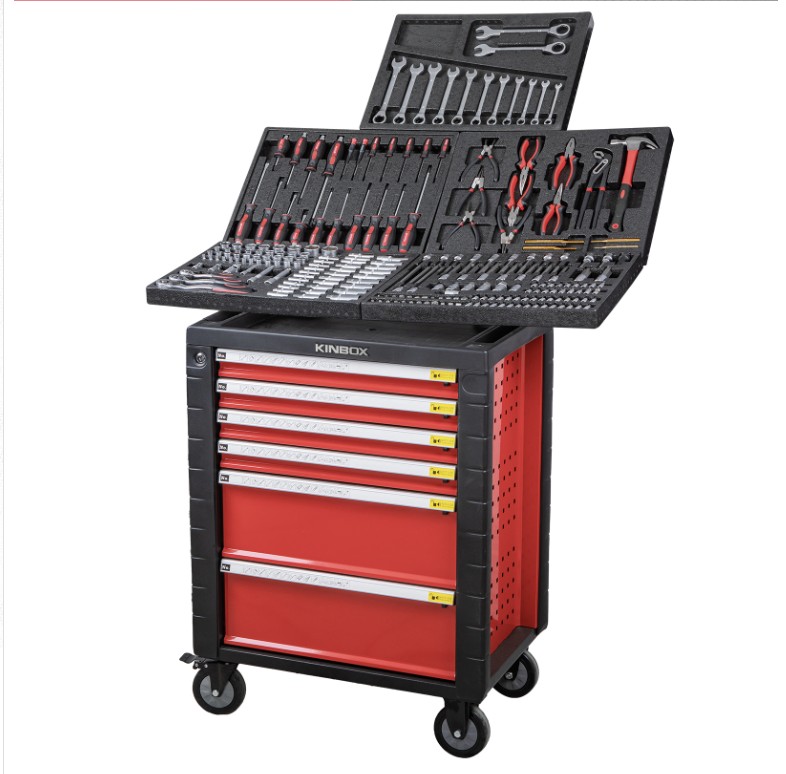
For a commercial fleet garage, look for a tool cabinet constructed with a frame thickness of 16 to 18 gauge cold-rolled steel. The individual drawers should be made from 18 to 20 gauge steel. Steer clear of light-duty 22 or 24 gauge consumer alternatives, as they will quickly bow and warp under the immense weight of heavy diesel repair equipment.
Dual ball-bearing slides double the weight capacity of a single drawer, often allowing it to carry over 200 pounds smoothly. This is absolutely critical for commercial truck repair shops, where a single drawer might hold massive, heavy items like 1-inch drive impact guns, heavy torque wrenches, or large pneumatic tools that would instantly bend standard single-slide tracks.
Yes, modular systems are designed for complete flexibility. You can mix and match tall locker units, wall-mounted overhead bins, and lower workbench modules to fit the exact footprint of your service bays. This allows you to build a cohesive layout around structural pillars, windows, or existing fluid lines while maintaining maximum storage capacity.
A fully loaded industrial tool cabinet can weigh over a thousand pounds. If a technician pulls out multiple deep drawers filled with heavy steel tools at the same time, the center of gravity shifts forward rapidly. An anti-tip interlocking system prevents more than one drawer from opening at a time, eliminating a major crush hazard.
Look for large, industrial-grade polyurethane or heavy-duty rubber casters with a high weight rating. Polyurethane wheels are highly recommended because they roll smoothly over rough concrete floors, resist flat-spotting under heavy static loads, and are completely impervious to spilled automotive chemicals like diesel fuel, motor oil, and brake cleaners.



