
 English

Views: 0 Author: Site Editor Publish Time: 2026-02-02 Origin: Site


When you first walk into a workshop, the thing that often catches your eye isn’t just the tools — it’s where those tools live. A professional tool cabinet isn’t just a “box on wheels.” It’s a carefully engineered system designed to withstand demanding environments, support workflow efficiency, and protect valuable equipment for years, even decades. In this article, we’ll explore exactly how professional tool cabinets are engineered for long-term industrial use — from design considerations to materials, testing, and practical performance.
By the end you’ll not only know what makes a tool cabinet truly “industrial-grade,” but you’ll understand why investing in one (especially if you’re serious about your workspace) makes total sense.
At the heart of any tool cabinet built for long-term industrial use is a design philosophy that prioritizes structural integrity. This isn’t the kind of product you slap together with minimal reinforcement. Instead, engineers carefully analyze where stress will occur, how weight will distribute, and how to ensure the cabinet resists bending, sagging, and wear over time.
Two key design features that boost structural integrity are:
Reinforced frames: Industrial tool cabinets often use a combination of welded steel frames and crimped edges to make the structure rigid without adding unnecessary weight.
Load-bearing support rails: Shelves and drawers are designed with built-in reinforcement so they can support heavy hand tools and power tools without warping.
These features work together to ensure that even after years of daily use — opening drawers, loading parts, or shifting tools — the cabinet stays straight, stable, and reliable.
Before anything goes into production, engineers use both physical and simulated stress testing. In some cases, computational models predict how a cabinet will behave under repeated loads; in others, manufacturers test real prototypes by adding weight, dropping them, or applying force against weak points.
This phase is crucial because it exposes potential weaknesses before the product is ever used on a real shop floor.
One of the primary reasons a professional tool cabinet can survive industrial use is the quality of the materials. Most industrial cabinets are made from either cold-rolled or hot-rolled steel — both offer excellent strength, but they differ in performance and finish.
Cold-rolled steel: Offers a smoother surface and higher dimensional accuracy, which means tighter tolerances for drawers and doors.
Hot-rolled steel: Slightly more rugged and resistant to bending during manufacturing, making it suitable for heavy-duty applications.
Choosing the right type of steel isn’t just about strength — it’s about how the material behaves through fabrication and on the work floor.
Once the base steel is selected, engineers turn their attention to surface treatment. Tool cabinets face oils, spills, impacts, and abrasions every day. The finish must resist corrosion and keep the cabinet looking sharp year after year.
Common industrial finishes include:
Powder coating: A durable, high-adhesion finish that resists chips and scratches better than traditional paint.
Electrostatic painting: Offers strong coverage while remaining cost-efficient.
The quality of the surface finish isn’t just cosmetic. It influences the cabinet’s resistance to rust, chemicals, and environmental factors that could weaken the steel over time.
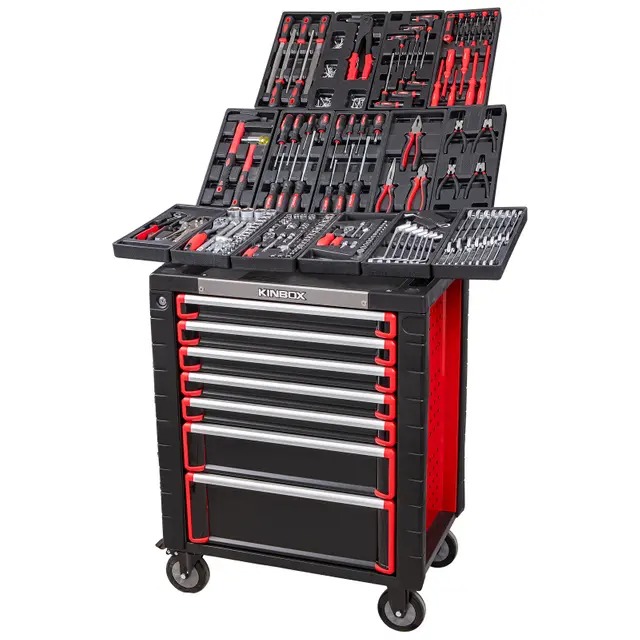
A professional industrial tool cabinet is only as good as its drawers. Even if the outside looks tough, cheap drawer slides can fail quickly under heavy loads, leading to stuck drawers, uneven wear, or outright breaks.
That’s why durable tool cabinets incorporate full-extension ball-bearing slides that:
Allow drawers to open fully with minimal force
Support heavier weights (sometimes 100+ lbs per drawer)
Resist wear from repeated cycles
Ball-bearing slides deliver a smooth feel every time, and they’re engineered to keep performing — whether it’s the first day on the job or the thousandth.
Manufacturers don’t just pick a random slide and hope for the best. They engineer drawer systems with:
Load-rating specifications: Defined limits that ensure the drawer will support a predictable amount of weight without bending.
Reinforced drawer bottoms: Additional supports under the tool tray protect against sagging.
This attention to performance detail guarantees the cabinet stays useful — and safe — through years of heavy use.
Tool cabinets aren’t just about strength — they’re about usability. An industrial engineer considers how tool cabinets will be used in a real workflow. This affects:
Cabinet height (for comfortable reach)
Drawer depth (for tool visibility)
Handle placement (for minimal strain)
Designing with ergonomics in mind means technicians work faster with less fatigue — and the cabinet experiences less misuse.
Industrial needs evolve. Good cabinets are designed to grow with the shop:
Stackable units
Modular add-ons
Custom drawer organizers
This modularity is a form of future-proofing that extends a cabinet’s usefulness beyond its initial installation.
Industrial environments are unpredictable. Cabinets often face:
High humidity
Corrosive chemicals
Fine metal dust
Extreme temperatures
Engineers address these challenges by:
Choosing rust-resistant finishes
Sealing vulnerable areas
Designing openings that minimize dust infiltration
Your tool cabinet shouldn’t rust by year two — and with proper engineering, it won’t.
In many factories, cabinets undergo salt spray tests or prolonged humidity exposure to simulate years of environmental wear in a short time. Passing these tests signals that the cabinet is truly engineered for long-term use.
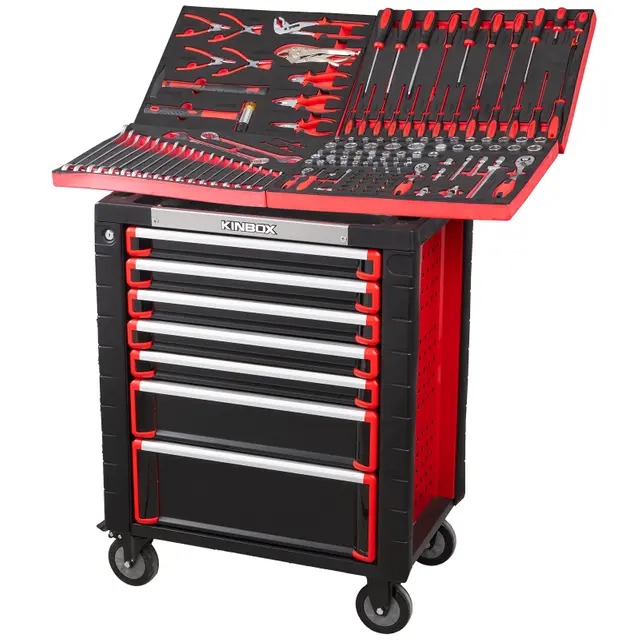
Tool cabinets often need to be secured — against theft, unauthorized use, or accidental opening during movement. So engineers design:
Heavy-duty locks with secure keying systems
Central locking bars that secure all drawers
Optional electronic locks for controlled access
Safety pays off in two ways: protecting tools (and investment) and preventing injuries.
Rolling tool cabinets must navigate workshop floors. Professional models use:
Industrial casters that roll smoothly even under load
Locking brakes that keep the cabinet stable when you need it
Cheap wheels might fail after a few months, but engineered options stand up to years of rolling and stopping without wobbling or seizing.
Before a tool cabinet is assembled, individual parts — slides, hooks, shelves, finishes — undergo inspection. This ensures:
Dimensions meet design specifications
Surface finishes adhere properly
Hardware (like bolts and rivets) meets strength standards
Skipping these steps might save time, but it shortens the life of the cabinet.
Once assembled, cabinets go through tests like:
Load testing on drawers
Door opening cycles
Lock functionality checks
Floor leveling verification
Every test aims to mimic real-world use to catch issues before the product ships.
A big part of “long-term industrial use” isn’t just strength — it’s repairability. Professional designs often allow:
Easy slide replacement
Swappable handles
Removable shelves
This design philosophy means you don’t toss a whole cabinet because one part wears out — you replace a component and keep going.
Good engineering comes with documentation: manuals, parts lists, and support channels. These make repairs and upgrades straightforward — saving time and frustration.
At this point you might be thinking: Okay, that’s a lot of engineering talk — does it matter in practice? The answer is a solid yes. A tool cabinet engineered for long-term industrial use delivers:
Years of reliable performance
Fewer maintenance headaches
Reduced downtime
Better protection for tools and equipment
Improved workflow and technician morale
All of these benefits translate to real value on the shop floor — and that’s why so many professionals insist on industrial-grade cabinets over cheap consumer ones.
At Ningbo Kinbox Tools Technology Co., Ltd., we take these engineering principles seriously. With over a decade of experience producing industrial-grade tool cabinets, tool trolleys, and storage solutions, we combine advanced sheet-metal processing technology with practical workshop insights to build products that stand the test of time.
Whether you need standard units or custom configurations for your facility, we’re here to help you organize your space efficiently and professionally.
Industrial-grade tool cabinets are built with higher-strength materials, reinforced construction, heavy-duty slides, and finishes designed to resist wear, corrosion, and frequent use.
Check the load ratings for drawers and shelves, the thickness and type of steel used, and whether the cabinet has reinforced structures and tested slides.
Yes, powder coating generally offers better adhesion and durability, making it more resistant to chips, scratches, and corrosion in industrial environments.
With proper engineering and materials, maintenance is minimal. Regular cleaning and occasional lubrication of slides and locks are usually sufficient to keep them in good shape.
Absolutely! Kinbox offers customization options like specific drawer sizes, foam inserts, tool organizers, and modular add-ons to fit your exact needs.



