
 English

Views: 0 Author: Site Editor Publish Time: 2026-08-26 Origin: Site


Tools are not cheap, especially in a professional workshop. A basic set of hand tools may already represent a significant investment, while diagnostic equipment, power tools, specialty tools, and measuring instruments can cost considerably more.
Yet tools are often exposed to a surprisingly rough environment.
They may spend hours on a workbench, get moved from one vehicle to another, come into contact with oil or grease, or end up underneath other equipment when the workshop gets busy. Small tools can disappear into drawers, while larger equipment may be left wherever there happens to be space.
This is where a well-planned Garage Storage System can make a real difference.
Good storage does more than keep a workshop looking tidy. It gives tools a fixed place, limits unnecessary handling, separates equipment that could damage one another, and keeps valuable items away from areas where they are likely to be knocked or misplaced.
For professional workshops, storage should therefore be considered part of the working environment. The right cabinet, drawer, workbench, or mobile storage unit can help protect equipment while also making it easier for technicians to use.
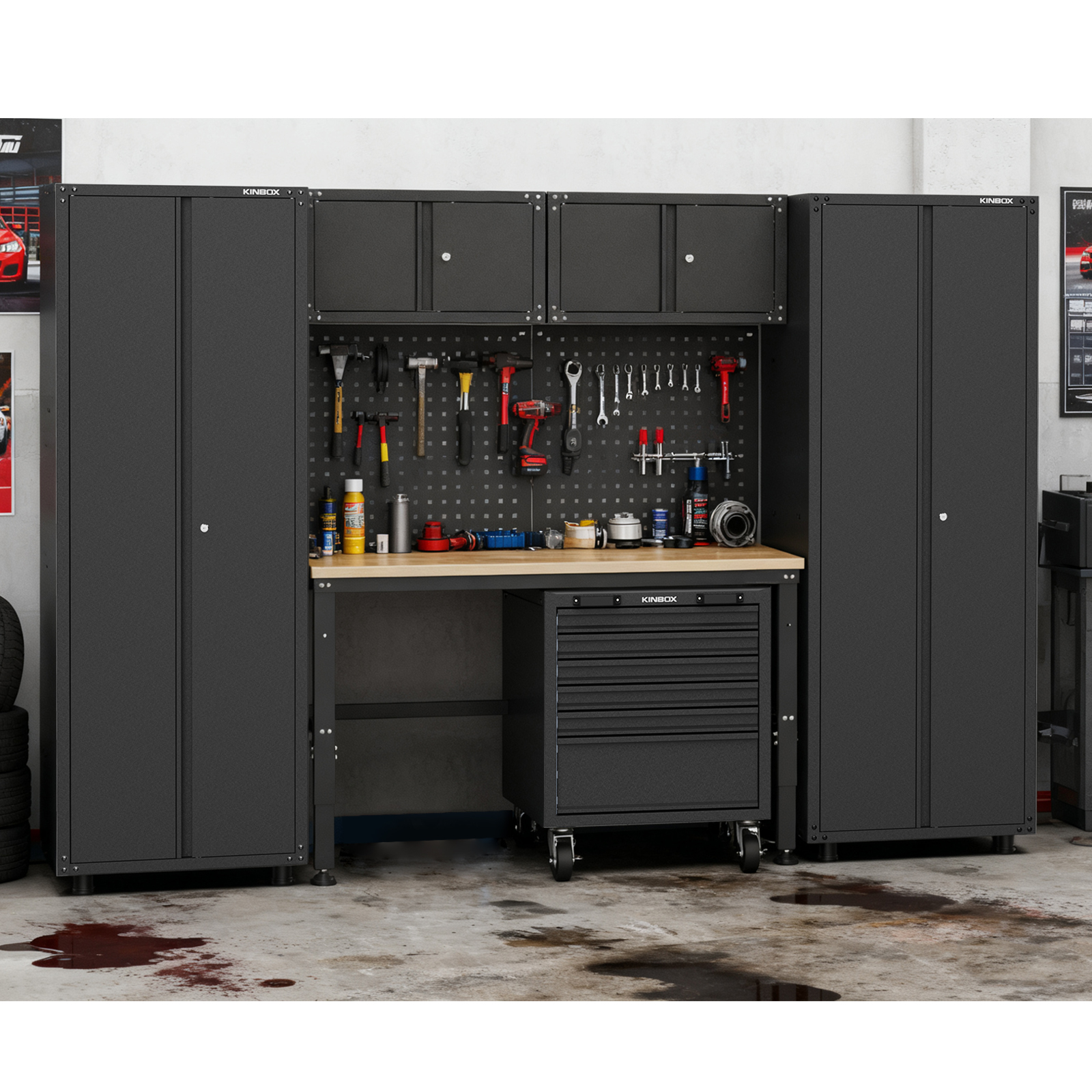
A tool does not necessarily become damaged because of one major accident. More often, problems develop through repeated everyday use.
A screwdriver may be dropped occasionally. A socket may be thrown into a drawer with heavier tools. A diagnostic device may be left on a dirty workbench. A measuring instrument may be placed somewhere unsuitable because the technician needs the workspace immediately.
One incident may not seem important.
Repeated over months or years, however, this kind of treatment can shorten the useful life of equipment.
Garages naturally contain dust, metal particles, dirt, and other debris.
Some tools can tolerate this without much trouble, but sensitive equipment may require more care. Diagnostic devices, electrical testing equipment, and precision instruments are not necessarily designed to sit uncovered in a workshop environment all day.
Enclosed drawers and cabinets provide a simple barrier between the equipment and the surrounding workspace.
They do not create a laboratory-style environment, of course. But keeping equipment inside a cabinet when it is not being used is generally preferable to leaving it exposed on an open bench.
Oil and grease are normal parts of many repair jobs.
Technicians may handle tools immediately after working on an engine, transmission, hydraulic system, or other mechanical component. If those tools are placed directly on other equipment, the contamination can spread.
Dedicated drawers make it easier to separate frequently used mechanical tools from equipment that needs to remain cleaner.
A workshop can also establish simple routines, such as wiping tools before returning them to storage. Having a designated storage location makes that routine easier to maintain.
Storage protects tools partly by controlling where they are kept.
Without dedicated storage, equipment tends to occupy whatever surface is available. A workbench becomes a temporary toolbox. A vehicle hood becomes a place for sockets. Boxes of parts get stacked beside diagnostic equipment.
The arrangement may work for one repair.
The problem usually appears when another job starts.
A busy garage involves constant movement.
Technicians carry parts, move carts, open vehicle doors, operate lifting equipment, and transport tools between work areas. A tool left on an exposed work surface can easily be knocked onto the floor.
A steel storage cabinet gives equipment a more protected location.
Once the drawer is closed, the contents are no longer sitting directly in the path of normal workshop activity. This is especially useful for larger or more expensive tools that are inconvenient to replace.
The cabinet itself also needs to be suitable for the environment. Strong construction, properly fitted drawers, and appropriate hardware matter when the unit is going to be used every day.
Putting everything into one large drawer is not necessarily good storage.
Heavy sockets can sit on top of smaller tools. Pliers can become mixed with screwdrivers. Sharp edges can rub against other equipment when the drawer is opened and closed.
Drawer dividers and organizers can prevent much of this unnecessary contact.
They also make the contents easier to see. A technician does not have to move a pile of tools around simply to find one particular item.
For expensive or delicate equipment, this type of internal organization can be especially useful.
Tool loss is not always theft.
In a busy workshop, equipment can simply end up in the wrong place.
A technician takes a socket set to another work bay. Someone borrows a diagnostic cable. A specialty tool is placed on a different workbench after a repair. At the end of the day, nobody is quite sure where it went.
This is a common problem when several people share equipment.
A Garage Storage System creates a consistent place for equipment.
For example, one drawer can be assigned to sockets, another to screwdrivers, and another to electrical testing tools. Larger specialty equipment can have its own cabinet.
The exact arrangement is up to the workshop, but the principle is simple: when everyone knows where a tool belongs, returning it becomes much easier.
This is particularly helpful for workshops with multiple technicians.
A new employee can learn the storage layout without having to ask where every individual tool should be kept. Experienced technicians can also find shared equipment more quickly because they are working with the same arrangement.
Not every drawer needs a complicated organization system.
Simple labels can be enough.
A drawer marked “Sockets,” “Electrical,” or “Measuring Tools” immediately tells technicians what belongs there. Foam inserts or custom organizers can provide another level of control for frequently used tools.
This can also make missing equipment easier to spot.
If a particular space is empty, someone can notice it during the normal end-of-job cleanup rather than discovering several days later that a tool has disappeared.
Not all workshop equipment has the same level of durability.
A heavy-duty wrench can tolerate conditions that would not be ideal for a diagnostic scanner or electronic testing device.
Sensitive equipment needs somewhere that reduces unnecessary exposure to dust, impact, and careless handling.
Modern repair workshops often rely on electronic diagnostic equipment.
Scanners, testing devices, cables, adapters, and related accessories can represent a substantial investment. They may also contain components that are more sensitive than conventional hand tools.
Keeping them in a dedicated cabinet or drawer when they are not being used gives them some separation from the general workshop environment.
Cable organization is useful here as well.
Cables that are left tangled on a bench are easier to step on, pull, or damage. Keeping them coiled and stored in a suitable drawer reduces unnecessary strain.
Some measuring equipment requires more careful handling than ordinary hand tools.
Calipers, gauges, electrical meters, and other precision instruments can be affected by impacts or poor storage practices.
They do not necessarily need an elaborate storage room. In many cases, a suitable drawer with dividers or a protective case is enough.
The main objective is to prevent them from being mixed with heavy tools that could damage them.
Storage cannot completely eliminate moisture problems, but it can help control exposure.
Workshops may have changing temperatures, open garage doors, vehicle washing areas, or other sources of moisture. Metal tools that are repeatedly exposed to damp conditions can eventually develop surface corrosion.
Floor-level storage is particularly vulnerable to moisture, dirt, and accidental contact with liquids.
A cabinet raises tools above the floor and keeps them away from puddles, cleaning water, and other contaminants.
This is a relatively basic improvement, but it is often overlooked when workshops are being organized.
Tools that are particularly susceptible to corrosion may need additional protection.
Depending on the equipment, this might include cleaning and drying tools before storage, applying an appropriate protective product, or using a closed container with suitable moisture control.
The storage cabinet itself also matters. A suitable protective finish can help the cabinet cope with the workshop environment, although no coating should be treated as a substitute for proper maintenance.
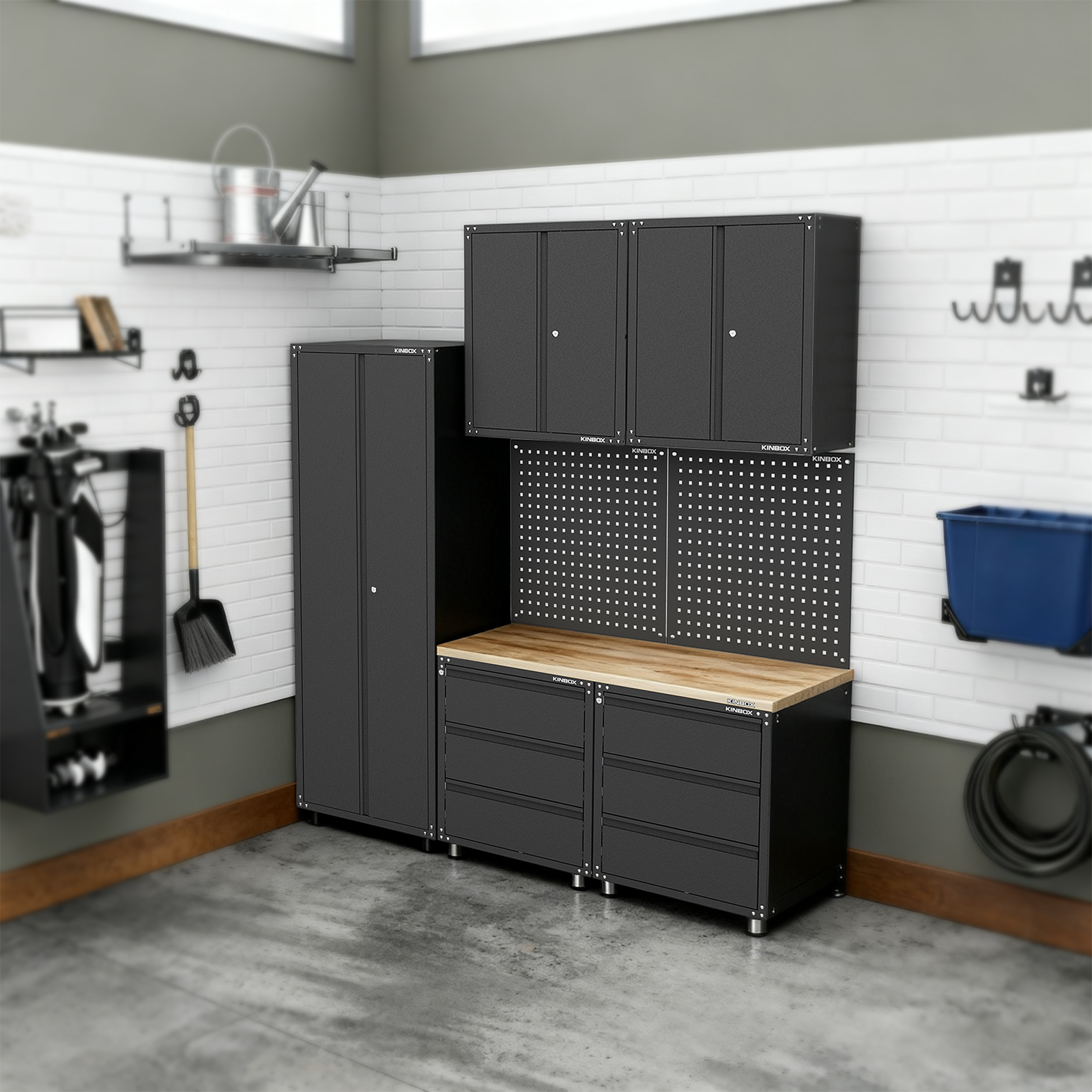
Physical damage is one of the most obvious reasons to store tools properly.
A tool can fall from a bench, be crushed underneath heavier equipment, or be struck by another object. Sometimes the damage is obvious. In other cases, repeated small impacts may affect the equipment without anyone noticing immediately.
Large tools should have enough room.
Trying to force oversized equipment into a shallow drawer can cause problems. The tool may have to be angled awkwardly, or the drawer may become difficult to close.
Deeper drawers are generally better suited to larger equipment.
The same applies to storage capacity. A drawer should not be overloaded simply because the cabinet has available space. Excess weight can affect the drawer mechanism and make everyday use more difficult.
Stacking is often the quickest way to create storage space, but it is not always the safest arrangement.
A heavy tool placed on top of smaller equipment can damage what is underneath. It also means the technician has to move several items just to reach the bottom one.
Separate drawers, shelves, or compartments are a better choice when equipment varies significantly in size and weight.
Mobile cabinets are useful in workshops where technicians work across different bays.
Instead of carrying individual tools back and forth, a technician can move the storage unit closer to the vehicle.
That reduces the number of trips and keeps tools together during the job.
A common problem during repairs is that tools gradually spread around the vehicle.
A wrench is placed near the front wheel. A diagnostic device sits on the roof. A socket set remains beside the engine bay.
A mobile cabinet can act as a central storage point.
The technician takes the required tools from the cabinet and returns them there when finished. The tools stay together instead of being scattered across the work area.
Mobility comes with its own requirements.
A fully loaded tool cabinet can be very heavy, so the casters need to support the actual working load. They should also suit the type of floor found in the workshop.
If the floor has thresholds, uneven areas, or ramps, these conditions should be considered before choosing a mobile storage unit.
Mobility is useful when it solves a real workflow problem. If a cabinet will rarely be moved, fixed storage may be more appropriate.
A workbench is often one of the busiest surfaces in a workshop.
Technicians use it for disassembly, inspection, assembly, measuring, cleaning, and small repairs. If tools and equipment remain on the bench after every job, the available working area quickly disappears.
Storage underneath or beside the workbench can help prevent that.
A clear workbench gives technicians somewhere to place the component they are working on.
This sounds obvious, but in a busy workshop the bench can easily become a temporary storage area.
A set of drawers underneath provides another location for tools once they are no longer needed. That means the technician can clear the surface without having to walk across the workshop every few minutes.
For smaller garages, combining a workbench with integrated storage can also save valuable floor space.
A crowded workbench creates another problem.
When several tools and components are sitting together, it becomes easier to knock one item into another. Cables can get caught underneath equipment, small parts can fall onto the floor, and sensitive devices may end up beneath heavier objects.
Putting equipment away when it is not required reduces those risks.
There is no fixed number of years that a storage cabinet will add to the life of a tool.
Tool life depends on the tool itself, how often it is used, the conditions in which it operates, and how well it is maintained.
Storage can nevertheless remove some unnecessary sources of wear.
When tools have designated locations, technicians do not need to pile them onto whatever surface is available.
A socket set can go into one drawer. A measuring instrument can stay in a protective compartment. A specialty tool can have its own location.
That reduces unnecessary movement.
Organized storage also makes routine maintenance more manageable.
If tools are returned to the same location, technicians are more likely to notice when something is dirty, damaged, or missing.
A damaged tool can be removed from service instead of being placed back into the drawer and forgotten.
This is particularly important in professional workshops where equipment is shared.
Not every cabinet offers the same level of protection.
Before buying, consider how the equipment will actually be used.
Look at the cabinet frame, drawer slides, handles, hinges, and overall build.
The storage unit should be capable of supporting the equipment you intend to put inside it. Drawer dimensions should also match the tools rather than forcing large equipment into unsuitable spaces.
A garage can be a harsh environment for metal products.
Look for a suitable protective finish that is intended for regular workshop use. It should also be reasonably easy to clean because dust, oil, and grease are unavoidable in many repair environments.
A cabinet with many drawers is not automatically a good cabinet.
Drawer depth, internal dimensions, accessibility, and the location of frequently used equipment all matter.
A shallow drawer can be excellent for hand tools but frustrating for large power tools. A deep drawer may solve that problem but be less convenient for small parts.
The layout should reflect the contents.
Start with the equipment rather than the cabinet.
Make a list of the tools and equipment that need storage. Separate them into groups based on size, weight, frequency of use, and sensitivity.
Everyday hand tools should normally remain close to the main working area. Heavy equipment needs storage that can safely support its weight. Sensitive electronic equipment deserves a cleaner and more protected location.
Small components can be placed in organizers or bins.
Larger equipment may need deep drawers or cabinets.
If several technicians use the same tools, keep the arrangement consistent across workstations where possible. This makes it easier to return equipment and identify missing items.
There is no need to make the system complicated.
A straightforward storage layout that technicians actually use is more useful than an elaborate arrangement that becomes inconvenient after a few weeks.
For a professional repair business, tools and equipment are working assets.
They generate value when technicians can use them efficiently. If equipment is difficult to find, frequently damaged, or constantly moved around, the problem affects more than the appearance of the workshop.
Good storage helps create a predictable working environment.
Technicians know where tools are kept. Expensive equipment has a designated location. Workbenches can remain available for repairs. Heavy equipment is stored where it can be handled safely.
None of these benefits is dramatic on its own.
The value comes from repeating the same small improvements every working day.
A properly selected Garage Storage System can therefore be part of a workshop's long-term equipment planning rather than simply a way to make the garage look cleaner.
For professional workshops looking to improve tool organization and equipment storage, Kinbox Tools provides steel tool cabinets, workbenches, garage storage systems, and related workshop storage equipment. The range is intended for practical working environments where storage needs to handle regular use while keeping tools and equipment accessible. Whether a workshop is being fitted out for the first time or replacing older storage, Kinbox Tools can provide different configurations to suit available space, tool collections, and working requirements. Choosing storage around the equipment technicians actually use can make the workshop easier to manage and keep valuable tools better protected over time.
Yes, although storage is only one part of tool protection. Cabinets and drawers keep equipment away from unnecessary impacts, floor-level dirt, and general workshop clutter. They also give technicians a consistent place to return tools after use.
It can be a sensible option when the cabinet has enough space and the equipment is stored appropriately. Diagnostic scanners, meters, cables, and adapters are better kept together in a clean, protected area than left on a busy workbench. For particularly sensitive equipment, a protective case inside the cabinet may also be useful.
The simplest method is to give commonly used tools fixed locations. Once technicians know which drawer or cabinet a tool belongs in, it becomes easier to notice when something is missing. This is especially helpful when several people share the same equipment.
They can be, provided the cabinet is designed and rated for the intended load. Check the total capacity as well as individual drawer and shelf ratings. Heavy tools should not be placed into drawers that are not designed to carry them.
Group tools according to how they are used. Keep frequently used hand tools close to the main workstation, put heavier equipment in suitable deep drawers or cabinets, and separate small parts with bins or organizers. Tools that need more careful handling should have their own protected storage area.



