
 English

Views: 0 Author: Site Editor Publish Time: 2026-05-25 Origin: Site


Running a busy auto repair shop is a balancing act. On any given day, your mechanics are swapping engines, diagnosing complex electrical faults, and performing routine maintenance—all under tight deadlines. In this fast-paced environment, time is quite literally money. Yet, walk into almost any shop, and you will likely see a familiar, frustrating scene: a technician standing around, hunting through a cluttered drawer for a misplaced 10mm socket. It looks like a minor inconvenience, but when multiplied across several mechanics over weeks and months, these wasted minutes turn into a massive drain on your shop's overall productivity and bottom line.
Maximizing efficiency in an automotive service center is not just about investing in the latest diagnostic software or hiring the most experienced staff. It often comes down to the physical layout of the workspace and, more specifically, how tools are stored and accessed. Choosing the right industrial tool cabinet is one of the most critical infrastructure decisions a shop owner or manager can make. It is not simply about buying a metal box with drawers; it is about establishing a highly organized system that supports your team’s workflow, protects your investment in high-end equipment, and creates a professional environment that instills confidence in your clients.
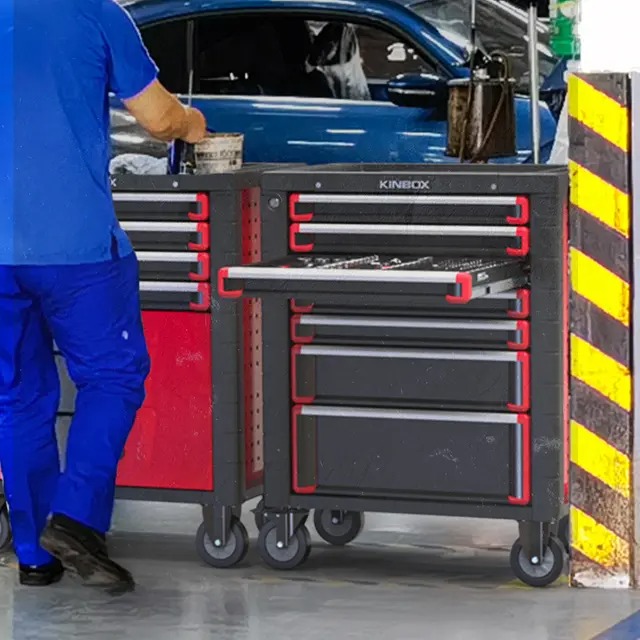
To understand why a premium tool cabinet is essential, it helps to look at the hidden costs of poor workshop organization. When tools are scattered across mismatched storage units or piled up on workbenches, your entire operation slows down. Technicians lose their momentum when they have to stop a complex repair task just to locate a specialized puller or a specific wrench. This disruption not only extends vehicle turn-around times but also increases the likelihood of errors, as mechanics lose their train of thought mid-job.
Furthermore, automotive tools represent a significant financial investment. High-quality impact wrenches, diagnostic tools, and specialized socket sets cost thousands of dollars. When stored improperly in flimsy, overcrowded drawers, these tools knock against each other, leading to premature wear and tear. Worse yet, they get lost. Replacing missing tools is an ongoing, avoidable expense that eats directly into your profit margins. A disorganized shop also sends a negative signal to customers. When a vehicle owner peeks into a chaotic, messy service bay, they may naturally question whether the quality of the mechanical work will be just as careless.
Transitioning to a dedicated, industrial-grade storage system changes the entire dynamic of the workshop. By providing a specific home for every single piece of equipment, you eliminate search times, safeguard your assets, and project an image of absolute professionalism.
The first step in selecting the ideal tool cabinet is evaluating how your technicians actually move and work within the service bays. Every auto repair shop has a unique footprint and workflow, meaning a storage solution that works perfectly for a quick-lube station might be entirely inadequate for a heavy-duty transmission repair shop. You must decide whether your shop will benefit more from stationary, centralized storage or highly mobile units.
For larger facilities or dedicated diagnostic bays, stationary setups are often the most effective choice. A permanent, heavy-duty storage configuration allows you to maximize vertical space and create a comprehensive workstation. These units often work hand-in-hand with a garage storage cabinet system, providing a seamless blend of tool drawers and upper overhead compartments for bulkier items. Stationary cabinets offer massive weight capacities and a sense of structural permanence, making them ideal for storing heavy diagnostic machinery, specialized pneumatic tools, and shop-wide equipment that stays in a fixed location.
On the flip side, general repair technicians usually need their tools right at the vehicle's side. This is where heavy-duty mobile cabinets and tool carts become indispensable. A mobile cabinet allows a mechanic to roll their entire setup from the back of the bay straight to the engine bay or the wheel well. When evaluating mobile options, look closely at the caster wheels. Flimsy casters will buckle under the weight of professional tools, especially when rolling over shop floors with drains, cracks, or spilled fluids. High-quality units utilize industrial-grade polyurethane or rubber casters with robust locking mechanisms to ensure the cabinet stays firmly in place while the technician is working.
The automotive repair environment is notoriously brutal on shop furniture. Cabinets are subjected to constant impacts, heavy loads, exposure to harsh chemicals, and relentless daily use. Therefore, looking at the build quality and material specifications is paramount. You want to invest in furniture that can survive years of hard labor without sagging, jamming, or rusting.
When comparing options, the thickness of the steel—often referred to as the gauge—is the ultimate indicator of durability. Cheap, consumer-grade cabinets use thin, high-gauge steel that easily dents under impact and warps when loaded with heavy metal tools. Professional environments require heavy-gauge cold-rolled steel construction. Cold-rolled steel is significantly stronger and features a smoother finish than hot-rolled alternatives. A properly constructed cabinet will feature reinforced sidewalls and double-walled corner posts to prevent the frame from twisting when fully loaded or moved across the shop floor.
The finish on your cabinet does much more than just look good; it serves as the primary line of defense against a hostile workshop atmosphere. Auto shops are filled with corrosive agents like brake fluid, motor oil, degreasers, and road salt brought in by vehicles. A standard liquid paint job will quickly scratch, chip, and peel, exposing the underlying steel to moisture and rust. Look for cabinets that feature an advanced industrial powder coating. This process electrostatically applies a dry powder that is then cured under heat, creating a thick, resilient barrier that resists scratching, impact, and chemical staining. It also makes the surfaces incredibly easy to wipe down at the end of a shift.
The true functionality of a tool cabinet lives and dies by its drawers. A cabinet can have a beautiful exterior, but if the drawers are shallow, difficult to open, or prone to falling off their tracks, it becomes a daily source of frustration for your team.
Think about the variety of tools your mechanics use. You have long, flat pry bars; tiny, precise diagnostic leads; massive, heavy impact sockets; and bulky power tools. A one-size-fits-all drawer arrangement simply will not work. A highly efficient cabinet should offer a diverse mix of drawer depths. Shallow top drawers are perfect for organizing hand tools like wrenches, screwdrivers, and pliers where visibility is key. Deeper bottom drawers are essential for housing heavy-duty power tools, blow-molded cases, and bulkier diagnostic equipment.
The weight rating of the drawer slides is a critical safety and usability metric. Standard friction slides have no place in a professional automotive environment; they will bind up and seize the moment you put real weight in them. Instead, insist on industrial ball-bearing drawer slides. For standard hand tool drawers, a rating of 100 to 150 pounds per drawer is typically sufficient. However, for deep drawers designed to hold heavy air impacts or large socket sets, you should look for units equipped with heavy-duty dual pairs of ball-bearing slides, which can handle upwards of 200 pounds or more. The drawers should glide open smoothly and effortlessly, even when loaded to maximum capacity.
Buying a high-quality cabinet is only half the battle; how you organize the interior space dictates the actual speed of your repairs. If a mechanic opens a premium drawer only to find a chaotic pile of loose tools, the efficiency gains are completely lost.
To achieve a truly optimized workflow, your storage system should utilize customizable internal organization tools. High-density EVA or EPS foam trays are a game-changer for professional technicians. These trays feature custom-routed cutouts for every single wrench, socket, and driver. This serves two major purposes: it prevents tools from sliding around and getting damaged when the drawer is opened and closed, and it provides an instant visual inventory. At the end of the day, a mechanic can look down at their drawers and immediately see if a tool is missing, preventing costly gear from being left inside a customer's vehicle engine bay.
For high-volume shops, a standalone cabinet might not offer enough storage capacity. To scale your workshop effectively, it is wise to integrate your primary mobile cabinets with a comprehensive garage storage cabinet network. By pairing your active, daily-use mobile units with wall-mounted cabinets and tall locker modules, you create a tiered storage strategy. Daily tools live in the mobile unit at the mechanic’s fingertips, while specialized, seasonal, or bulk items are stored neatly in the surrounding garage storage cabinet setup. This keeps the immediate work zone clear of clutter while ensuring everything remains within arm's reach.
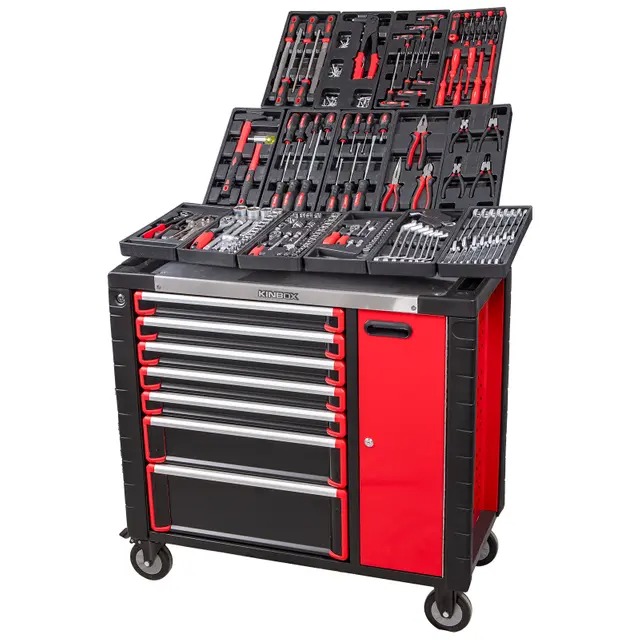
In the hustle of a commercial shop, safety and security cannot be overlooked. A fully loaded tool storage unit can weigh hundreds of pounds, creating a significant hazard if it tips over or falls into unauthorized hands.
When multiple heavily laden drawers are pulled out at the same time, the center of gravity shifts forward drastically, risking a catastrophic cabinet tip-over. Premium industrial cabinets feature an integrated interlocking drawer system, which physically prevents more than one drawer from being opened at a time. Additionally, look for drawers with positive latching mechanisms or self-closing features that ensure drawers stay firmly shut while the cabinet is being rolled across the shop floor.
Since technicians often invest their own hard-earned money into their tool collections, robust security is non-negotiable. A reliable central locking system with heavy-duty cylindrical keys or digital electronic locks provides peace of mind when the shop closes for the night. Furthermore, investing in durable equipment pays off immensely over time. While consumer-grade alternatives might save money upfront, their frequent replacement costs and the operational downtime caused by broken drawers mean they cost significantly more in the long run than a professional-grade asset.
Upgrading your automotive repair shop with the right storage infrastructure requires a supplier who deeply understands industrial-grade durability and manufacturing precision. This is where Ningbo Kinbox Tools Technology Co., Ltd. stands out as a premier global manufacturing partner. Established in 2013 and operating out of a modern, state-of-the-art 50,000 square meter facility in Ningbo, China, Kinbox specializes in advanced sheet metal processing and industrial workshop optimization.
We engineer high-performance workspace solutions specifically designed to withstand the harsh realities of commercial automotive and manufacturing environments. Our extensive product line ranges from heavy-duty mobile cabinets and comprehensive hand tool sets featuring custom EVA/EPS foam trays, to fully modular garage storage cabinet systems and heavy industrial workbenches. By combining automated fabrication technologies with strict quality control testing, Kinbox ensures that every drawer slide, latch, and powder-coated panel delivers maximum durability and seamless reliability. Whether you are looking to equip a single specialty service bay or overhaul a large-scale commercial fleet maintenance facility, Kinbox provides the scalable manufacturing capacity and versatile OEM/ODM customization services needed to take your shop's efficiency to the absolute next level.
For professional auto repair environments, look for cabinets constructed from 16-gauge to 18-gauge cold-rolled steel for the main frame and structural supports. Drawers should ideally be made from 18-gauge to 20-gauge steel. Avoid higher gauges (like 22-gauge or 24-gauge), as the thinner metal will easily dent and warp under industrial loads.
Ball-bearing slides contain steel bearings that allow the drawer to roll open effortlessly, even when holding over 100 pounds of heavy tools. They prevent binding, sticking, and sagging, allowing a mechanic to access their tools quickly with one hand, which dramatically speeds up repair workflows and reduces physical strain.
Yes, a modular workspace design is highly recommended for commercial shops. You can install a stationary garage storage cabinet system along the perimeter walls to handle bulk storage, diagnostic equipment, and fluid supplies, while incorporating matching roll-away mobile units that fit perfectly beneath the workbenches when not in use.
Powder coating creates a much thicker, more resilient finish that is chemically bonded to the steel. This makes the cabinet highly resistant to chipping, scratching, and the corrosive automotive fluids frequently encountered in repair shops, such as brake fluid, gasoline, solvents, and motor oil.
You should prioritize cabinets equipped with a one-drawer-at-a-time interlocking safety system. This mechanism prevents a technician from opening multiple loaded drawers simultaneously, which shifts the center of gravity and can cause a dangerous tip-over accident. Robust locking casters are also vital for mobile units.



