
 English

Views: 0 Author: Site Editor Publish Time: 2026-07-02 Origin: Site


A workbench usually becomes messy before anyone admits the garage needs a storage plan.
At the beginning, it is just one drill left on the top. Then a box of screws stays there because the next project is coming soon. A charger remains plugged in. A pair of gloves gets pushed behind a bottle of cleaner. A tape measure, some spare blades, a few washers, and half a roll of masking tape somehow become permanent residents.
The bench is still called a workbench, but less and less work happens on it.
That is where Garage Storage Cabinets earn their place. Not as decoration around the wall, and not simply as a way to hide everything behind doors. Cabinets around a workbench have a more practical job: they stop the bench from becoming storage.
A wall full of cabinets can still leave the bench unusable. That happens more often than people expect. The cabinets may be too far away, too deep, too high, or filled with items that have nothing to do with the work area. The garage looks organized after installation, but the first few weekends bring the clutter back.
Planning cabinets around a workbench is really about one question: when the job is finished, is it easy to put everything back?
A garage layout often starts with a tape measure and an empty wall. That seems reasonable. Measure the wall, choose the cabinet sizes, fit the workbench into the remaining space.
The problem is that a workbench is not just another storage unit. It is where the activity happens.
If the bench is used for car care, the nearby cabinet space will likely collect microfiber towels, sprays, wax, gloves, battery chargers, small tools, tire gauges, and bottles that need to stay upright. If the bench is used for repair work, the nearby storage will need screws, drill bits, wrenches, tape, clamps, measuring tools, small parts, and power tool accessories. If the garage is shared by the whole family, the workbench area also needs protection from sports gear, seasonal boxes, and outdoor supplies that slowly move into every open corner.
The cabinets should respond to that work pattern.
A Garage Storage Cabinet near the bench does not need to hold everything in the garage. It needs to hold the items that keep landing on the bench because there is no obvious home for them.
The cabinet closest to the bench usually solves weekly clutter, or lets it come back.
If drill bits are stored across the garage, they will probably stay on the worktop. If fasteners live in one mixed box, they will spread into cups, trays, and plastic bags. If gloves, tape, chargers, and small tools have no nearby position, they become part of the bench surface.
A closed garage cabinet works well for bottles, boxes, cleaning products, and general supplies. A Tool Cabinet with drawers works better for hand tools that need separation: sockets, screwdrivers, pliers, wrenches, and measuring tools. They solve different problems. One keeps larger items out of sight. The other keeps smaller tools from becoming a drawer full of metal noise.
Around a busy workbench, the two usually belong together.
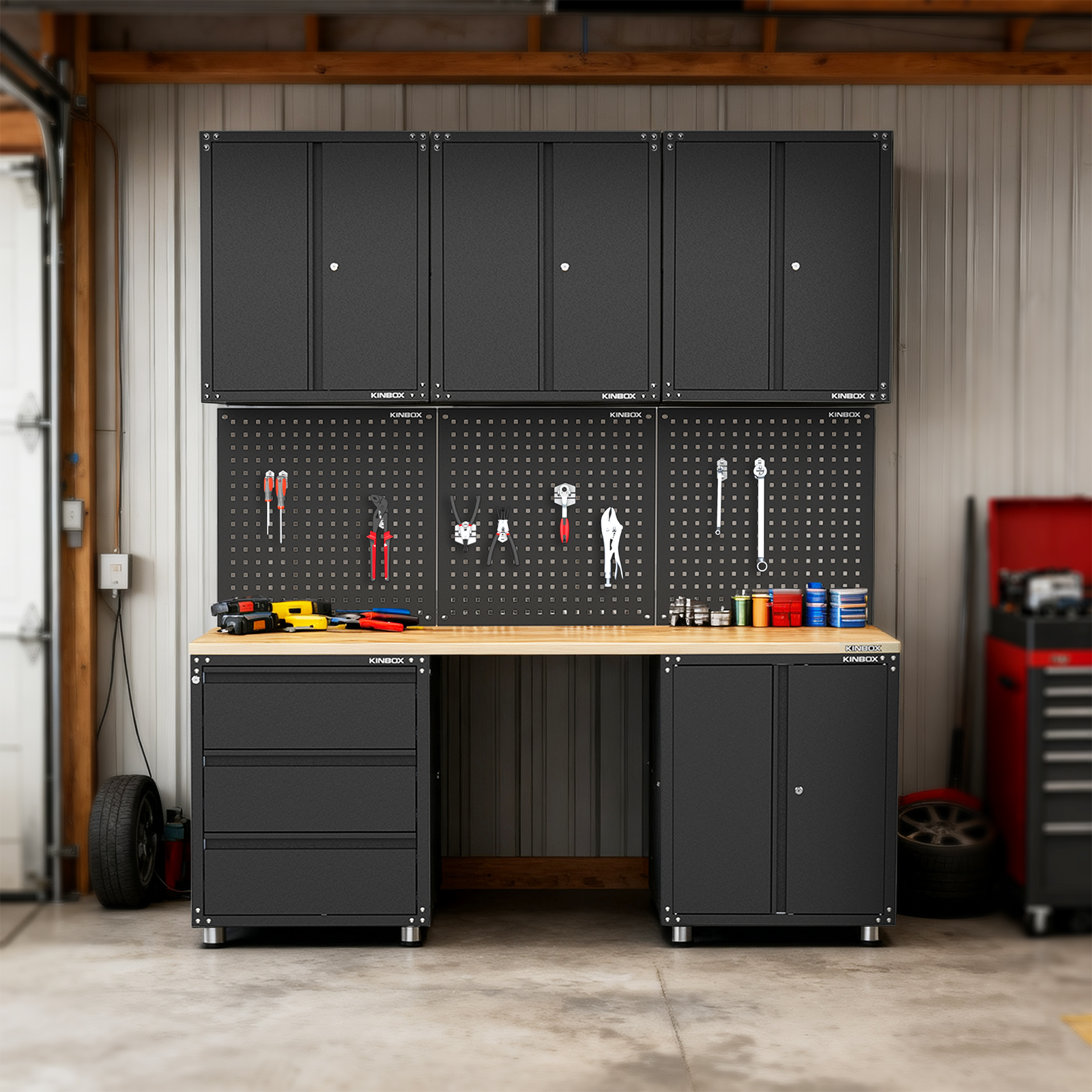
The clearest sign of a bad storage layout is not the inside of the cabinet. It is the worktop.
A clean worktop after installation means very little. The real test comes later. After a month, is there still room to place a part down? Can the user start a quick repair without first clearing old tools? Are chargers, bottles, fasteners, and gloves sitting there because they are used often, or because the cabinet arrangement is inconvenient?
A garage workbench becomes cluttered when the storage nearby asks too much from the user. A cabinet door that is awkward to open, a shelf that is too deep, a wall cabinet that is too high, or a drawer placed on the wrong side can all lead to the same result: things stay on the bench.
Good cabinet planning does not rely on perfect habits. It makes the normal habit easier.
Chargers are a good example. They often start on the workbench for a practical reason. They need power. Then they stay there forever.
The same happens with gloves, tape measures, drill bits, small bottles, loose hardware, and cutting tools. They are used often enough to be nearby, but not important enough to occupy the surface all day.
A small shelf inside a Garage Storage Cabinet can hold chargers. A shallow drawer can hold measuring tools. A labeled bin can hold fasteners. A side cabinet can hold car care products. The worktop should be available for the current job, not for every item that might be useful later.
That one change can make the whole garage feel less crowded.
Wall cabinets look efficient in garage design drawings. They lift storage off the floor and make the space look finished. Around a workbench, though, they can create problems if they are installed without enough open space.
When wall cabinets sit too low, the bench feels boxed in. Tall items cannot stand on the surface. The user works under a shadow. Reaching for tools becomes uncomfortable. When the cabinets sit too high, they become storage for items that are rarely used, because no one wants to reach that far during a quick job.
There is no universal height that fits every garage. A bench used for small repair work needs more open wall area than a bench used mostly as a storage counter. Cabinet depth, user height, lighting, and the type of work all change the answer.
The area above the worktop should still feel like a working space. If the cabinet makes the bench feel like a narrow slot, it is probably too much.
Lighting is often remembered late.
A wall cabinet can block light or cast shadows exactly where small parts, markings, screws, blades, wires, and measurements need to be seen clearly. This becomes irritating fast. A garage storage layout that makes the workbench darker has solved one problem and created another.
Under-cabinet lighting can help. So can leaving a clear wall section above the main working area. Sometimes the best decision is not another cabinet, but better visibility.
A workbench needs light before it needs one more shelf.
The lower area around the bench is usually the right place for weight.
Power tools, cases, clamps, bottles, parts boxes, larger accessories, and heavier supplies are better stored below or beside the worktop than above it. A base Garage Storage Cabinet can hold bulkier items behind doors. A Tool Cabinet can keep metal hand tools separated in drawers. A garage storage unit can handle a specific category that does not fit neatly into the bench zone.
The lower storage area often becomes the backbone of the workbench setup.
Still, deep cabinets are not automatically useful. A deep shelf can hide problems. A drill case sits in front, a box of screws disappears behind it, cleaner bottles take one corner, and a small accessory ends up somewhere in the back. From the outside, the cabinet looks clean. Inside, it has become a closed version of the old mess.
Many garages do not need only more cabinet space. They need divided space.
Bins, shallow trays, labels, drawer inserts, and small containers often do more for daily use than another large shelf. A shelf for fasteners is vague. A container for screws, another for washers, another for wall anchors, and another for clips is useful. A shelf for power tools works better when batteries and accessories have a place beside them.
Cabinet doors reduce visual clutter. Internal organization keeps the clutter from rebuilding.
That difference matters around a workbench because the bench becomes the overflow area whenever the cabinet interior is hard to use.
Tall garage cabinets are useful, but they can easily dominate a bench area.
They are good for larger tool cases, car care products, seasonal supplies, cleaning equipment, outdoor items, or categories that do not need to be touched during every project. Around a workbench, they often work best at the ends of the layout rather than directly crowding the main working position.
Placed well, a tall Garage Storage Cabinet frames the work area. Placed badly, it makes the bench feel squeezed into a corner.
A tall cabinet also needs a clear purpose. One cabinet for car care. One for outdoor supplies. One for household repair materials. One for seasonal garage items. Without a category, tall cabinets become the place where “things without a home” go to disappear.
The doors close, but the problem remains.
The wall behind the bench gets most of the attention, but the side space often matters more in daily use.
A rolling Tool Cabinet beside the workbench can be more useful than another wall cabinet. It can stay near the bench for tool organization, then move closer to a car, motorcycle, mower, or project area. A smaller garage storage unit can hold specific supplies on one side. A portable tool box can have a fixed parking place. Even a trash bin, extension cord, or small parts station needs a planned location.
This side space decides whether the work area feels natural or cramped.
A garage drawing may show that everything fits. Real use asks a different question: can the person stand, bend, open drawers, swing doors, pull out a cabinet, lift a tool case, and still move around the vehicle?
A deeper cabinet stores more, but it also takes more space from the user.
In a narrow garage, cabinet depth may matter more than cabinet width. A deep base cabinet can make the workbench area feel tight. A wide workbench can make drawers harder to open if a car is parked nearby. A mobile cabinet without a clear parking position will eventually block the walkway.
Planning around a workbench means leaving space for movement, not just finding space for products.
This is especially important for homeowners who still need to park a car inside the garage. The storage system may look excellent when the garage is empty. It has to work when the car is back in place.
A workbench area often supports different kinds of tasks. Car cleaning, drilling, sanding, painting, household repair, assembly, tool maintenance, and small electrical work may all happen in the same space.
Not everything belongs together.
Microfiber towels should not sit next to oily tools. Measuring tools should not be thrown into a bin with loose screws. Paint and sprays need a more careful place than daily hand tools. Gloves and safety glasses need to stay easy to reach. Power tool batteries should not be buried under random hardware.
Garage Storage Cabinets make separation possible, but only if the categories are respected.
One section can hold car care products. Another can hold tool accessories. Another can hold safety gear. Another can hold fasteners. The cabinet becomes easier to maintain when each shelf has a reason to exist.
If every open space is treated as available storage, the cabinet will be messy again after the next project.
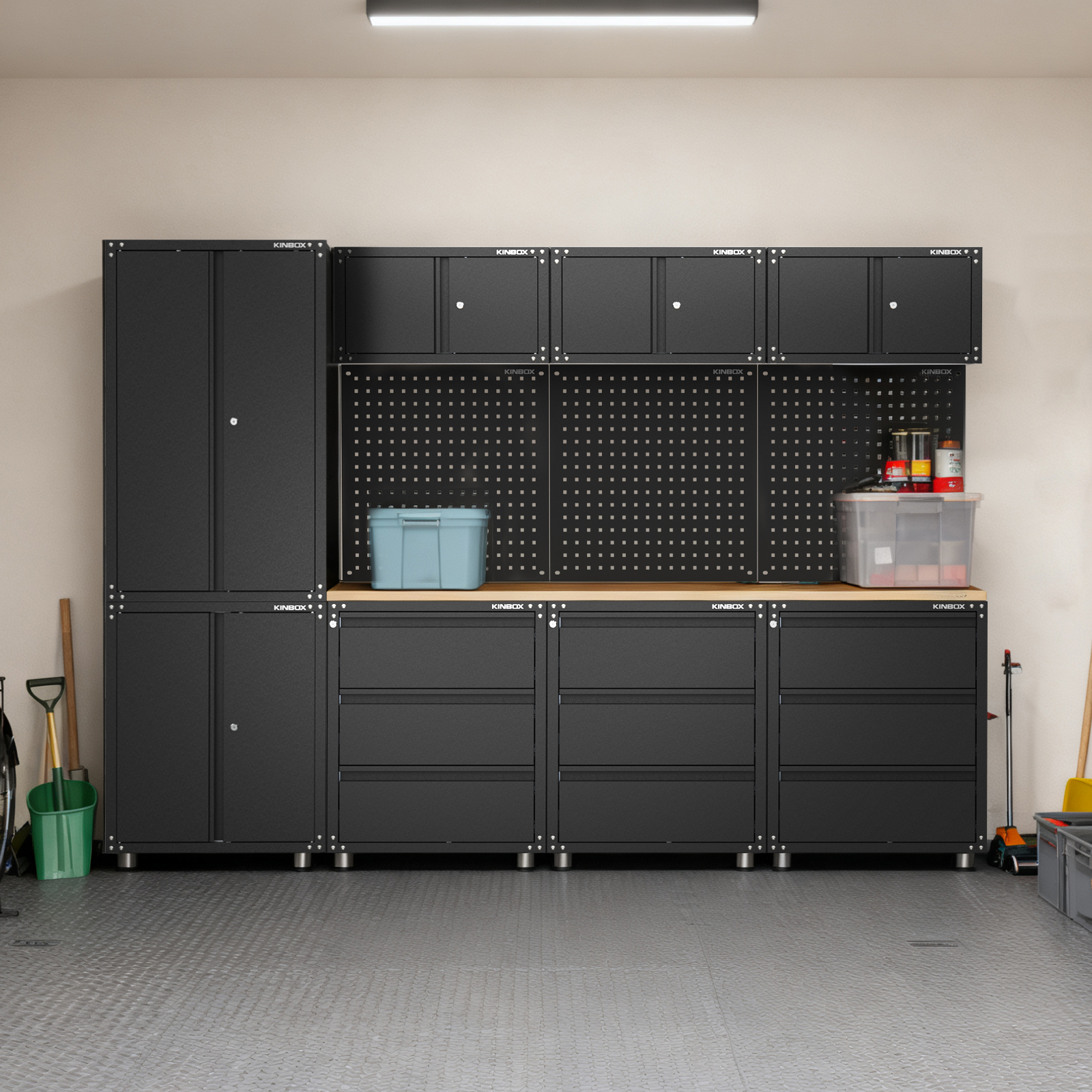
A single cabinet can improve part of a garage. A workbench can improve another part. The best results usually appear when the pieces are planned as one working zone.
The bench gives the user a surface. Base cabinets carry heavier supplies. Wall cabinets hold lighter items. Tall cabinets handle larger categories. A Tool Cabinet organizes hand tools. A garage storage unit solves special storage needs. Together, they create a garage storage system that supports actual work instead of simply filling empty walls.
For a manufacturer such as Kinbox Tools, this is where the product range becomes useful. The workbench, tool cabinet, wall cabinet, base cabinet, garage storage cabinet, and garage storage unit can be planned as one group instead of unrelated items. That is valuable for homeowners, but also for brands and distributors developing a more complete garage storage line.
A matched system looks cleaner. More importantly, it gives every item a better chance of returning to the right place.
In OEM or private-label projects, color and logo matter. They help the product look like part of a brand. Around a workbench, though, the layout should come first.
Cabinet height, worktop material, drawer position, shelf depth, handle style, coating, packaging, and modular combination all affect the final user experience. A good-looking cabinet that does not fit the workbench area is still a weak product.
Customization is more useful when it supports how the garage works. A matching Tool Cabinet beside the bench, wall cabinets above lighter supplies, base cabinets for heavier items, and a tall cabinet at the edge can create a stronger product story than a single cabinet with a different logo.
A garage does not stay organized because the owner is unusually disciplined. It stays organized when the layout makes cleanup simple.
The tools used most often are near the bench. Fasteners have containers. Chargers are close but not on the top. Power tools have enough room. Chemicals and cleaners are separated. Wall cabinets leave working space. Tall cabinets hold larger categories. The Tool Cabinet handles detailed hand tool storage. The floor stays easier to clear.
That is what Garage Storage Cabinets should do around a workbench.
They are not there to surround the bench with furniture. They are there to protect the bench from becoming furniture itself. When the layout works, the user can finish a job, return the tools, close the cabinets, and start the next project without first cleaning yesterday’s mess.
A workbench without storage becomes a pile. Storage without a workbench becomes passive. Together, planned with real habits in mind, they turn the garage into a space where work can actually happen.



