
 English

Views: 0 Author: Site Editor Publish Time: 2026-06-08 Origin: Site


Industrial operations run on a simple reality: you cannot produce high-precision work without high-precision tools. Whether your facility specializes in heavy-duty structural fabrication, high-volume aerospace machining, or complex equipment assembly, the financial investment sitting inside your technicians' hands is staggering. We are talking about calibrated digital torque wrenches, intricate pneumatic drivers, micro-precise micrometer sets, and expensive custom carbide cutting heads. Yet, walk through many large-scale production facilities, and you will spot a massive operational contradiction. Millions of dollars are poured into advanced machinery, while the very tools needed to set up and calibrate those machines are tossed casually onto greasy metal workbenches, piled into unlined drawers, or left exposed to airborne grit and chemical spray.
This careless approach to asset management acts like a slow bleed on an industrial facility's bottom line. When expensive equipment is stored improperly, it doesn't just look messy; it undergoes continuous physical degradation. Dropped tools, nicked cutting edges, contaminated sensors, and cross-contact calibration loss all result directly from poor storage infrastructure. When an operator has to use a damaged or uncalibrated tool, the consequences ripple right through your quality control line, leading to out-of-tolerance parts, wasted materials, and unexpected assembly line downtime. To stop this financial drain, facility managers must look at their storage setups as active protective shielding. Upgrading to an industrial-grade, highly organized tool cabinet system is the most effective way to eliminate mechanical damage, prevent chemical corrosion, and ensure that your technical assets perform flawlessly every time a shift starts.
To build a truly bulletproof asset protection strategy, you have to understand exactly how tools get damaged when they are stored incorrectly on a busy shop floor. The most common culprit is metal-on-metal impact friction. When hand tools and precision gauges are piled loosely inside a generic, unlined drawer, they slam into each other every single time that drawer is rapidly yanked open or slammed shut by a busy operator. Over time, these repeated impacts cause microscopic fractures, dull sharp cutting surfaces, and knock sensitive digital indicators out of calibration. A tool doesn't have to fall from a high shelf to become useless; a few months of sliding around on bare sheet metal can ruin the accuracy of a high-end micrometer just as easily.
Environmental contamination is another massive, silent threat on the factory floor. Industrial facilities are filled with airborne hazards, including fine abrasive metal dust, carbon soot, water-soluble coolant mists, and aggressive chemical cleaners. When tools are left sitting out on open workbenches or stored in loose, poorly sealed utility carts, these airborne contaminants settle deep into moving parts, hinge joints, and digital display screens. Abrasive dust acts like sandpaper inside a tool's internal gears, accelerating mechanical wear, while corrosive moisture traces lead to flash rusting that locks up precision adjustments overnight.
Finally, there is the ongoing issue of human handling errors caused by a lack of organization. When a workstation is disorganized, technicians naturally drop tools on top of one another or misplace specialized components, leading to accidental drops onto hard concrete floors. By introducing a rigid, sealed, and highly organized structural enclosure, you create a dedicated physical barrier that completely insulates your high-value gear from the harsh realities of a busy industrial plant.
You can't count on a cheap residential storage chest to protect your industrial assets. A flimsy consumer box lacks the structural rigidity needed to keep dust out and handle heavy tool loads without warping. True asset protection requires a cabinet built to demanding industrial engineering specifications.
The primary line of defense for your tools is the structural shell of the cabinet itself. In a heavy manufacturing facility, shop furniture is exposed to constant vibrations from stamping presses and overhead cranes, as well as accidental impacts from heavily laden material handling equipment. To ensure your tools remain completely undisturbed, look for a tool cabinet built from heavy-gauge, cold-rolled steel, preferably 14-gauge or 16-gauge for the main load-bearing chassis. The cabinet must feature a double-wall steel design with fully welded seams. This dual-layer architecture ensures that if a forklift or a rolling jack strikes the outside of the unit, the external skin absorbs the physical impact while the internal wall remains perfectly plumb and square. This structural separation prevents the internal drawer tracks from warping, ensuring the drawers continue to glide open smoothly without catching or binding.
To combat the corrosive chemical mists and fine dust floating around an active production floor, the finish on your storage cabinet must be incredibly resilient. Standard liquid spray paint easily scratches and flakes, creating areas where moisture can take hold and cause rust to spread to your tools. True industrial cabinets must feature an advanced, electrostatically applied powder coating that is oven-cured to form a thick, non-porous chemical barrier. This premium finish completely resists scratches and impacts, and it won't break down when exposed to harsh industrial fluids like cutting oils, hydraulic fluids, and strong degreasers. Furthermore, look for cabinets that feature flush-closing drawer fronts and perimeter seals that create a physical barrier against airborne particulates, keeping the interior drawers completely clean and dry even in the grittiest workshop environments.
The mechanical performance of your cabinet's drawers plays a direct role in protecting the tools stored inside them. If a drawer is difficult to operate, jerks when pulled, or sags under weight, the physical jolt can damage delicate instruments every time an operator reaches for a tool.
Friction-based slides have no place in a professional manufacturing environment. Industrial cabinets require precision-engineered, heavy-duty ball-bearing drawer slides that deliver an effortless, fluid glide regardless of how much weight is packed into the unit. For lighter tool sets, a standard slide rating of 100 to 150 pounds is sufficient. However, for deep drawers designed to hold heavy impact guns, iron clamping fixtures, or massive socket blocks, you must specify dual-slide configurations that provide a certified load rating of 200 to 400 pounds per drawer. The slides should also offer absolute full-extension capabilities. This allows the drawer to extend completely past the front frame of the cabinet, ensuring that operators can lift heavy tools straight up out of the back corners without scraping them against the drawer above.
To eliminate metal-on-metal collisions inside the drawers, look for units equipped with advanced soft-closing or self-closing tracks. These systems feature internal hydraulic dampers or spring tensioners that catch the drawer during the last few inches of travel, pulling it shut gently and smoothly to prevent the sudden stop that sends tools sliding into one another. Additionally, ensure the cabinet incorporates a positive latching system or a secure detent mechanism that keeps the drawers firmly closed while in transit. This prevents drawers from drifting open on their own due to floor slopes or heavy plant vibrations, eliminating the risk of a catastrophic tip-over accident.
Investing in a rugged exterior shell is only half the battle; the real work of preventing tool damage happens inside the drawers. If you open a premium steel drawer only to find a chaotic pile of loose tools, your equipment is still at risk. To achieve true asset protection, you must implement a structured, visual organization system rooted in Lean 5S principles.
The gold standard for industrial tool protection is the integration of oil-resistant, high-density EVA or EPS custom foam trays. These inserts feature exact, laser-cut profiles tailored to the precise dimensions of every single wrench, socket, and gauge in your kit. The foam cradles each item securely, eliminating metal-on-metal contact and absorbing shop vibrations that can throw sensitive calibration settings out of alignment. By utilizing a high-contrast dual-color layout—such as a dark gray top layer over a bright yellow base—management can perform an instant visual tool audit in under three seconds. If a tool is missing, the bright yellow cutout stands out immediately, alerting the technician to locate the tool before it gets lost on the assembly line or left inside a machine enclosure.
An efficient, damage-preventing cabinet configuration must feature a diverse mix of drawer depths rather than a uniform layout. Shallow top drawers are ideal for organizing flat hand tools and precision measuring instruments in a single layer, ensuring that no tool is ever buried beneath another. Medium drawers should be reserved for mid-sized hand-held power tools and diagnostic meters. Deep bottom drawers are essential for housing heavy specialty kits and blow-molded cases that would otherwise clutter the top of the work surface. This structured arrangement ensures that delicate tools are never crushed by heavier equipment and allows technicians to group their gear logically by task complexity.

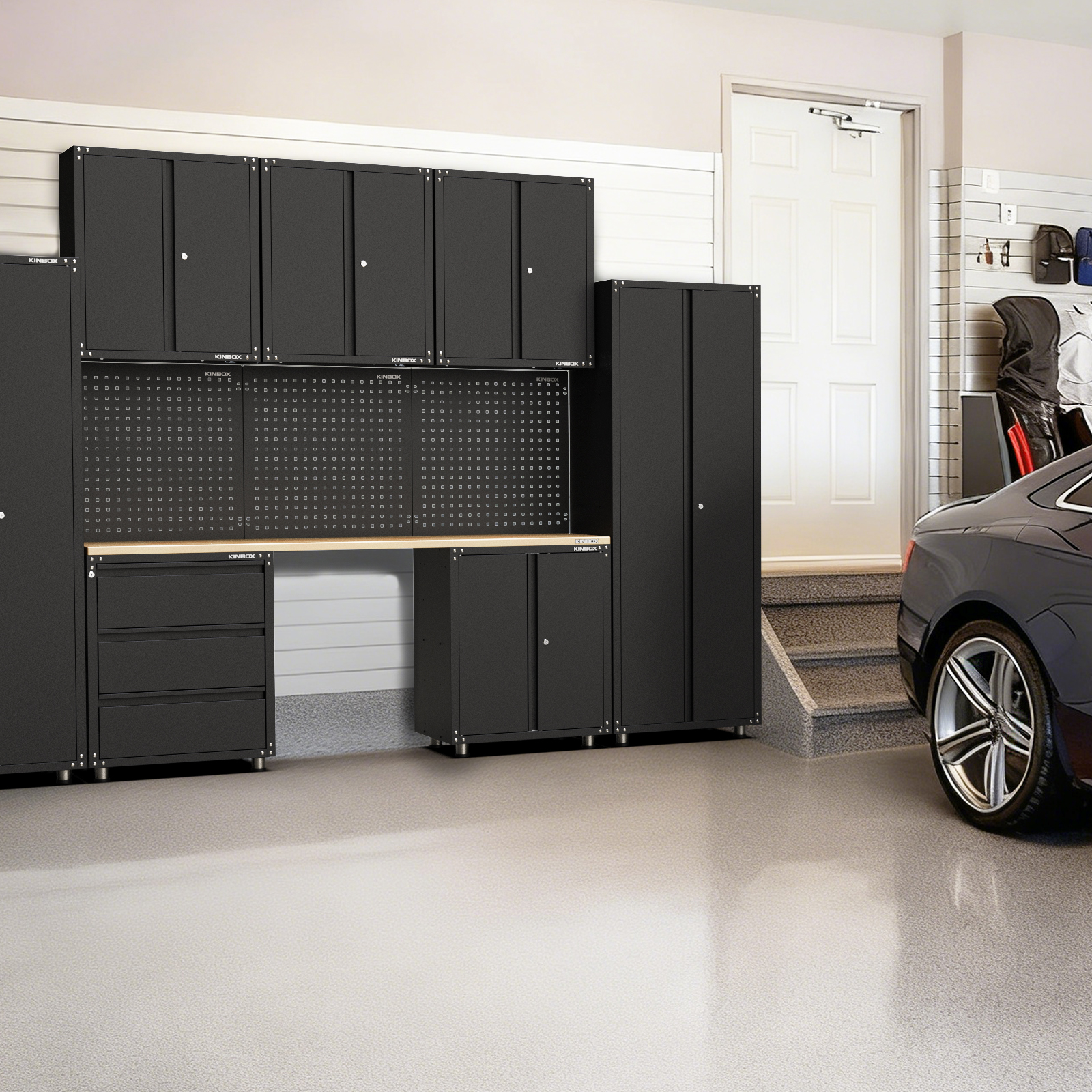
While a mobile tool cabinet serves as a technician's immediate response workstation right at the machine side, high-volume industrial facilities can maximize their asset protection by combining these rolling units with a stationary garage storage cabinet infrastructure along the perimeter walls. This integrated layout allows you to establish a multi-tiered storage strategy that balances point-of-use speed with massive bulk storage protection.
Under this multi-tiered model, the mobile tool cabinet is kept streamlined and light, carrying only the high-frequency hand tools and calibration instruments required for the active shift's specific production run. This keeps the rolling unit agile and easy to position safely within tight work zones, away from moving machinery or forklift paths.
Meanwhile, a comprehensive, modular garage storage cabinet network is anchored securely to the facility's perimeter walls to serve as the master supply depot. These large, permanent wall lockers, upper bins, and heavy-duty stationary workbenches are ideal for protecting low-frequency specialty fixtures, bulk replacement hardware, raw materials, and secondary diagnostic equipment from the harsh environment of the active production floor. By moving these larger, less-utilized assets into a dedicated garage storage cabinet matrix, you clear up critical pathways and reduce the risk of forklift accidents. This separation keeps the immediate work zone free of clutter, eliminates trip hazards, and creates a highly structured manufacturing environment that passes strict safety audits and projects an image of absolute operational precision to visiting clients.
In a massive industrial plant, tool damage isn't just caused by dropped equipment; it also stems from unauthorized or untrained personnel using specialized tools they don't know how to handle. If a line worker grabs a highly sensitive digital torque wrench meant for aerospace assembly and uses it to break loose a rusted bolt on a piece of shop furniture, that tool's calibration is instantly ruined. Controlling access to your technical assets is an absolute necessity for long-term quality control.
While traditional centralized cylinder locks provide a reliable baseline for security, modern high-volume facilities are increasingly upgrading their tool cabinet networks with smart electronic access control systems. These advanced setups replace physical keys with digital electronic keypads, proximity RFID card readers, or biometric fingerprint scanners connected to central asset management software. This allows facility managers to restrict access to specialized calibration gear, ensuring that only certified, trained technicians can open those specific drawers. It also automatically generates a digital audit trail showing exactly who unlocked a cabinet and when, which drastically reduces internal tool loss and ensures employees take care of the equipment they check out.
Because a fully loaded industrial tool cabinet can easily weigh over a thousand pounds, implementing proper safety features is vital for protecting your workforce. A premium cabinet must incorporate an integrated anti-tip interlocking drawer safety system. This internal mechanical guard ensures that the moment one drawer is extended, all other drawers are physically locked shut, completely eliminating the danger of a catastrophic cabinet tip-over if a busy worker tries to open multiple drawers at once. Investing in these rugged safety features protects your personnel, prevents tool damage, and eliminates costly operational downtime, delivering immense long-term value that far outweighs the upfront cost of cheap retail furniture.
Eliminating operational bottlenecks and safeguarding sensitive technical assets requires working with a manufacturing partner who understands the absolute extremes of industrial durability. Ningbo Kinbox Tools Technology Co., Ltd. is a premier global manufacturing leader specializing in advanced sheet metal processing and professional workshop optimization systems. Established in 2013 and operating out of a world-class 50,000 square meter production facility in Ningbo, China, Kinbox designs and builds heavy-duty storage products explicitly engineered to withstand the relentless, multi-shift punishment of high-precision manufacturing and automotive environments worldwide.
Rather than offering generic, light-duty boxes, Kinbox delivers a comprehensive industrial storage ecosystem. Our product line includes ultra-rugged tool cabinet models, mobile tool trolleys, and fully integrated modular garage storage cabinet networks. By combining automated laser cutting and CNC fabrication with strict quality control, load-cycle testing, and advanced powder coating, Kinbox ensures that every drawer slide, safety latch, and lock delivers smooth, reliable performance under the heaviest industrial tool loads. We excel at deep OEM/ODM customization, allowing plant managers and industrial distributors to configure custom drawer depths, secure electronic locking systems, and high-density EVA/EPS custom foam trays tailored to precise tool geometries. Partnering with Kinbox means choosing world-class manufacturing scale and robust supply chain expertise, providing your industrial facility with the unyielding structural foundation needed to prevent tool damage, protect critical technical assets, and drive long-term business profitability.
For demanding industrial facilities, look for a tool cabinet constructed with a frame thickness of 14-gauge to 16-gauge cold-rolled steel. The individual drawer bodies should utilize at least 18-gauge steel. Avoid light-duty 22-gauge or 24-gauge consumer boxes, as they lack the structural strength to hold heavy industrial tools without bending, which can warp the frame and bind the drawer tracks.
Industrial powder coating involves electrostatically applying a dry powder that is baked under intense heat to create a thick, completely non-porous skin over the steel frame. Unlike traditional liquid paint, this specialized finish is highly resistant to impact chipping and will not degrade, blister, or peel when constantly exposed to harsh water-soluble cutting fluids, hydraulic oils, and aggressive shop solvents.
Absolutely. A highly efficient industrial layout utilizes a mobile tool cabinet as a fast-response tactical workstation right at the machine side for high-frequency gear, while relying on a stationary garage storage cabinet system mounted to the perimeter walls to hold bulk hardware, clean rags, and low-frequency specialty equipment, keeping the main floor clear of clutter.
An anti-tip interlocking system is an essential internal mechanical safety feature that permits only one drawer to be opened at a time. Because an industrial cabinet packed with solid steel tools can weigh well over a thousand pounds, opening multiple drawers simultaneously shifts the center of gravity forward rapidly, creating a dangerous tip-over hazard that can crush an operator or damage production machinery.
Custom high-density foam trays feature precise cutouts for every single tool, utilizing a high-contrast dual-color layout. This allows technicians to perform a visual tool audit in under three seconds at the end of a shift; if an empty slot is visible, they know immediately that a tool is missing, preventing a forgotten wrench from causing a catastrophic machine crash during the next production cycle.



