
 English

Views: 0 Author: Site Editor Publish Time: 2026-06-01 Origin: Site


When you are running a high-volume automotive repair shop, the pace of the daily grind is relentless. Vehicles roll in and out of the service bays, flat-rate hours dictate your profit margins, and your technicians are constantly pushing their gear to the absolute limit. In this kind of high-pressure environment, a tool box ceases to be a simple storage box; it becomes an active component of your shop's daily output. Buying a low-grade, residential-tier cabinet for a busy commercial workshop is a recipe for operational disaster. Within months, the drawers stick, the frame warps, and your mechanics lose valuable, billable time fighting with their own equipment.
Choosing the right industrial storage asset requires looking far beyond the exterior dimensions and the color of the paint. You need to analyze the underlying engineering, structural load capacities, and workflow integration capabilities that allow a premium unit to survive decades of heavy-duty commercial abuse. Whether you are equipping a team of seasoned master technicians or upgrading your facility’s shared diagnostic bays, understanding the exact technical specifications that define a true commercial-grade storage setup is essential. Making an informed procurement decision guarantees that your shop floor operates at peak efficiency, protecting both your expensive tool assets and your bottom line.
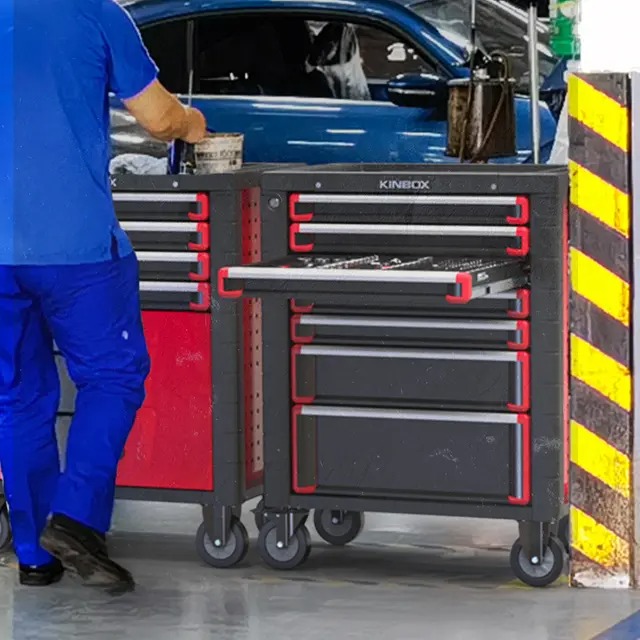
The first thing you must inspect when buying a professional tool cabinet is the underlying structural integrity of the unit. High-volume shops subject their furniture to a level of physical punishment that residential gear never encounters. From the constant vibration of rolling across rough concrete floors to accidental impacts from heavy jacks or car parts, the frame must be built like a tank.
The thickness of the sheet metal used in production is the ultimate indicator of structural longevity. In the manufacturing world, steel thickness is measured in gauges, where a lower number indicates thicker, stronger metal. Cheap, consumer-grade boxes rely on thin 22-gauge or 24-gauge steel that easily bends and flexes under pressure. For a commercial high-volume shop, you should look for a frame built from heavy-duty 16-gauge or 18-gauge cold-rolled steel. Furthermore, top-tier industrial cabinets utilize a double-wall steel design with solid, fully welded joints rather than cheap rivets. This rigid, dual-layer construction ensures that the outer wall can take a hard dent without transferring the force to the inner wall, keeping the drawer tracks perfectly square and functional.
A cabinet might look sturdy when empty, but you need to know how it performs when packed with hundreds of pounds of solid steel wrenches, impact sockets, and pneumatic equipment. Manufacturers rate their units based on two critical metrics: static load capacity (when the cabinet is stationary) and dynamic load capacity (when the cabinet is being rolled across the shop floor). A premium commercial cabinet should easily support a static load of 2,000 to 3,000 pounds. If the manufacturer does not explicitly state these load capacities in their technical specifications, it is highly likely that the unit is not engineered for high-volume commercial service.
The drawers are the most heavily utilized components of any storage cabinet, opened and closed hundreds of times throughout a standard shift. If a drawer sticks, catches, or requires significant physical effort to open when fully loaded, it creates a massive bottleneck in your shop's repair speed.
Friction slides or cheap plastic rollers have absolutely no place in a professional automotive service environment. True commercial units utilize precision-engineered, industrial ball-bearing slides that deliver an effortless, smooth glide even under maximum weight capacity. For standard hand tool drawers containing lighter gear like screwdrivers and pliers, a slide rating of 100 to 150 pounds is typically sufficient. However, for deep bottom drawers designed to hold heavy air impact guns, large socket sets, or blow-molded diagnostic cases, you must insist on units equipped with dual pairs of ball-bearing slides on each side. This heavy-duty configurations bumps the individual drawer load rating up to 200 pounds or more, preventing the tracks from sagging or binding over years of constant service.
When a technician is rolling a heavy cabinet across the shop floor, the last thing they want is for the drawers to suddenly drift open, which can unbalance the unit and cause a catastrophic tip-over. High-quality cabinets feature positive latching mechanisms—often integrated into the drawer handles—that require a deliberate lift or squeeze to open. Alternatively, look for premium self-closing or soft-close ball-bearing tracks that utilize an internal tension system to pull the drawer firmly shut during the last few inches of travel, ensuring the cabinet remains secure while in transit.
A massive tool cabinet is useless if it is poorly organized inside. If your mechanics have to dig through piles of loose tools to find a specific socket, the efficiency gains of buying a premium box are completely lost. High-volume shops require a highly strategic approach to internal layout configuration.
A one-size-fits-all drawer layout simply does not work for a commercial technician. An optimized cabinet setup must offer a versatile, tiered mix of drawer depths to accommodate different categories of tools:
Ultra-Shallow Top Drawers: Perfect for organizing vast collections of wrenches, sockets, ratchets, and extensions in a single, easily scannable layer. This allows a mechanic to grab the exact size they need at a glance.
Medium-Depth Drawers: Designed to hold air tools, torque wrenches, diagnostic meters, and hand-held power tools.
Deep Bottom Drawers: Essential for housing heavy specialty kits, bulk supplies, and large pneumatic jacks that would otherwise clutter the top of the work surface.
To take workflow efficiency to the next level, the internal drawers should be paired with high-density foam tool trays, such as custom-routed EVA or EPS foam inserts. These trays provide a dedicated, perfectly fitted cutout for every single tool in the kit. This layout prevents tools from sliding around and getting scratched when the drawers are opened rapidly, and more importantly, it provides an instant visual inventory. At the end of a complex repair, a technician can look down at their drawer and immediately see if a slot is empty, ensuring that no expensive tools are accidentally left inside a customer's vehicle engine bay.
In the fast-paced, high-energy environment of a commercial vehicle repair shop, workplace safety and asset protection are massive operational priorities. Because a fully loaded industrial cabinet can weigh well over a thousand pounds, implementing proper safety features is non-negotiable.
When a technician is working quickly, they might accidentally pull open multiple heavy drawers at the same time. This action shifts the entire weight of the cabinet forward rapidly, creating a severe danger of the unit tipping forward and crushing the worker or damaging expensive shop equipment. Premium industrial cabinets prevent this workplace hazard by incorporating an integrated anti-tip interlocking drawer system. This mechanical safety guard ensures that the moment one drawer is extended, all other drawers in the cabinet are physically locked shut, keeping the center of gravity perfectly stable.
Mobility is key in a large facility, but flimsy wheels will quickly buckle under commercial loads. A mobile tool cabinet requires industrial-grade, heavy-duty polyurethane or solid rubber castor wheels. Polyurethane castors are highly recommended because they roll smoothly over rough concrete shop floors, resist flat-spotting under long periods of static weight, and are completely impervious to harsh shop chemicals like motor oil, brake cleaner, and diesel fuel. Furthermore, ensure the unit is equipped with a robust dual-locking mechanism that locks both the wheel rotation and the swivel pivot, keeping the cabinet rock-solid and stationary when parked next to a vehicle lift.
Because professional technicians spend thousands of dollars out of pocket to build their personal tool sets, robust security features are essential for maintaining workforce morale. A reliable central locking system featuring heavy-duty cylinder keys or digital electronic keypads is a must-have feature. This central lock secures all drawers with a single action, preventing tool theft during shift changes, protecting corporate diagnostic assets from unauthorized use, and minimizing costly tool shrinkage when the facility is closed for the night.
While a mobile tool cabinet serves as a technician's immediate, tactical workstation right at the vehicle's side, a high-volume shop can drastically scale its efficiency by pairing these rolling units with a stationary garage storage cabinet system along the perimeter walls. This integrated approach allows you to establish a highly effective, tiered storage strategy that maximizes available square footage.
The rolling cabinet handles your high-frequency, daily-use hand tools and impact equipment, moving with the mechanic to wherever the work is happening. Meanwhile, the surrounding garage storage cabinet network serves as the macro-depot for the entire service bay. These large, permanent wall modules, tall lockers, and overhead bins are ideal for organizing low-frequency specialty tools, bulk shop consumables, clean towels, and heavy diagnostic machinery that doesn't need to be rolled to the vehicle lift. By shifting these bulkier items to the perimeter wall storage, you keep the active floor space completely clear of clutter, which drastically reduces dangerous trip-and-fall hazards, protects customer vehicles from accidental scratches, and creates a clean, high-tech environment that instills absolute confidence in your corporate fleet clients.
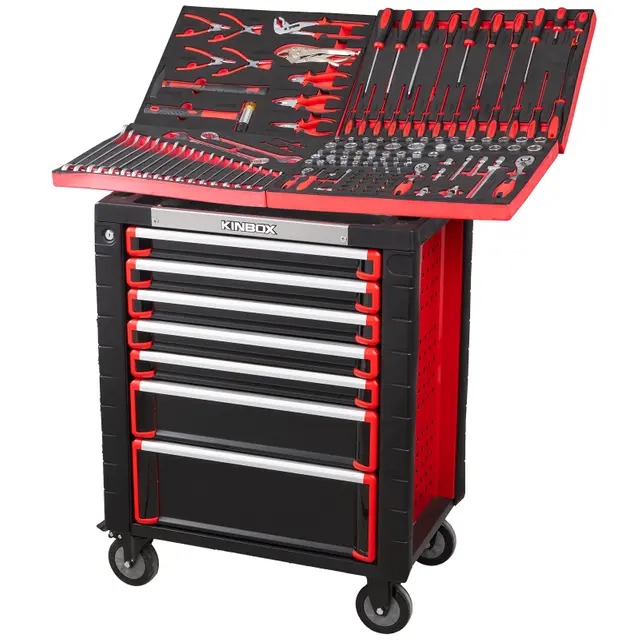
Partnering with an elite manufacturer is paramount when equipping high-volume service centers with reliable storage infrastructure. Ningbo Kinbox Tools Technology Co., Ltd. (established in 2013) operates a state-of-the-art 50,000 square meter factory in Ningbo, China, utilizing automated fabrication and advanced powder coating to deliver premium, industrial-grade storage solutions worldwide. Our robust product ecosystem spans heavy-duty tool cabinets, mobile trolleys, workbenches, and fully modular garage storage cabinet systems. Every unit undergoes rigorous load and cycle testing to guarantee flawless performance under brutal workshop conditions. With flexible OEM/ODM capabilities, Kinbox allows international distributors and fleet buyers to fully customize dimensions, drawer configurations, and high-density EVA/EPS foam tool trays. Choosing Kinbox means secure asset protection, streamlined shop workflows, and an unyielding structural foundation built by a trusted global supply chain leader.
For high-volume commercial shops, you should look for a tool cabinet constructed with a frame thickness of 16-gauge to 18-gauge cold-rolled steel, and drawer panels utilizing 18-gauge to 20-gauge steel. Avoid thin 22-gauge or 24-gauge consumer alternatives, as they lack the structural integrity required to hold heavy industrial tools without warping.
Ball-bearing slides use hardened steel bearings to ensure the drawer rolls open smoothly and effortlessly, even when carrying over 100 pounds of solid metal tools. Friction slides, on the other hand, rely on metal-on-metal rubbing, which will quickly bind, stick, and jam under commercial weight loads, slowing down your mechanics.
Yes, modular systems are highly recommended for growing shops. You can start with a heavy-duty mobile cabinet as your primary tactical workstation and later integrate matching wall lockers, overhead bins, and heavy workbenches from a compatible garage storage cabinet network to maximize your perimeter wall space.
An anti-tip interlocking system is an essential safety guard for heavy cabinets. It physically prevents a technician from opening more than one drawer at a time. This keeps the cabinet's center of gravity stable, eliminating the risk of a dangerous tip-over accident if multiple heavily loaded drawers are extended simultaneously.
Polyurethane casters combine the high load capacity of hard plastic with the smooth, floor-protecting ride of soft rubber. They resist flat-spotting when parked in one place for long periods, roll effortlessly over floor cracks and drains, and are completely impervious to harsh garage chemicals like motor oil and brake fluid.



