
 English

Views: 0 Author: Site Editor Publish Time: 2026-03-23 Origin: Site


Small workshops have a way of filling up faster than you expect. One new drill, one extra box of fasteners, a few backup supplies, and suddenly the room that once felt workable starts to feel tight, messy, and strangely exhausting to use. The issue usually is not that the space is too small in an absolute sense. More often, the problem is that the storage system is not doing enough heavy lifting.
That is where a Garage Storage Cabinet becomes more than just another piece of furniture. In a small workshop, the right cabinet can act as the backbone of the whole layout. It creates structure, reduces visual clutter, protects tools, and gives every category of item a defined home. Once that happens, the room starts working with you instead of against you.
There is also a practical safety side to this. OSHA emphasizes that stored materials must be secured against sliding or collapse, and that storage areas and aisles should be kept clear of hazards such as tripping and fire risks. NIOSH guidance also notes that keeping materials off the floor and organizing storage to reduce awkward lifting can lower strain during manual handling. In other words, better storage is not just about neatness; it supports safer and smoother work.
A small workshop rarely becomes inefficient overnight. Usually, the decline happens in stages. First, tools start living on benches instead of being put away. Then spare parts migrate into corners. Then boxes go under tables, extension cords hang wherever there is room, and frequently used items end up buried behind things you barely touch. Before long, you are walking around obstacles, searching for basic tools, and clearing surfaces every time you want to start a job.
The real problem is not only the lack of square footage. It is the lack of vertical organization and category control. When a workshop does not have dedicated enclosed storage, almost everything ends up exposed, stacked, or temporarily placed somewhere “just for now.” Those temporary spots become permanent surprisingly fast.
That is why the first big improvement in a small shop is often not a new tool or a bigger bench. It is a smarter storage foundation. A well-planned Garage Storage Cabinet gives structure to the room by moving items off open surfaces and into a system that is easier to maintain day after day.
Open shelves have their place, but in a small workshop they can also make the room look busier than it is. Cabinets solve a different problem. They hide visual clutter, protect equipment from dust, and stop small items from spreading across the room. That matters more than many people realize. A workshop can be functional on paper and still feel stressful because every surface looks overloaded.
A cabinet also forces a useful discipline. It naturally encourages grouping by category: measuring tools in one section, cutting accessories in another, safety items in another, and consumables somewhere separate. That kind of organization aligns well with 5S principles, which ASQ summarizes as sort, set in order, shine, standardize, and sustain. The point is not simply to make things look cleaner. It is to make the workplace more efficient, safer, and easier to maintain over time.
In a small workshop, one cabinet can do the work of several scattered storage solutions. It can replace stacked bins, random drawers, and half-used corner shelves. When storage becomes centralized, the room feels calmer, and your workflow usually gets faster without any major renovation.
Not every cabinet improves a small shop. The wrong one can eat up floor area and still fail to hold what you need. The best choice usually comes down to proportion, internal flexibility, and how well the cabinet matches your actual workflow.
In a compact workshop, floor space is precious. That makes tall cabinets especially useful. A vertical Garage Storage Cabinet uses wall height more effectively while preserving walking space and bench clearance. If you can gain storage upward instead of outward, the room immediately feels less crowded.
This also supports safer housekeeping. OSHA requires aisles and passageways to remain clear, and materials must not be stored in ways that create hazards. Keeping storage concentrated against the wall instead of spreading it across the floor helps maintain cleaner access paths.
A workshop rarely stores only one type of item. You may need space for power tools, cases, hardware organizers, spray products, gloves, measuring tools, and odd-shaped accessories all in one place. That is why adjustable shelves matter. Fixed interiors look neat in a brochure, but real workshops change over time.
A practical cabinet often includes a mix of shelving, drawer space, and possibly lockable compartments. That combination lets you separate daily-use tools from backup stock and fragile items from heavy-duty equipment.
A workshop cabinet should be built for work, not just appearance. Load-bearing shelves, strong hinges, durable finishes, and easy-to-clean surfaces matter far more than cosmetic extras. In busy work areas, cabinets get opened constantly, bumped by carts, brushed by tool belts, and exposed to dust. A cabinet that looks sleek but wears out quickly is not an upgrade.
This part gets overlooked a lot. In a tight workshop, the cabinet is not only about what it stores, but also how it opens. Make sure doors do not block major pathways or interfere with nearby benches and machines. A cabinet that technically fits but makes movement awkward is solving one problem by creating another.
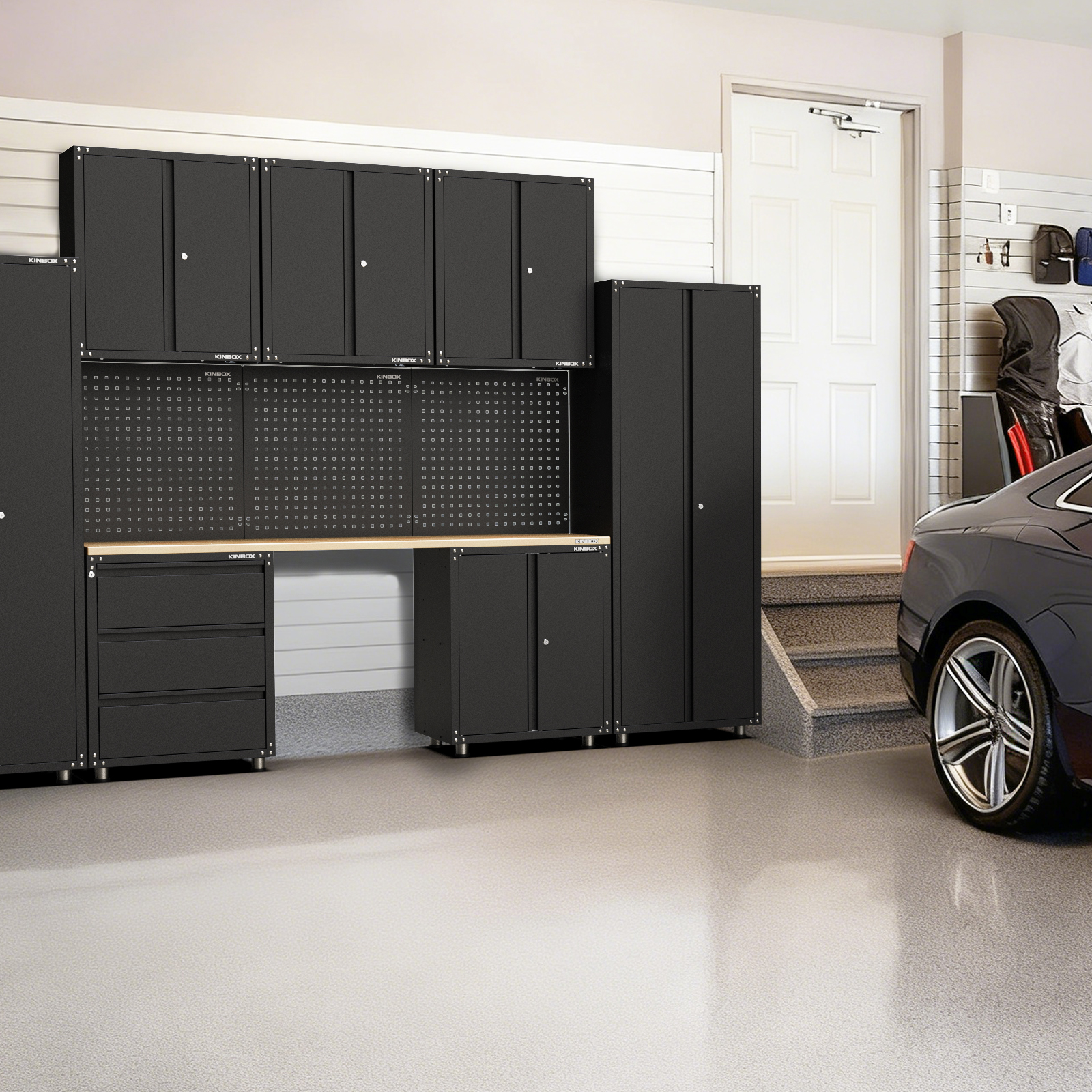
One of the most common mistakes is filling a cabinet based on available space instead of daily routine. A better method is to organize the cabinet around how work actually happens.
Start by asking a simple question: what do you reach for every single day? Those items should live in the easiest-to-access zones, usually between knee and shoulder height. Less frequently used stock can go higher or lower. NIOSH ergonomic guidance recommends reducing lifts from the floor and arranging materials in ways that keep handling within more comfortable zones whenever possible. Heavy items are generally better stored lower to reduce strain and improve stability.
That means your cabinet should have layers of priority.
Use the upper shelves for items you do not need all the time: extra packaging supplies, seasonal equipment, spare PPE, backup adhesives, or rarely used jigs. Keep it light. High shelves are for low-frequency access, not for weight.
This is the money zone. Place measuring tools, hand tools, bits, blades, fasteners, marking tools, and frequently used accessories here. If an item comes out almost every day, it should not require bending, kneeling, or climbing to reach.
Heavier tools, dense material boxes, and large containers belong lower down. This is a common-sense layout choice, but it also aligns with safety guidance that heavy objects should be stored at low levels to make handling easier and reduce the risk of falling items.
Once you arrange the cabinet by workflow instead of by random fit, the workshop becomes easier to use almost immediately.
A cabinet is powerful, but it should not try to do everything. The smartest small workshops combine cabinet storage with a few other elements, each used for a clear purpose.
A Garage Storage Cabinet is ideal for:
power tools and their cases
hand tools that need dust protection
measuring equipment
fasteners and organized parts bins
safety gear
maintenance products
backup supplies
items that look messy when left exposed
But some things are better outside the cabinet or in specialized storage. For example, very long tools, lumber offcuts, clamps, and frequently used bench-top items may be better handled with wall racks, pegboards, or dedicated holders. The cabinet should be your anchor, not your entire system.
There is one more important point here. If your workshop stores flammable liquids such as certain paints, solvents, or fuels, those materials may require approved safety cabinets and handling practices under applicable regulations. A standard utility cabinet is not automatically the right place for every chemical product. OSHA has specific requirements for flammable liquid storage, so it is worth treating that category separately instead of folding it into general tool storage.
People often underestimate how much space is trapped in poor storage habits. A cabinet helps reclaim that wasted space in several ways.
First, it clears horizontal surfaces. Benches are for working, not long-term storage. Once small tools, boxes, and supplies move into the cabinet, your bench becomes usable again. That alone can make the room feel bigger.
Second, it reduces “scatter storage.” Instead of having drill bits in one drawer, screws in a plastic tub, gloves on a shelf, and chargers on a bench corner, you bring those items together into one controlled location. That cuts down on wasted movement and hunting time.
Third, it improves visibility. Oddly enough, closed storage can make it easier to find things, because the cabinet encourages deliberate categorization. Without that structure, items are technically visible but practically lost.
And fourth, it supports routine cleanup. When every item has a defined location, putting things away at the end of a job becomes much easier. OSHA’s housekeeping guidance stresses that storage areas should remain free of materials that create tripping, fire, or other hazards. Good cabinet use makes that standard easier to live with every day, not just when you are doing a full cleanout.
A cabinet helps most when it is part of a layout plan rather than an isolated purchase. Even in a small workshop, a few placement decisions can make a big difference.
People often push storage into the furthest possible corner. That sounds efficient, but it can be annoying in practice. If the cabinet holds daily-use items, place it close enough to your primary workbench that access feels natural. You do not want to cross the room every few minutes just to grab hardware or a measuring tool.
A cabinet only works when it opens easily. Avoid storing carts, scrap material, or temporary boxes in front of it. Clear access matters for speed and safety. OSHA repeatedly stresses clear aisles and hazard-free passageways, and that principle applies just as much in small work environments.
You do not need a color-coded system worthy of a factory unless your inventory is complex. Often, simple labels are enough: “Fasteners,” “Electrical,” “Safety,” “Cutting Accessories,” “Finishing,” and so on. The point is to reduce thinking friction. A good cabinet system should make the correct storage spot obvious.
This also matters for chemical and maintenance products. CDC/NIOSH materials note that inadequate or illegible labeling can create hazards, especially where chemicals are involved. Even in a modest workshop, clearly identified containers and zones help prevent mistakes.
This is where many good storage upgrades quietly fail. The cabinet works beautifully for a month, then slowly becomes a cleaner-looking version of the old clutter problem. The solution is not complicated, but it does require habits.
Start with a short reset routine. At the end of the day or end of the week, return stray items to their assigned sections. Toss packaging, empty boxes, or dead supplies before they accumulate. Review the lowest shelves every so often, because that is where forgotten clutter often hides.
The 5S approach is helpful here again. Sorting removes what does not belong. Setting in order defines locations. Standardizing keeps the logic consistent. Sustaining turns the whole thing into a habit rather than a one-time cleanup event. That is why 5S remains so widely used in organized work environments. It is not about perfection. It is about repeatability.
A good rule is this: if an item has not been used in a year, ask whether it truly deserves prime cabinet space. Small workshops do better when storage is active, not sentimental.
When people talk about workshop storage, they usually focus on space savings. That matters, of course. But the less obvious benefits are often just as valuable.
A cleaner, more structured workshop reduces decision fatigue. You waste less time wondering where something might be. You start jobs faster. Cleanup feels less overwhelming. You are also more likely to maintain your tools properly when they have a protected, consistent storage location. OSHA’s hand and power tool guidance emphasizes regular maintenance and checking tools for damage before use, and organized storage makes those habits easier to support.
There is also a professional side to this. Whether your workshop serves customers, supports production, or is simply your own serious work area, a well-organized environment sends a message. It says the work is controlled, standards matter, and the space is built for efficiency rather than improvisation.
That kind of atmosphere is hard to create when every surface is crowded. A properly chosen Garage Storage Cabinet helps establish it without requiring a major remodel.
Maximizing a small workshop is not really about cramming more things into less space. It is about deciding what deserves space, where it should live, and how the room should support the way you actually work. A quality Garage Storage Cabinet makes that possible by turning scattered storage into a system. It clears benches, protects tools, improves access, and helps maintain a safer, more efficient workspace over the long run. And if you are sourcing cabinets for your business or project, it pays to work with a supplier that understands real workshop needs—strong load-bearing construction, flexible internal layouts, reliable quality control, and customization options that fit different spaces and storage habits. The right product partner does not just sell storage; they help create a workshop that feels more usable from day one.
For most small workshops, a tall and relatively narrow cabinet is the best starting point. It uses vertical wall space efficiently while preserving floor area for movement, benches, and machines. The exact size depends on your tool mix, but in general, height gives you more value than extra width in compact rooms.
Yes. It may not increase the actual square footage, but it can dramatically improve usable space. By moving tools and supplies off benches and floors, a cabinet opens up working surfaces and clears pathways, which makes the workshop feel more spacious and easier to navigate.
Lower shelves are best for heavy and bulky items, such as power tools, dense hardware boxes, and larger supply containers. This improves stability and makes lifting safer and easier. Lighter and less frequently used items should go on the upper shelves instead.
It depends on the item category, but for many small workshops, cabinets offer major advantages. They reduce visible clutter, protect tools from dust, and keep loose items contained. Open shelving still works well for oversized items or materials that need very quick access, so a combination of both is often ideal.
Not always. Some flammable or hazardous products require specialized storage solutions and must be handled according to applicable safety rules. If your workshop uses paints, solvents, fuels, or similar materials, check product labels and local safety requirements before storing them in a standard cabinet.



