
 English

Views: 0 Author: Site Editor Publish Time: 2026-06-05 Origin: Site


In the world of high-volume manufacturing and assembly operations, downtime is the ultimate enemy. Every single second an automated assembly line or a manual production station grinds to a halt, profit margins shrink. Plant managers spend endless hours analyzing overall equipment effectiveness, tweaking lean manufacturing protocols, and tracking supply chains to keep things running smoothly. Yet, one of the most common causes of operational delay is staring everyone right in the face: basic tool transit time. When an assembly line technician or a maintenance engineer has to drop what they are doing, walk clear across a massive factory floor, and sort through a central tool crib just to find a specific torque wrench or a backup Allen key, the facility is bleeding money.
Maximizing throughput is not just about faster conveyor belts; it is about bringing the necessary resources directly to the point of action. This is exactly where integrating a professional mobile tool cabinet into your production line floor plan becomes a major operational win. Instead of forcing your workforce to adapt to a rigid, centralized storage layout, a high-quality mobile workstation shifts the dynamic entirely. It allows your team to establish a highly agile setup where specialized tooling, critical spares, and diagnostic devices travel seamlessly alongside the technician. Minimizing those unnecessary steps across the concrete floor eliminates hidden waste, slashes your mean time to repair, and turns chaotic changeover processes into a highly disciplined, synchronized operation.
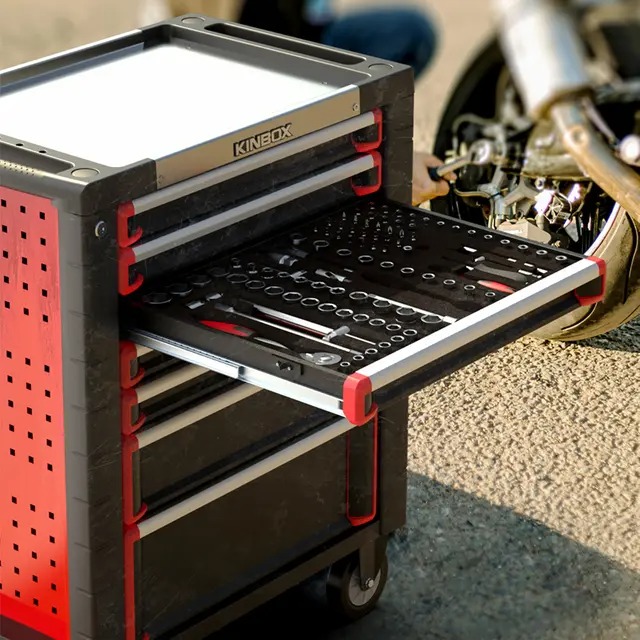
To realize why mobile storage makes such a huge impact on production metrics, you have to look closely at the hidden movement costs built into traditional factory floor designs. Many older facilities operate under a strict, centralized storage model. All hand tools, specialized fixtures, and spare components live in a single, distant tool crib or a massive, stationary perimeter wall setup. On paper, it looks like an easy way to keep track of inventory. In practice, it creates a massive logistical bottleneck.
When a machine on the line goes down due to a simple mechanical failure or a worn-out belt, a technician has to leave the station, walk to the tool crib, wait in line to check out the necessary gear, and walk all the way back. If they arrive back at the machine only to discover they brought the wrong size metric socket, the entire wasteful process starts over again. During this time, the assembly line is completely dead, operators are standing around idle, and scheduled shipment goals are actively slipping away.
Furthermore, forcing employees to carry heavy tools over long distances increases physical fatigue and introduces serious workplace safety risks, such as dropped tool hazards or strained muscles. Centralized storage also leads to a psychological phenomenon where employees start hoarding tools at their individual stations to avoid making the long trek across the plant floor. This unorganized hoarding creates a chaotic, messy work environment where critical corporate assets vanish into thin air, forcing procurement teams to spend money replacing items the company already owns. Transitioning to an agile, point-of-use mobile system fixes these systemic issues, instantly transforming your floor into a lean, highly efficient workspace.
Putting a tool storage unit on wheels sounds simple enough, but a commercial manufacturing floor is an incredibly brutal environment for mobile furniture. Between constant shifts, heavy loads, and rough floor conditions, a standard consumer-grade utility cart will literally fall apart within a matter of weeks. True industrial engineering is required to ensure these mobile assets can take a beating and keep rolling safely day after day.
The absolute most critical failure point on any mobile cabinet is the wheel assembly. Flimsy plastic or low-grade rubber casters will crack, develop permanent flat spots under heavy static loads, or completely lock up when they roll over tiny metal chips, floor drains, or expansions joints. Industrial-grade mobile units must utilize large-diameter polyurethane casters built around a solid cast iron or reinforced steel hub. Polyurethane combines the immense load capacity of hard plastic with the floor-protecting elasticity of rubber. It rolls effortlessly over rough concrete and resists chemical degradation from spilled motor oils, harsh solvents, and synthetic coolants. Additionally, the unit must feature a robust dual-pedal braking mechanism that locks both the wheel's rotation and the swivel pivot simultaneously, ensuring the workstation remains rock-solid and completely stationary once it reaches the production line.
The overall chassis of the cabinet requires a heavy-gauge cold-rolled steel construction to withstand the physical impacts common on a busy production floor. Look for units that feature a double-wall steel design with solid, fully welded joints. This dual-layer architecture creates a built-in shock absorption buffer; if a passing forklift or a heavy motorized pallet jack bumps the side of the cabinet, the outer skin takes the dent while the inner structural wall remains perfectly square. This structural separation prevents the internal drawer tracks from warping or binding, ensuring your technicians can always access their tools in an emergency.
A mobile tool cabinet is only as effective as the engineering behind its drawers. Because assembly line technicians and maintenance teams work under intense time pressure, accessing the correct tool must be an instantaneous, fluid action that requires zero second-guessing or physical straining.
Friction-based drawer slides are a non-starter in an industrial manufacturing plant. Packed with solid steel wrenches, pneumatic impact drivers, and heavy metal fixtures, drawers quickly accumulate hundreds of pounds of static weight. True industrial units utilize precision-engineered ball-bearing slides that deliver a perfectly smooth, effortless glide even when loaded to maximum capacity. For standard hand tool drawers, a slide rating of 100 to 150 pounds is standard. However, for deep bottom drawers housing heavy-duty power tools, diagnostic testing equipment, or heavy iron clamps, you must look for cabinets engineered with dual pairs of ball-bearing tracks on each side, pushing the individual drawer capacity to 200 or 300 pounds without risking slide failure or track separation.
Mobility introduces distinct safety challenges that stationary furniture never has to deal with. When a technician is rapidly maneuvering a thousand-pound tool cabinet around tight corners on a factory floor, centrifugal force can cause heavily loaded drawers to suddenly drift open. This shifts the unit's center of gravity instantly, risking a catastrophic tip-over accident. To eliminate this severe workplace hazard, premium mobile units incorporate an integrated one-drawer-at-a-time interlocking safety system. This internal mechanical guard ensures that the moment one drawer is pulled open, all other drawers are physically locked shut. Furthermore, each drawer should feature a positive latching mechanism—such as a trigger release built right into the handle—that requires a deliberate human hand movement to unlock, keeping the cabinet perfectly stable while in transit.
While a mobile tool cabinet acts as a fast-response tactical workstation right at the assembly line, a large-scale manufacturing plant can achieve peak efficiency by combining these rolling units with a stationary garage storage cabinet infrastructure along the perimeter walls. This multi-tiered logistics strategy allows you to balance point-of-use speed with massive bulk storage capacity.
Under this layout model, the mobile cabinet is streamlined, carrying only the high-frequency tools, calibrated torque instruments, and specific wear parts required for the active shift's production run. This keeps the mobile unit agile, lightweight, and easy to position in tight spaces right next to the assembly workers.
Meanwhile, a comprehensive, modular garage storage cabinet network is anchored securely to the facility's perimeter walls to function as the primary cell depot. These tall lockers, wall-mounted bins, and heavy-duty stationary workbenches are ideal for housing low-frequency specialty tools, bulk safety equipment, clean rags, raw hardware inventory, and secondary diagnostic equipment. By moving these bulkier, less-utilized assets off the active production floor and into a dedicated garage storage cabinet matrix, you clear up critical pathways for automated guided vehicles (AGVs) and manual forklifts. This smart separation keeps the immediate production line completely free of clutter, lowers the risk of accidental product damage, and creates a clean, world-class manufacturing environment that satisfies rigorous internal safety audits and impresses visiting corporate clients.
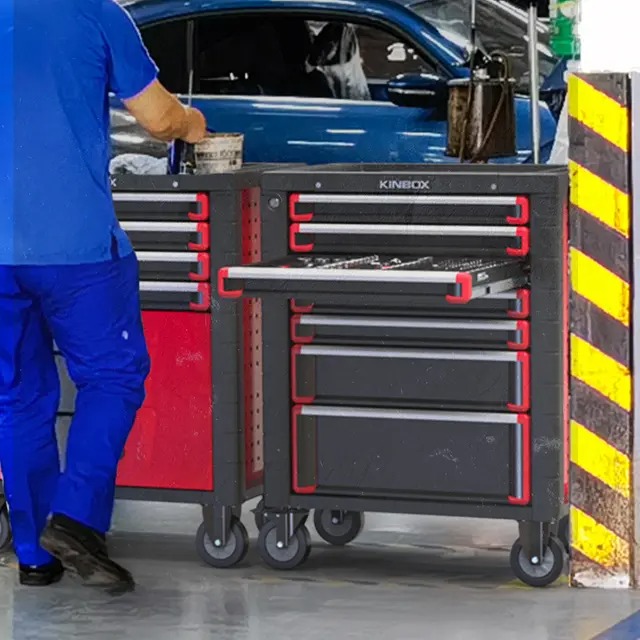
In modern smart factories, tool tracking is no longer just about neatness; it is an active component of quality assurance and regulatory compliance, especially in sectors like aerospace, automotive, and medical device manufacturing. Leaving a rogue wrench inside a complex machine enclosure can cause a catastrophic mechanical crash or lead to massive product recalls.
To maintain absolute tool control, the internal drawers of a mobile tool cabinet should be integrated with high-density, oil-resistant EVA or EPS custom foam trays. These inserts utilize precise, laser-routed cutouts that cradle every single wrench, socket, and driver in a specific orientation. By using a dual-color foam layout (such as a black top layer over a bright red base), an operator can open a drawer and instantly spot if a tool is missing. This visual management approach forms the absolute bedrock of Lean 5S methodologies, allowing for immediate tool inventory audits at shift changes and ensuring no equipment is left behind on the production line.
To further secure valuable corporate assets, many leading manufacturing facilities are moving away from traditional mechanical keys and upgrading their mobile fleets with electronic locking systems. These cabinets utilize digital keypads, RFID proximity card readers, or biometric scanners linked to central asset management software. This advanced setup allows supervisors to control exactly which technicians have permission to access specialized, high-value calibration tools. It also generates an automated digital audit trail showing precisely who unlocked a specific cabinet and when, eliminating internal tool shrinkage, encouraging employee accountability, and streamlining your entire industrial maintenance workflow.
Eliminating operational bottlenecks and protecting high-value industrial assets requires a manufacturing partner who understands the absolute extremes of heavy-duty durability. Ningbo Kinbox Tools Technology Co., Ltd. is a premier global leader specializing in advanced sheet metal processing and industrial workshop optimization systems. Established in 2013 and operating a state-of-the-art 50,000 square meter production facility in Ningbo, China, Kinbox designs and manufactures premium storage solutions engineered specifically to handle the relentless, multi-shift demands of international manufacturing and assembly environments.
Rather than providing generic, flimsy residential storage boxes, Kinbox delivers a comprehensive industrial ecosystem. Our product lineup includes ultra-rugged mobile tool cabinet models, heavy-duty tool trolleys, and fully integrated modular garage storage cabinet networks. By combining automated laser cutting and CNC metal fabrication with strict quality control, load-cycle testing, and advanced powder coating, Kinbox ensures that every drawer slide, safety latch, and lock delivers flawless, reliable performance under the heaviest industrial loads. We excel at deep OEM/ODM customization, allowing plant managers and industrial distributors to configure custom drawer arrangements, advanced electronic locking systems, and high-density EVA/EPS foam trays tailored to precise tool geometries. Partnering with Kinbox means investing in world-class manufacturing capacity and reliable supply chain expertise, providing your business with the unyielding structural foundation needed to minimize production line downtime, protect critical technical assets, and drive long-term manufacturing profitability.
Polyurethane wheels combine the massive weight capacity of hard plastic with the smooth, shock-absorbing qualities of rubber. They resist flat-spotting when parked under heavy loads for long periods, roll effortlessly over concrete seams and metal debris, and are completely unaffected by spilled industrial lubricants, cutting fluids, and harsh solvents.
An anti-tip interlocking system is an essential internal mechanical safety feature that permits only one drawer to be opened at a time. Because an industrial cabinet packed with solid steel tools can weigh well over a thousand pounds, opening multiple drawers simultaneously shifts the center of gravity forward rapidly, creating a dangerous tip-over hazard that can crush an operator or damage production machinery.
Absolutely. A highly efficient lean manufacturing cell utilizes a mobile tool cabinet as a fast-response workstation right at the machine side, while relying on a stationary garage storage cabinet system mounted to the perimeter walls to hold bulk hardware, clean rags, and low-frequency specialty equipment, keeping the main floor clear of clutter.
For high-volume manufacturing environments, look for a mobile cabinet constructed with a main frame thickness of 14-gauge to 16-gauge cold-rolled steel, and internal drawers utilizing 18-gauge steel. Avoid thin 22-gauge or 24-gauge consumer boxes, as they lack the structural strength to handle constant transit and heavy tool weights without warping.
Custom high-density foam trays feature precise cutouts for every single tool, utilizing a high-contrast dual-color layout. This allows technicians to perform a visual tool audit in under three seconds at the end of a shift; if an empty slot is visible, they know immediately that a tool is missing, preventing a forgotten wrench from causing a catastrophic machine crash during the next production cycle.



