
 English

Views: 0 Author: Site Editor Publish Time: 2026-04-17 Origin: Site


Buying an industrial Tool Cabinet sounds straightforward on paper. You need storage, you compare a few sizes, check the price, maybe glance at the drawer count, and place the order. Simple enough. But in real procurement, it rarely stays that simple for long.
The problem is that a Tool Cabinet is one of those products that looks easy to buy until it starts being used every day. That is when the real test begins. Drawers are opened again and again, heavy tools get dropped in without much thought, units are rolled across workshop floors, locks are used by multiple people, and storage needs change faster than expected. A cabinet that looked perfectly fine in a quotation sheet can suddenly feel like the wrong decision within a few months.
That is why procurement mistakes in this category are surprisingly common. Not because buyers are careless, but because industrial tool storage sits right at the intersection of function, durability, workflow, safety, and budget. If even one of those areas is misjudged, the cabinet may still arrive, still look good, and still technically work—but not in the way the end user actually needs.
And to be fair, some procurement issues do not show up immediately. A weak drawer slide may not fail in week one. An underbuilt cabinet frame may not twist until the drawers are fully loaded. A poor layout may not feel inconvenient until technicians are repeatedly searching for tools in the middle of a busy shift. That delayed pain is exactly why buyers need to think ahead.
So instead of focusing only on what to buy, it is often more useful to look at what goes wrong most often. Here are five of the most common mistakes companies make when procuring an industrial Tool Cabinet, along with some practical ways to avoid them.
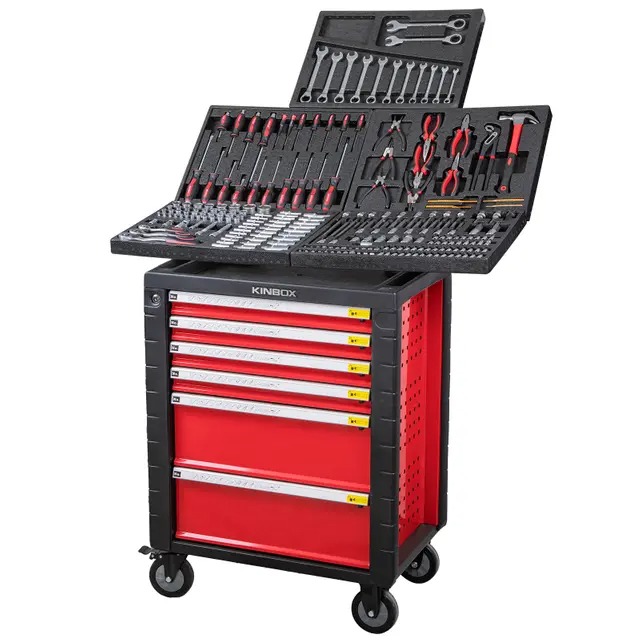
This is probably the most common mistake, and honestly, it is also the most understandable one.
Every buyer has a budget. Procurement teams are expected to control costs, compare suppliers, and justify spending. In that context, it is very tempting to treat a Tool Cabinet like a standard commodity item and go with the lowest acceptable quote. On a spreadsheet, that choice can look perfectly reasonable. In practice, though, the cheapest cabinet often becomes the most expensive one over time.
A cabinet price only tells you what you pay up front. It does not tell you much about the life of the product. Lower-priced units may use thinner steel, lighter-duty slides, weaker caster assemblies, simpler locking systems, or lower-grade finishes. None of those issues necessarily jump out in a product photo. And some suppliers are good at making a cabinet look more robust than it really is.
Once that cabinet is put into an actual industrial environment, the weaknesses begin to show. Drawers stop sliding smoothly under weight. Cabinet bodies wobble more than expected. The finish starts scratching or wearing quickly. Replacement parts are hard to find. In some cases, the cabinet gets replaced much earlier than planned. That is where the “cheap” purchase stops looking cheap.
Instead of looking at price alone, experienced buyers look at overall value. They ask a few extra questions: What is the load rating? What kind of steel is used? Are the drawer slides ball-bearing and full extension? Is the finish suitable for workshop conditions? Can spare parts be supplied later? Those questions usually reveal whether the lower quote is really competitive or just incomplete.
Put simply, the right way to compare industrial Tool Cabinet options is not “Which one costs less today?” It is “Which one will still be performing properly after sustained daily use?” That is a very different question—and often a much more useful one.
This is another classic procurement problem: the cabinet is purchased based on catalog specifications, not on how people actually work.
On paper, two cabinets can look quite similar. They may have the same footprint, the same color, and the same total number of drawers. But from the end user’s point of view, the difference can be huge. One layout may support fast, organized work. The other may create constant frustration.
One of the easiest traps to fall into is assuming that “more drawers” automatically means “better storage.” It does not. What matters is whether the drawer sizes and layout match the tools being stored.
If technicians mainly use hand tools, sockets, pliers, measuring tools, and small parts, then several shallow drawers may be ideal. If they work with larger repair tools, power tools, boxed kits, or bulky spare components, then deeper drawers become much more important. A mixed layout often makes the most sense, but only if somebody actually thinks through the intended use before ordering.
This is where procurement can become disconnected from the workshop floor. A buyer may choose a cabinet because it looks versatile, while the end user ends up struggling to fit standard tools into awkward drawer sizes. Then people start improvising. Tools get stacked instead of organized. Frequently used items are stored in the wrong place. Productivity drops in small but noticeable ways.
Talk to the users before buying. It sounds obvious, but it is skipped more often than it should be. Ask what kinds of tools need to be stored, which items are used most often, whether the cabinet will stay in one location, and whether the setup may need to expand later. Even a short conversation can reveal practical requirements that never appear in a quotation request.
A good Tool Cabinet should not just store tools. It should support the workflow around those tools. That is what turns storage into something genuinely useful.
This is the mistake that tends to show up after the cabinet is installed and fully loaded—usually at the exact moment nobody wants a problem.
Industrial buyers sometimes focus heavily on dimensions and drawer layout but pay too little attention to load capacity. That is risky, because industrial storage is not a decorative category. Cabinets are expected to hold real weight, and often more of it than buyers first assume.
Tools are dense. That is the part people underestimate. A drawer filled with sockets, wrenches, metal parts, or service equipment gets heavy fast. If the cabinet structure is not designed for that kind of repeated load, stress builds quickly. Weak spots usually show up in the drawer slides, the drawer bottoms, the frame, or the caster mounting points on mobile units.
Sometimes the issue is not immediate failure but gradual decline. The drawer still opens, just not smoothly. The cabinet still stands, just not as firmly. The unit still works, but now the user has to deal with sticking drawers, instability, and less confidence in daily use. That sort of slow deterioration is common when the original procurement decision was based more on appearance than on engineering details.
Buyers should look at both overall cabinet load capacity and drawer-by-drawer load ratings. That second number is especially important. A supplier may advertise a cabinet as “heavy-duty,” but unless the drawer capacities are clearly defined, the term does not mean much.
It is also worth asking about steel thickness, reinforcement points, drawer slide type, and whether the cabinet was designed for static storage only or for repeated industrial use. That distinction matters more than some buyers realize. A cabinet that looks solid in a showroom may behave very differently when used hard in a factory, garage, or service environment.
In short, if procurement does not verify structural strength early, the users will end up testing it later—and that is usually the more expensive way to learn.
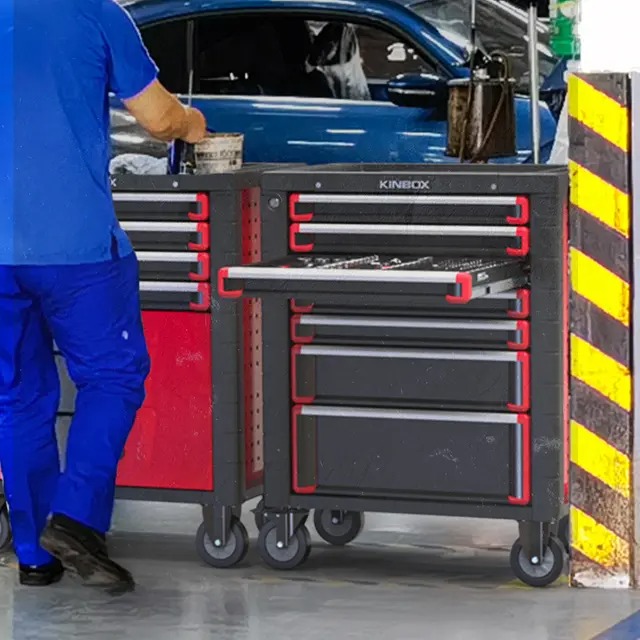
In many purchasing decisions, mobility and safety get pushed down the checklist. Buyers focus first on size, layout, and cost, then assume wheels, brakes, locks, and anti-tip features are just minor add-ons. In industrial environments, that assumption can create real problems.
If a cabinet is going to stay in one fixed location forever, then mobility may not matter much. But if it needs to move across a workshop, along service bays, between workstations, or near production equipment, then mobility becomes a core performance issue.
A mobile Tool Cabinet is only as good as its caster system, balance, and loaded stability. Small or poorly designed wheels can make a fully loaded cabinet difficult to move. Weak brakes may not hold properly on workshop floors. Poor balance can make the unit feel unsafe, especially when drawers are opened while tools are inside.
When buyers overlook safety features, they are not just missing optional extras. They may be increasing daily operational risk. Industrial storage should remain stable, secure, and predictable in use. That includes reliable locking systems, solid wheel brakes on mobile cabinets, stable cabinet construction, and—where relevant—anti-tip mechanisms that reduce the chance of dangerous imbalance.
This is especially important in shared work environments. Cabinets are opened by different people, not all of whom use them carefully. Drawers may be overloaded. Two drawers may be pulled at once. Units may be parked on uneven surfaces. In that kind of real-life use, safety features stop being theoretical very quickly.
Another thing worth mentioning is that poor housekeeping and unstable storage conditions are not just inconvenient; they can become workplace hazards. That is part of why buyers should not separate cabinet selection from broader storage safety thinking. A cabinet needs to support a safer, more orderly workspace, not add risk to it.
Ask very practical questions. Does the cabinet lock securely? Are the brakes reliable under load? Is the cabinet stable when drawers are opened? If it is mobile, what kind of floor is it expected to move across? These are not technical side notes. They are part of whether the product is fit for the job.
This last mistake is sometimes the one that causes the most frustration, because the cabinet can be decent while the buying experience still goes wrong.
Too many procurement decisions focus only on the product specification sheet and not enough on the supplier behind it. That can lead to problems later with communication, replacement parts, repeat orders, quality consistency, and after-sales support.
Industrial procurement is rarely a one-time interaction. Buyers may need follow-up documentation, packaging details, spare parts support, customization, replacement orders, or clarification on technical points. If the supplier is slow to respond, vague with specifications, or inconsistent across orders, the relationship becomes difficult even if the original cabinet looked acceptable.
This matters even more for importers, distributors, and project buyers. In those cases, supplier reliability is often just as important as product reliability. A strong-looking Tool Cabinet does not solve much if the supplier cannot support repeat business or provide dependable communication when issues come up.
Look at how clearly the supplier answers technical questions. Do they provide detailed specifications or mostly broad marketing claims? Can they explain material choices, load ratings, finishes, and configuration options with confidence? Do they have a clear after-sales process? Can they provide spare parts if needed? Do they understand export requirements, packaging standards, or market-specific expectations?
These details are easy to overlook when price pressure is high. But they often determine whether procurement stays smooth after the order is placed. In many cases, buyers do not regret paying a little more for a better-supported supplier. They regret choosing a cheaper one that becomes difficult to work with later.
By this point, the pattern is probably clear: most industrial Tool Cabinet procurement mistakes happen when buyers simplify the decision too much. They reduce it to dimensions and price, when the real decision is broader than that.
A better approach is to treat the cabinet as part of a working system. Think about who will use it, what tools it will hold, how often it will move, what kind of floor or environment it will operate in, how much weight it will carry, and whether the supplier can support the product after delivery. Once buyers look at those questions together, the right option tends to become much easier to identify.
Before placing an order, it helps to check five things: actual user needs, cabinet strength, safety and mobility, finish and durability, and supplier reliability. That framework is not complicated, but it does force the buyer to look beyond surface-level comparisons.
The goal is not simply to buy a cabinet. It is to buy the right cabinet for the intended working environment, at the right quality level, from the right supplier. When procurement is done well, the cabinet becomes one of those products nobody complains about because it just works. That, in industrial settings, is usually a sign that the buying decision was a good one.
The five mistakes above are common not because industrial buyers lack experience, but because Tool Cabinet procurement is easy to underestimate. A cabinet seems simple until it has to perform day after day in a demanding environment. That is when material quality, load capacity, drawer configuration, mobility, safety, and supplier support all start to matter at the same time.
For companies that want to avoid those problems, it makes sense to work with a manufacturer that understands both product performance and long-term customer support. Ningbo Kinbox Tools Technology Co., Ltd. has specialized in iron and sheet metal product processing since 2013 and focuses on products such as tool trolleys, tool cabinets, tool carts, garage storage systems, and workbenches. Based in Cixi, Ningbo, with a modern production facility of approximately 50,000 square meters, Kinbox emphasizes durable construction, practical workstation organization, flexible product solutions, and responsive service including spare parts and customer support. For buyers who care not only about the cabinet itself but also about stable cooperation, that combination can make a meaningful difference.
The biggest mistake is usually choosing based on price alone. A lower upfront cost may look attractive, but if the cabinet lacks strength, durability, or proper support from the supplier, the long-term cost can end up being much higher.
Because storage efficiency depends on whether the drawer sizes match the tools being used. A cabinet with the wrong layout may still hold tools, but it will not support an efficient workflow and can quickly become inconvenient in daily use.
That depends on the work environment. If tools need to move with the technician or between workstations, a mobile cabinet is usually the better choice. If the cabinet will stay in one place, a stationary design may be more suitable.
Look beyond the label. Check the overall load capacity, per-drawer load ratings, steel thickness, drawer slide quality, and caster strength if the unit is mobile. Specific technical data is much more useful than general marketing language.
Because industrial procurement often involves repeat orders, spare parts, technical support, and ongoing communication. A good supplier helps reduce long-term risk, while a weak supplier can create problems even if the original cabinet looks acceptable.



