
 English

Views: 0 Author: Site Editor Publish Time: 2026-06-15 Origin: Site


Humidity is one of the biggest enemies of metal storage equipment. In coastal cities, tropical regions, and even garages exposed to seasonal moisture, rust can quietly damage metal surfaces long before owners notice the first orange stains. For homeowners, mechanics, and industrial users investing in a durable tool cabinet or garage storage cabinet, corrosion resistance is not just a bonus feature anymore—it is essential.
This is where powder coating technology plays an important role. Compared with traditional liquid paint, powder coating offers stronger adhesion, improved durability, and better long-term protection against moisture and chemical exposure. But many buyers still wonder: what actually makes powder coating more resistant to rust? And how does it help garage storage systems survive in humid environments for years?
The answer lies in both chemistry and engineering. From surface preparation to electrostatic application and high-temperature curing, every step of the powder coating process contributes to corrosion resistance. Understanding this process can help buyers choose a storage cabinet that lasts longer, looks better, and performs reliably even in difficult climates.
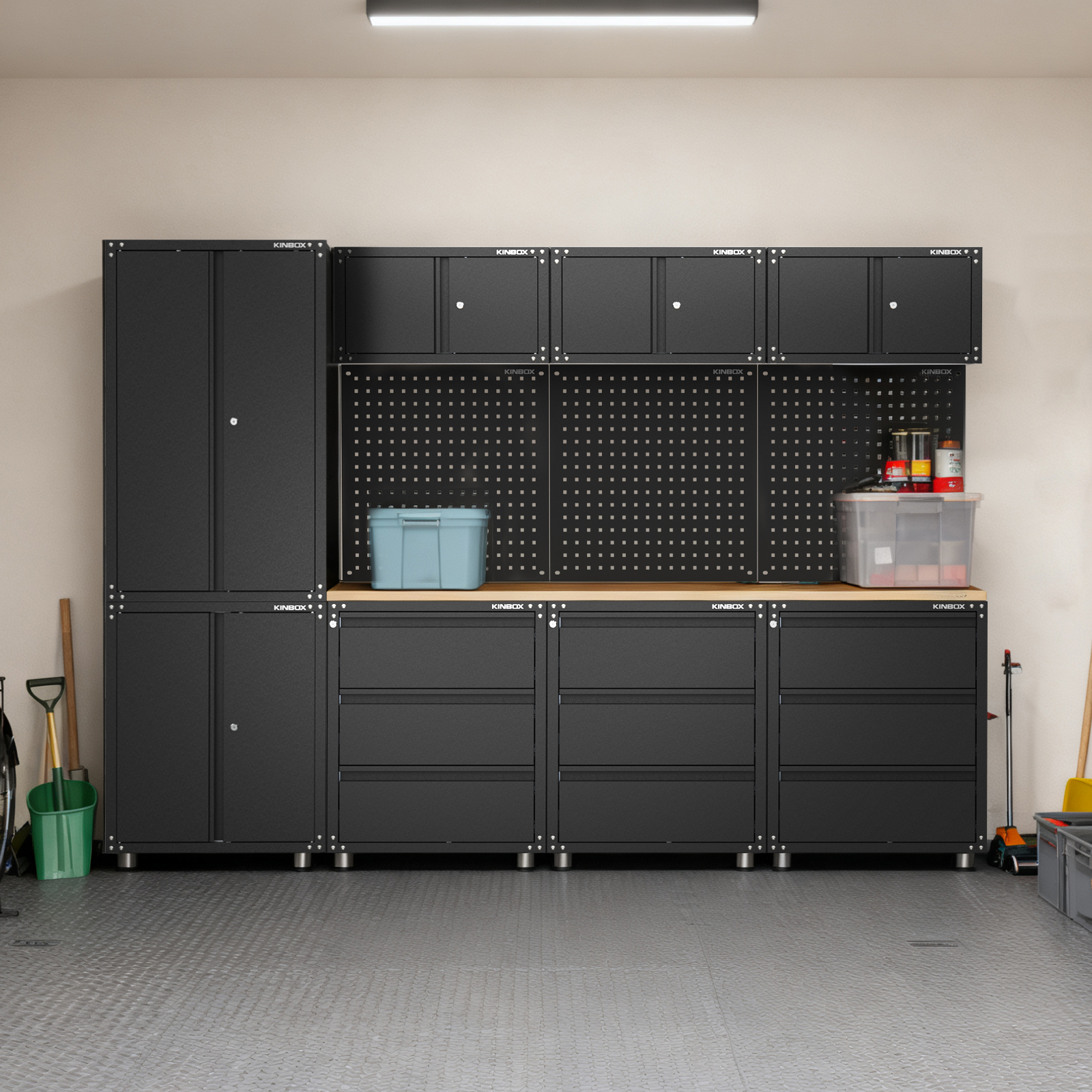
Metal and moisture have never worked well together. When steel is exposed to oxygen and water over time, oxidation begins. That reaction gradually forms rust, weakening the structure and damaging the surface finish.
In garages, humidity problems are often worse than people expect. Even if rain never directly touches the cabinet, moisture in the air can still settle onto metal surfaces. Condensation becomes common when temperatures fluctuate between day and night. Coastal regions add another layer of risk because salt particles in the air accelerate corrosion dramatically.
For a standard garage storage cabinet, rust usually starts in vulnerable areas:
Welded joints
Drawer edges
Corners and seams
Scratched surfaces
Areas with poor paint adhesion
Once corrosion begins underneath ordinary paint, it spreads quietly. Eventually, bubbling, peeling, and structural weakening appear.
This is exactly why high-quality surface treatment matters so much in modern storage systems.
Powder coating is a dry finishing process used to create a durable and protective layer on metal surfaces. Instead of liquid paint containing solvents, powder coating uses finely ground particles made from resin, pigments, and additives.
The powder is sprayed onto metal using an electrostatic process. Because the particles carry an electrical charge, they bond evenly to the grounded metal surface. After application, the coated part is heated inside an industrial curing oven. The powder melts, flows, and chemically cross-links into a hard protective shell.
The final finish becomes:
More resistant to corrosion
Less likely to chip or peel
More uniform in thickness
Better able to resist chemicals and impacts
For manufacturers producing a professional tool cabinet, powder coating has become the industry standard because it combines aesthetics with long-term durability.
Many people assume the coating itself is the only thing preventing rust. In reality, surface preparation is equally important.
Before powder coating begins, metal sheets typically undergo several pretreatment stages:
Degreasing
Cleaning
Phosphating or chemical conversion coating
Drying
These steps remove oil, dirt, oxidation, and contaminants that would otherwise weaken adhesion.
Phosphating is especially important because it creates a microscopic crystalline layer on the steel surface. This layer improves coating adhesion and provides additional corrosion resistance.
Without proper pretreatment, even thick coatings can eventually fail.
Traditional liquid paint can drip, pool, or leave uneven spots. Powder coating behaves differently because of electrostatic attraction.
During application:
Powder particles receive a positive electrical charge
Metal surfaces are grounded
Charged particles wrap around the metal evenly
This process allows better coverage in corners and edges where rust commonly begins.
For a garage storage cabinet used in humid conditions, uniform coating thickness is critical. Thin spots often become the first locations where moisture penetrates.
Once coated, the metal enters a curing oven at temperatures generally between 180°C and 220°C.
At this stage, several things happen:
Powder melts into a continuous film
Resin molecules chemically bond together
The surface hardens into a dense protective layer
This cross-linking reaction is what gives powder coating its famous durability.
The cured surface becomes highly resistant to:
Water penetration
Salt exposure
Chemical cleaners
Abrasion
UV degradation
For workshops and garages where humidity fluctuates constantly, this barrier significantly slows corrosion.
Liquid paint often relies heavily on solvent evaporation. Over time, weak bonding can lead to cracking or peeling.
Powder coating chemically bonds during curing, resulting in much stronger adhesion to steel surfaces.
This matters because moisture usually enters through damaged or separated paint layers first.
Cabinet edges are extremely vulnerable to corrosion. Traditional paint tends to thin out around sharp corners.
Powder coating generally provides more consistent edge coverage, helping protect critical stress points in a tool cabinet.
Garage environments are rough. Tools hit surfaces, drawers slam shut, and heavy equipment causes scratches.
A damaged coating becomes an entry point for rust.
Powder-coated finishes resist chipping and scratching better than many wet-paint systems, helping maintain protection over time.
Powder coating is also considered more environmentally friendly.
Unlike solvent-based paints, powder coatings release minimal volatile organic compounds (VOCs). Oversprayed powder can often be recycled as well.
As environmental regulations continue tightening worldwide, powder coating has become the preferred solution for many industrial manufacturers.
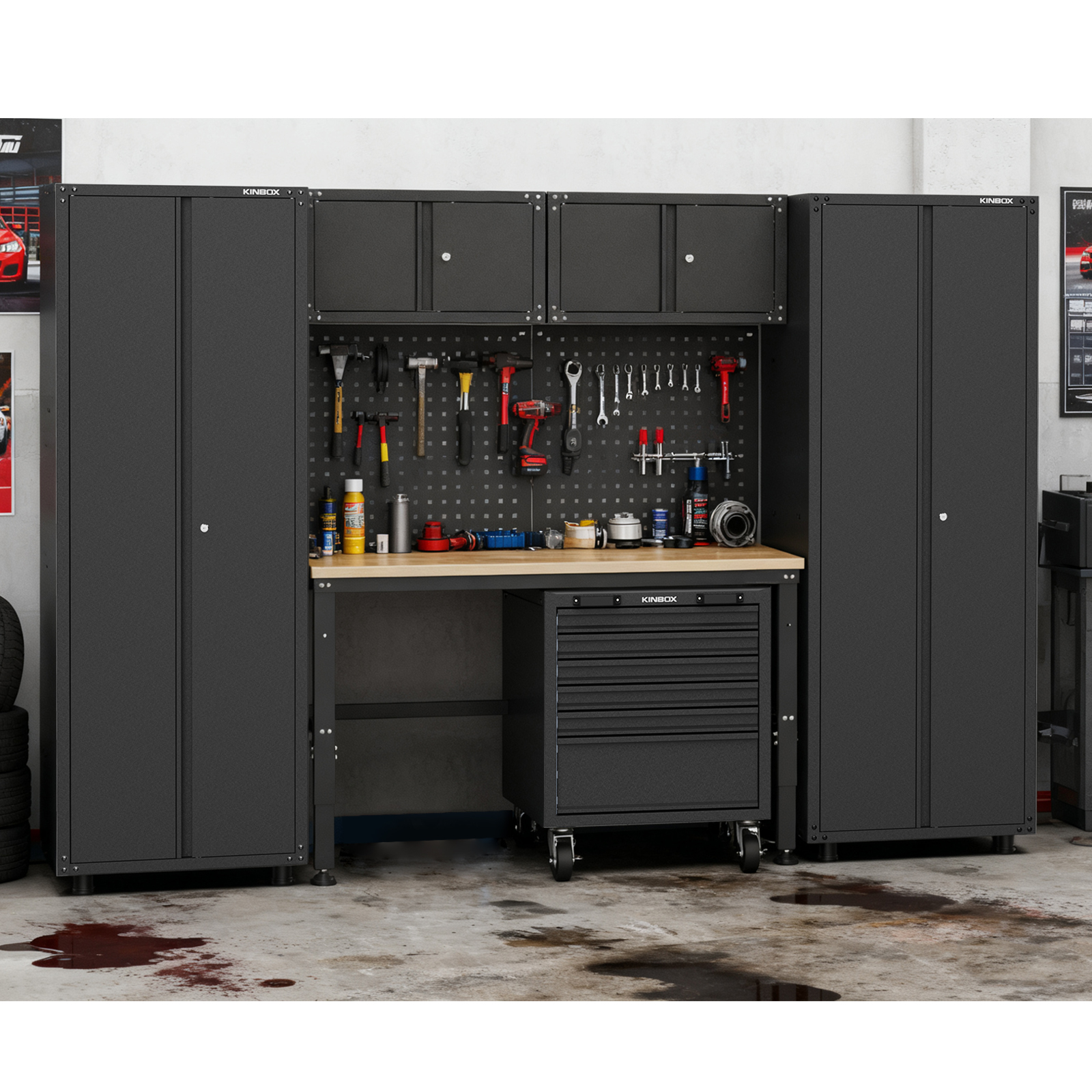
Not all coatings perform equally. Serious manufacturers test their products using standardized corrosion evaluations.
One of the most common methods is salt spray testing.
In this process:
Coated metal samples are placed in a controlled salt fog chamber
Continuous salt mist simulates harsh coastal conditions
Engineers monitor rust formation over time
Higher-quality powder-coated cabinets can survive hundreds of hours without significant corrosion.
Humidity chambers expose cabinets to high moisture and temperature cycles repeatedly.
These tests help manufacturers evaluate:
Adhesion durability
Blister resistance
Coating stability
Long-term moisture protection
For buyers in humid climates, these test results often reveal far more than marketing claims alone.
Not every cabinet advertised as “powder coated” offers the same level of protection. Quality depends on several manufacturing factors.
Even the best coating cannot compensate for weak steel.
A professional-grade tool cabinet should use durable cold-rolled steel with sufficient thickness for structural integrity.
Thicker steel also handles impacts better, reducing coating damage.
Manufacturers using advanced pretreatment systems usually achieve significantly better corrosion resistance.
This is especially important for export markets and coastal regions.
Poor welding can create tiny gaps where moisture accumulates.
Well-finished welds combined with uniform powder coating reduce hidden corrosion risks.
Moisture often collects around moving components.
High-quality cabinets typically include:
Smooth drawer rails
Reinforced hinges
Anti-rust hardware
Consistent internal coating coverage
These details greatly affect long-term durability.
Even though powder coating is highly durable, proper maintenance still helps maximize service life.
Dust, grease, and chemical residue can trap moisture against the surface.
Regular cleaning with mild soap and water helps preserve the coating.
Avoid aggressive solvents unless recommended by the manufacturer.
While powder coating resists impact well, deep scratches exposing bare metal should be repaired promptly.
Touch-up paint or protective sealants can help prevent rust from spreading.
In extremely humid climates, additional humidity control makes a big difference.
Helpful solutions include:
Garage ventilation
Dehumidifiers
Moisture barriers
Proper airflow around cabinets
Even premium storage systems benefit from reduced environmental stress.
Today’s garages are no longer simple parking spaces. Many have become professional workshops, hobby studios, or organized storage areas.
As storage systems evolve, buyers expect more than just basic functionality. They want cabinets that:
Maintain appearance for years
Resist corrosion in harsh conditions
Handle heavy daily use
Require minimal maintenance
Powder coating supports all of these goals simultaneously.
For industrial users, repair shops, and homeowners alike, investing in a high-quality powder-coated garage storage cabinet often reduces long-term replacement costs significantly.
A cabinet that survives ten or fifteen years without major corrosion ultimately delivers far greater value than a cheaper alternative needing early replacement.
Powder coating technology continues improving rapidly.
Modern manufacturers are now developing:
Nano-ceramic pretreatment systems
Ultra-low VOC coatings
Antibacterial finishes
UV-resistant outdoor formulations
Smart curing technologies for energy efficiency
Automation has also improved consistency dramatically. Robotic spray systems can apply coatings with precision difficult to achieve manually.
As industrial standards rise, powder-coated storage systems will likely become even more durable and environmentally sustainable.
A durable coating alone is not enough. Long-term cabinet performance depends on the entire manufacturing process—from steel selection and fabrication to pretreatment, coating application, and quality inspection.
This is why experienced manufacturers continue to stand out in the global market. Companies with advanced sheet metal processing capabilities and modern production facilities can maintain better consistency across every stage of production.
Established in 2013, KINBOX has grown into a professional manufacturer specializing in metal tool storage solutions, including tool trolleys, workbenches, and garage storage cabinet systems. Located in the Cixi industrial area of Ningbo, the company operates a modern workshop covering approximately 50,000 square meters and integrates advanced sheet metal processing technologies with efficient production management. By focusing on product durability, practical workstation organization, and reliable customer support, KINBOX continues serving both domestic and international markets with dependable storage solutions designed for demanding working environments.
Powder coating forms a thicker and more durable protective layer than many traditional liquid paints. It offers stronger adhesion, better moisture resistance, and improved protection against scratches, impacts, and corrosion.
Yes, but high-quality powder coating significantly slows the corrosion process. Rust usually appears only if the coating becomes deeply damaged or if poor surface preparation was used during manufacturing.
Absolutely. Powder-coated cabinets are commonly used in coastal and humid regions because they provide strong resistance against salt air and moisture exposure. Choosing cabinets with proper pretreatment and quality steel is especially important in these environments.
With proper maintenance, powder-coated finishes can last many years. In indoor garage environments, high-quality coatings often remain durable and visually attractive for over a decade.
Regular cleaning, avoiding prolonged moisture buildup, and repairing deep scratches quickly are the best ways to maintain a powder-coated cabinet. Proper garage ventilation also helps extend its lifespan.



