
 English

Views: 0 Author: Site Editor Publish Time: 2026-08-26 Origin: Site


A professional garage is a demanding environment for storage. Tools are heavy, drawers may be opened dozens of times during a working day, and cabinets are exposed to dust, oil, grease, metal parts, and the occasional bump from moving equipment.
This is why the material used for garage storage deserves more attention than it might initially seem to.
Steel is widely used for tool cabinets, workbenches, storage cupboards, and workshop shelving. Once a cabinet is filled with sockets, wrenches, power tools, diagnostic equipment, measuring instruments, and spare parts, the storage unit has to handle considerable weight. It also has to remain usable after years of regular handling.
For a professional workshop, storage is not simply about finding somewhere to put things. The arrangement affects how quickly technicians can find tools, how much floor space remains available, and how easily the work area can be kept in order.
A Garage Storage System can include tool cabinets, workbenches, mobile units, shelving, wall storage, and other components. Steel is often chosen for the main structure because it combines useful load-bearing capability with the durability expected in a working garage.
That said, not every workshop needs the same solution. The amount of available space, type of repair work, number of technicians, tool collection, and plans for future expansion all need to be considered.

Steel has a long history in industrial and workshop equipment. It is capable of supporting substantial loads and can be formed into cabinets, drawers, frames, shelves, and workbench structures.
This makes it particularly suitable for places where storage equipment is going to be used every day rather than occasionally.
Imagine a fully loaded tool cabinet. The upper drawers may contain screwdrivers and pliers, while the deeper drawers hold socket sets, impact tools, pullers, or other heavy equipment. The cabinet is no longer just holding a few items. It is supporting a considerable amount of weight across several levels.
The construction of the cabinet needs to account for that.
A professional repair shop can accumulate a surprisingly large amount of equipment.
There are hand tools, power tools, specialty tools, diagnostic devices, replacement parts, measuring equipment, and consumables. Some items are small enough to fit into a shallow drawer, while others require considerably more room.
Steel provides a suitable structural material for this range of storage requirements.
It can be used for reinforced cabinet frames, heavy-duty drawers, shelves, and workbench supports. The exact load capacity will depend on the product design, so buyers should still check the manufacturer's specifications rather than assuming that every steel cabinet can handle the same weight.
Steel construction is only one part of the equation. The thickness of the material, frame design, drawer slides, joints, reinforcement, and hardware can all affect how a cabinet performs.
You notice poor construction fairly quickly in a busy workshop.
A drawer that sticks when loaded, a cabinet that flexes when several drawers are open, or a workbench that moves when pressure is applied can become an everyday annoyance.
A properly constructed steel frame gives the storage unit a firm base. This is useful when technicians are opening drawers, placing equipment on a work surface, or moving tools between different areas of the workshop.
Professional workshop furniture has to cope with more demanding use than ordinary household storage. That difference should be reflected in the construction.
Steel is popular for more than one reason. Its structural properties make it useful for heavy-duty storage, while the way steel cabinets can be configured gives workshops considerable flexibility.
The actual benefits will depend on the quality of the product and how it is used, but several characteristics are particularly relevant to professional garages.
Garage storage is usually expected to last for years.
A technician may open the same drawer repeatedly throughout the day. Tools are taken out, returned, rearranged, and sometimes placed back in a hurry when the next job is waiting.
Storage equipment also gets cleaned regularly and may come into contact with oil, grease, dust, and other workshop residue.
A well-made steel cabinet is capable of handling this kind of routine use.
Of course, steel does not make a product immune to damage. Poor welding, weak drawer mechanisms, inadequate reinforcement, or an unsuitable surface finish can still cause problems. The quality of the finished cabinet matters just as much as the material itself.
Heavy tools are one of the clearest reasons to consider steel.
A collection of impact sockets, ratchets, wrenches, and power tools can quickly become too heavy for lightweight storage furniture. The cabinet needs to support the contents without making the drawers difficult to operate.
This is where the load rating becomes important.
A cabinet may have a high overall capacity but lower limits for individual drawers. Before buying, it is worth looking at both figures and comparing them with the tools that will actually be stored.
Professional garages are not particularly gentle environments for furniture.
Oil may be wiped from a bench several times a day. Tools can leave scratches and marks. Metal parts may be placed directly onto surfaces, and dust can build up around corners and handles.
A steel cabinet with a suitable protective coating can be cleaned relatively easily and withstand routine contact better than many types of ordinary furniture.
The surface treatment still matters. A steel cabinet should not be judged by the raw material alone. Coating quality, preparation, and manufacturing standards all contribute to how the finished product performs over time.
A workshop can have plenty of storage and still feel disorganized.
The problem is often not the amount of space but the way that space is used. If sockets, screwdrivers, electrical equipment, fasteners, and specialty tools all end up in the same drawer, finding one particular item becomes unnecessarily difficult.
A properly planned Garage Storage System gives different equipment a logical place.
A multi-drawer cabinet makes it possible to divide equipment by type or frequency of use.
Sockets can stay together. Screwdrivers and pliers can occupy another drawer. Electrical testing equipment can have its own section, while larger specialty tools can go into deeper drawers or a separate cabinet.
This arrangement becomes even more useful when several technicians share the same tools.
A mechanic taking a tool from a common cabinet does not have to decide where it should go when the job is finished. There is already an established location.
That sounds like a small detail, but shared workshops rely on this kind of consistency. Without it, tools gradually migrate from one workstation to another and nobody knows where they ended up.
Open shelving has its place in a garage. Large equipment, boxes, and items that need frequent access can be easier to retrieve from shelves.
Small equipment is a different story.
One box gets left behind after a repair. A few tools are placed beside it. Someone adds another container because there is no empty drawer nearby. After a while, the shelf becomes difficult to navigate.
Drawers and enclosed cabinets give equipment a defined location.
Once a job is finished, the tools can be put away instead of remaining on the workbench. That leaves the work surface available for the next repair.
A workbench is not simply another storage cabinet.
It is where technicians inspect parts, disassemble components, assemble equipment, take measurements, and carry out smaller repair tasks. Some of those jobs involve considerable pressure.
The supporting structure therefore needs to remain steady.
Steel is often used for workbench frames because it provides a solid structural base and can be designed to support substantial loads.
A technician working on a component often needs several tools within reach.
A socket may be needed for one step, a screwdriver for the next, followed by a measuring tool or a pair of pliers. If all of these items are stored in a toolbox several meters away, the technician has to keep walking back and forth.
Drawers beneath the work surface provide another option.
Frequently used tools can stay at the workstation, while less common equipment can remain in a larger cabinet elsewhere. The arrangement can be adjusted to suit the type of work performed at that particular bench.
This also helps smaller workshops make better use of limited floor space. A single workbench can provide a solid work surface and a significant amount of enclosed storage.
Some jobs require more force than others.
A technician may need to loosen a stubborn component, press a part into position, or hold an assembly firmly while taking measurements. If the bench shifts every time pressure is applied, the job becomes unnecessarily difficult.
A rigid steel frame can provide the stability required for normal workshop tasks.
The top surface itself does not necessarily need to be steel. Depending on the work being carried out, a different worktop material may be more appropriate. What matters is that the complete structure remains stable and capable of handling the intended workload.
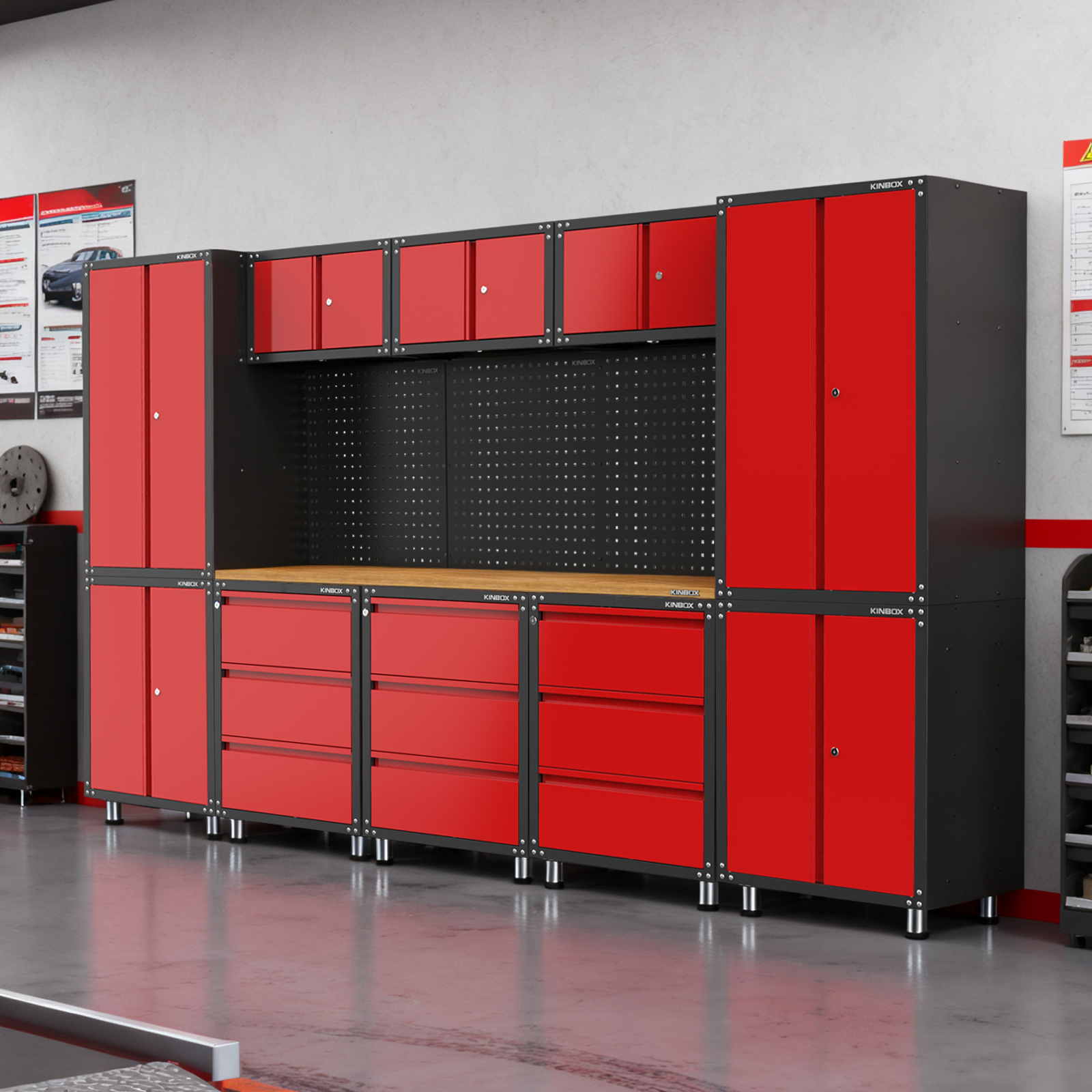
Storage has a direct relationship with the way people move around a garage.
A professional workshop may contain vehicles, lifting equipment, carts, tools, spare parts, electrical devices, fluids, and components at the same time. If these items are left wherever there is room, walking and working areas become increasingly difficult to manage.
Good storage gives the workshop another way to control that situation.
A vehicle bay needs more space than the footprint of the vehicle.
Technicians need to walk around it, open doors, bring tools into position, and move equipment from one location to another. A box or loose tool on the floor may seem harmless when viewed on its own, but several such items can quickly make a busy area harder to navigate.
Tool cabinets, workbenches, shelving, and wall storage can take many of those items off the floor.
The purpose is not to make a workshop look empty. A working garage will always have equipment in use. The point is to keep equipment where it can be accessed without becoming an obstacle.
The location of a heavy tool matters as much as whether there is technically enough room for it.
A large power tool might fit on a high shelf, but lifting it down from above shoulder height is not always convenient. For heavy equipment, a lower drawer or cabinet can make retrieval easier.
The same thinking should be applied to shelves and drawers. Storage should be loaded according to its rated capacity rather than simply filled until there is no space left.
Housekeeping becomes easier when every tool has somewhere to go.
At the end of a repair, technicians can return equipment to the appropriate drawer or cabinet instead of leaving it on the bench. This helps prepare the workstation for the next vehicle.
Storage does not replace workshop safety procedures, but a sensible layout makes those procedures easier to follow.
Professional workshops often have a significant amount of money tied up in tools.
Diagnostic equipment, specialty tools, power tools, and professional hand-tool sets can be expensive. Some equipment is also sensitive enough that leaving it exposed on a busy workbench is not ideal.
A dedicated cabinet or drawer keeps equipment out of the way when it is not required.
That can reduce the chance of a tool being knocked from a work surface or buried beneath other equipment. It also means technicians know where to look when the tool is needed again.
For diagnostic devices and other equipment that needs a little more care, enclosed storage can be particularly useful.
A cabinet will not protect against every possible type of damage, but it can eliminate a lot of unnecessary exposure.
Tools can damage one another if they are simply thrown into the same drawer.
Heavy sockets can knock against smaller tools. Sharp edges can scratch neighboring equipment. Small pieces can disappear underneath larger items.
Dividers and organizers solve some of these problems without requiring additional cabinets.
They also make it easier to see what is actually in the drawer. Instead of searching through a pile of equipment, a technician can identify the required tool more quickly.
Storage affects how technicians move.
A mechanic may spend most of a working day standing, reaching, bending, lifting, and walking around vehicles. If frequently used tools are consistently stored in inconvenient locations, those movements are repeated throughout the day.
A practical storage arrangement reduces some of that unnecessary effort.
Not every tool needs to be stored within arm's reach.
The tools used on nearly every job are the ones that benefit most from nearby storage. Sockets, screwdrivers, pliers, ratchets, and commonly used measuring equipment might stay in drawers beneath a workbench or in a nearby mobile cabinet.
Specialty tools that only come out for certain repairs can be stored elsewhere.
This simple division prevents valuable storage space close to the workstation from being occupied by equipment that rarely gets used.
Small hand tools and heavy equipment should not necessarily be stored at the same height.
Frequently used light tools can be kept in convenient drawers. Heavier items are often easier to handle when stored lower down. Equipment that is rarely needed can occupy less accessible areas.
There is no universal height that works for every workshop. The technician, the equipment, and the type of work all matter.
The useful principle is to arrange storage around actual movements rather than treating every shelf and drawer as interchangeable.
Steel is a strong option for workshop storage, but it does not mean every part of a garage should be made from steel.
Different materials have different strengths.
Plastic is useful for small parts and removable bins. Wood can make a comfortable work surface for certain tasks. Aluminum is attractive when keeping weight down is important.
The right combination depends on the workshop.
Wood can be a good choice for certain workbench surfaces.
It provides a different working feel from metal and can suit assembly, inspection, and general bench work. Some workshops also prefer its appearance.
The main structure is another matter.
A cabinet full of metal tools places considerable stress on its frame and drawers, which is where steel construction can be more appropriate. Wood also needs suitable protection in environments where moisture, oil, grease, and chemicals are regularly present.
There is no need to choose one material for everything. A steel-framed workbench with a suitable wooden top can be a sensible combination.
Plastic bins are particularly convenient for small workshop components.
Bolts, washers, clips, connectors, fuses, and other small parts can be separated into individual containers. A technician can also pick up a bin and carry it directly to the vehicle.
Heavy equipment requires something different.
Large collections of metal tools need a rigid cabinet structure. Steel is generally better suited to the main body of a heavy-duty tool cabinet or workbench.
Using both materials together is often more practical than trying to make one material handle every storage task.
Aluminum is useful where low weight is a priority.
It can be a good choice for cases, portable equipment, and applications where storage needs to be moved frequently.
A fixed workshop cabinet has different requirements. When the unit is expected to carry a large collection of heavy tools, rigidity and load capacity can be more important than reducing the weight of the cabinet itself.
Steel is therefore often the more sensible option for fixed heavy-duty storage.
Two cabinets can both be advertised as steel storage and still perform very differently.
The material is only the starting point. The details of the construction determine how useful the cabinet will be once it is loaded and put into daily service.
Start by considering what will actually go into the cabinet.
A drawer containing screwdrivers and pliers has very different requirements from one filled with impact sockets and power tools.
Look at the total cabinet capacity as well as the rating of individual drawers and shelves. If the cabinet will carry heavy equipment, these figures should be part of the buying decision.
A large cabinet does not automatically have a higher load rating.
Drawers are used constantly in a professional garage.
Check their dimensions, opening mechanism, slides, and stated load capacity. It is also worth considering how stable a drawer remains when it is fully extended.
This matters much more after the cabinet has been filled.
A drawer that feels smooth when empty may behave differently once it contains a large collection of steel tools. For a busy workshop, that difference can become noticeable very quickly.
Mobility is useful when technicians regularly move between work areas.
A mobile cabinet can bring a collection of tools directly to a vehicle rather than requiring repeated trips back to a fixed toolbox.
If most work is carried out at one workstation, however, fixed storage may make more sense.
For mobile units, check the casters and their rated capacity. They need to support the cabinet when it is fully loaded, not just when it is empty.
Not every workshop needs lockable storage.
If the garage has expensive diagnostic equipment or specialty tools, keeping them behind a lock may be worthwhile. In other environments, a standard cabinet may be sufficient.
Security should therefore be considered according to the value of the equipment and the way the workshop operates.
A workshop's tool collection rarely stays unchanged.
New equipment may be added when the business takes on different types of work. Existing tools may also be replaced with larger or more specialized versions.
A cabinet that is completely full on installation day leaves little room for this.
Where space allows, spare capacity is useful. Modular storage can also make future expansion easier because another cabinet or workbench can be added without redesigning the entire workshop.
For a professional workshop, storage is something technicians interact with every working day.
Its value is not necessarily obvious as a single dramatic improvement. Instead, it shows up in routine situations.
A technician opens a drawer and finds the required socket immediately. A diagnostic device has a designated location. A workbench remains available because tools are not permanently sitting on it. A heavy piece of equipment does not have to be moved from one temporary location to another.
None of these things takes much time on its own.
The problem is that poor storage creates the opposite experience repeatedly. Tools get misplaced. Work surfaces become crowded. Equipment is moved around to make room for another repair. Technicians spend time looking for things that should have been easy to find.
Across hundreds or thousands of repair jobs, those small delays add up.
That is why workshop storage is better considered part of the working infrastructure rather than simply another piece of furniture.
The most expensive storage setup is not necessarily the best one.
Start with the workshop's actual working pattern.
Look at which tools are used every day, which equipment needs to remain near a particular workstation, and which items can be kept further away. Also consider where technicians walk, where vehicles are positioned, and which areas need to remain clear.
A combination of storage products will often work better than one oversized cabinet.
A workbench with drawers can handle everyday tools while providing a dedicated surface for repair work. A tall cabinet can accommodate equipment that does not need constant access. Wall storage can make use of vertical space, while a mobile tool cabinet can follow technicians between work bays.
Small parts may be easier to manage in labeled plastic bins placed inside steel drawers or cabinets.
The important thing is that each part of the system has a clear job.
A cabinet should make tools easier to locate. A workbench should provide a dependable working surface. Shelving should be used for items that are suitable for open storage. Mobile storage should be used where moving tools genuinely saves time.
When the different elements are selected according to how the workshop operates, the result is a Garage Storage System that feels like part of the workspace rather than a group of unrelated storage products.
For professional workshops, Kinbox Tools provides steel tool cabinets, workbenches, garage storage equipment, and related workshop storage solutions. The focus is on storage that can be incorporated into real working environments, where tools are used frequently and available space needs to be used carefully. Whether a repair shop is setting up a new workspace or replacing older cabinets, Kinbox Tools provides different storage configurations that can be considered according to the workshop's equipment, layout, and daily requirements. Choosing storage around the way technicians actually work can make the finished workshop easier to manage and more practical to use.
A garage tool cabinet has to carry a lot of weight. Once it is filled with sockets, wrenches, power tools and other metal equipment, the cabinet is under constant load. Steel is a practical choice because it can provide the rigidity needed for this type of storage.
Start with the tools that will actually go inside it. Check the drawer sizes and load ratings, then look at the slides and the overall construction. If the cabinet is going to be moved around the workshop, the wheels and their rated capacity also deserve attention.
It can be. Leaving diagnostic equipment and specialty tools on a bench exposes them to knocks, dirt, and general workshop activity. Putting them away after use keeps the equipment in one place and leaves the bench available for the next job. A lock is worth considering if the tools are particularly valuable.
Not necessarily instead of them. Plastic bins are handy for small items that are easy to lose, such as clips, bolts, connectors, and other parts. Steel cabinets are more useful for heavier equipment. In a busy workshop, plastic organizers can simply be used inside the steel storage.
It is better not to plan the cabinet around today's tool collection alone. Workshops often add equipment as the business takes on new jobs. Leaving some unused drawer or shelf capacity gives you room to add tools later without having to reorganize the entire storage area.



