
 English

Views: 0 Author: Site Editor Publish Time: 2026-06-24 Origin: Site


A mechanic does not judge a tool cabinet the way a catalog does.
The catalog looks at the number of drawers, the color, the cabinet size, and maybe the caster diameter. A mechanic looks at something else: how quickly the right socket can be found when the car is already on the lift, whether the torque wrench has a safe place to sit, whether the bottom drawer can take heavier tools without feeling tired, and whether the cabinet still works smoothly after a long day of opening and closing.
That is why the best Tool Cabinet layout for mechanics is not simply the largest cabinet or the one with the most drawers. It is the layout that follows the way mechanics actually move.
In an automotive workshop, tools are used in patterns. Some tools are touched every hour. Some are needed only for specific jobs. Some are expensive and should not be thrown into a general drawer. Some are heavy enough that storing them in the wrong place makes the whole cabinet harder to use. A good layout respects those patterns.
For buyers, distributors, and tool brands, this is where a tool cabinet becomes more than a steel storage product. The internal layout can decide whether the cabinet feels professional or just looks professional.
A common error is to start with the outside dimensions. Width, depth, and height matter, but they do not tell the full story. A wide cabinet with a poor drawer arrangement can still slow a mechanic down. A smaller Tool Cabinet with the right layout can sometimes feel more efficient because every drawer has a clear job.
The center of the cabinet is the working zone. Drawers around waist to chest height are usually the most valuable because they can be reached without bending or stretching. This area should be reserved for tools used most often: sockets, ratchets, wrenches, screwdrivers, pliers, hex keys, small measuring tools, and daily hand tools.
Heavy tools should not sit in the top drawers. A loaded top drawer can make the cabinet feel less stable, especially on a mobile roller cabinet. The lower section should handle heavier items such as power tools, pullers, hammers, larger socket sets, parts boxes, and specialty tools.
A good mechanic’s cabinet usually follows a simple physical logic: frequent tools near the hands, heavy tools near the floor, delicate tools away from rough storage, and job-specific tools grouped together.
The top drawer is often the most abused part of a Tool Cabinet. It is easy to reach, so everything gets thrown into it: loose screws, spare bits, tape, blades, adapters, old receipts, broken clips, and tools that never made it back to their proper place.
That drawer can ruin the whole cabinet.
For mechanics, the top section should be controlled. It is better used for precision tools, smaller hand tools, commonly used sockets, or tools that need quick visual access. If the cabinet includes a worktop, the upper drawers become even more important because they sit directly below the working surface.
Foam trays can help here. Kinbox Tools offers tool storage products with foam tray options such as EVA, EPS, BMC, and blow molding trays. For a mechanic’s cabinet, foam trays are not only for appearance. They stop small tools from drifting across the drawer, make missing tools easier to notice, and give the cabinet a cleaner daily rhythm.
A drawer with fitted foam does something very practical: it tells the user where the tool belongs without needing a label.

Socket storage deserves its own thinking. Mechanics use sockets constantly, and small changes in layout can either save time or create irritation.
A shallow drawer near the top or upper-middle section usually works best for sockets and ratchets. The drawer should open fully enough for the back row to be visible. If a drawer only opens partway, the sockets at the rear become second-class storage. They are still there, but the mechanic uses them less because access is slower.
Ball bearing slides and full-extension drawer movement matter a lot in this area. A drawer full of sockets is heavier than it looks, and it is opened repeatedly throughout the day. If the slide feels rough under load, the cabinet will feel cheap no matter how good the paint looks.
Kinbox’s tool cabinet and roller cabinet products include practical features such as ball bearing slides, full-extension or fully extractable drawers, central locking systems, and steel cabinet structures. These details are especially relevant for mechanics because drawers are not opened occasionally. They are part of the work cycle.
A mechanic’s socket collection rarely stays the same. New sizes, specialty sockets, impact sockets, adapters, extensions, and bit sockets are added over time. If the drawer is designed too tightly, the layout looks clean on the first day and becomes messy later.
For a professional Tool Cabinet, the socket drawer should allow some empty space. That space is not wasted. It is future capacity.
A buyer planning an OEM cabinet with a tool set should think about this carefully. A foam tray that uses every centimeter may look impressive in a sales photo, but the end user may prefer a layout that leaves room for extra tools. Good tool storage is not only about holding the first set. It should also let the mechanic keep using the cabinet after the tool collection changes.
Hand tools are often grouped together in catalogs, but mechanics use them differently.
Wrenches need length. Screwdrivers need visibility. Pliers need separation because their shapes do not stack neatly. If all of these tools are thrown into one wide drawer, the cabinet may technically hold them, but it does not organize them.
A better layout gives each category its own space. Wrenches can sit in a shallow or medium drawer with foam or racks. Screwdrivers work well when arranged by length and type. Pliers are easier to manage when they are stored upright in a rack or placed in shaped foam.
The goal is not to make the drawer look perfect. The goal is to make the drawer easy to reset at the end of a job. If returning the tool is easy, the cabinet stays organized. If returning the tool requires thinking, the workbench becomes the storage area.
In a busy workshop, a mechanic may not have time to search through three drawers for a missing wrench. A clear layout helps with visual checking. At the end of the day, a missing tool should be obvious.
This is another reason foam trays are useful in professional tool cabinets. The empty shape tells the user what is missing. For automotive workshops, fleet maintenance teams, and racing garages, this can reduce tool loss and improve daily tool control.
For tool brands and distributors, this also creates a stronger product story. A Tool Cabinet with a planned hand tool layout is easier to sell than a cabinet that simply offers empty drawers.
Lower drawers are often where a cabinet proves whether it was designed properly. This is where users store heavier tools, larger kits, and items that do not belong in shallow upper drawers.
Power tools, torque multipliers, pullers, hammer sets, pry bars, large socket cases, drill accessories, and parts organizers all tend to move downward in a mechanic’s cabinet. That is the right direction. Heavy items stored low make the cabinet feel more stable and reduce strain when drawers are opened.
But lower drawers must be built for it. A deep drawer with weak slides is worse than no deep drawer at all. It invites users to load the drawer heavily, then fails in daily use.
A cabinet with too many deep drawers can become inefficient. Deep storage is useful, but it can also become cluttered if the drawer has no internal organization. For mechanics, two or three well-placed deeper drawers are often more practical than a whole lower section of oversized storage.
A good lower-drawer layout might separate power tools from mechanical pullers, and parts boxes from impact accessories. The heavier the drawer, the more important slide quality, frame accuracy, and handle strength become.
This is where sheet metal processing matters. A Tool Cabinet is not just a set of drawers. The cabinet body has to keep its shape while loaded. Kinbox Tools positions itself as a manufacturer focused on iron and sheet metal product processing, with product lines covering tool cabinets, tool carts, tool trolleys, garage storage cabinets, garage storage systems, and workbenches. For B2B buyers, that manufacturing background matters because drawer layout only works if the cabinet structure can support it.
A cabinet that stays against the wall can be arranged differently from a roller cabinet that follows the mechanic around the shop.
For a fixed cabinet, the layout can focus on storage capacity and integration with a workbench or garage storage system. For a mobile Tool Cabinet, the layout has to consider movement. Heavy tools should stay low. Drawers should not open accidentally. The side handle should feel secure. Casters should remain stable when the cabinet turns.
A mobile cabinet also benefits from a cleaner upper layout. If the top area becomes a pile of loose tools and parts, those items may shift when the cabinet is moved. In a garage or repair shop, that creates noise, frustration, and sometimes damage.
Many buyers treat casters and drawers as separate specifications. In real use, they work together.
When a loaded cabinet moves across a floor joint, the vibration travels through the frame and into the drawers. If the drawer slides are loose or the latch system is weak, the cabinet rattles. If the caster base is unstable, the user feels the whole cabinet shift. This is why a mobile mechanic’s cabinet needs a layout that respects weight distribution.
A tall roller cabinet with overloaded top drawers can feel unsafe. A cabinet with heavy lower drawers and lighter upper drawers feels more controlled. The layout is not only about organization. It is also about balance.
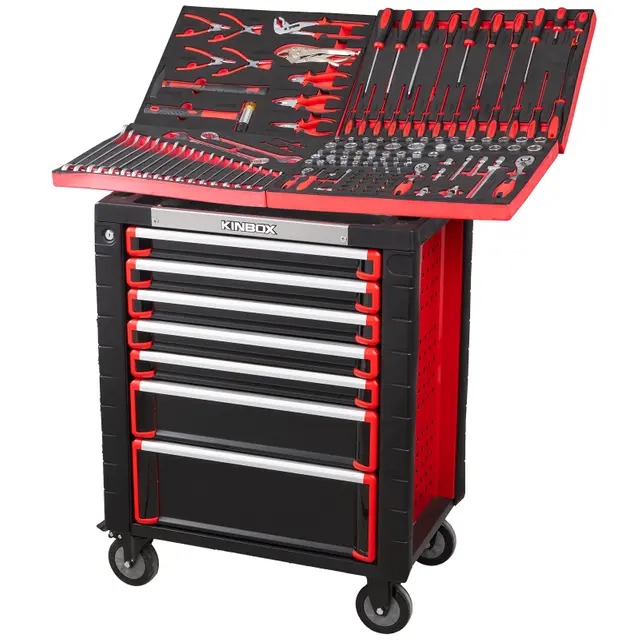
A Tool Cabinet with a worktop often becomes a small workbench. Mechanics place parts on it, compare fasteners, lay out tools, write notes, clean small components, or prepare for the next step of a job.
That means the top surface should not be treated as decoration. If the cabinet has a wood worktop, steel top, stainless-style surface, or rubber mat, the choice should match the work environment. A mechanic may need a surface that can handle tools, small parts, oil exposure, and daily cleaning.
The drawers under the worktop should support what happens above it. If the top is used for quick mechanical work, the nearest drawers should hold the tools used in those moments: ratchets, sockets, wrenches, screwdrivers, measuring tools, and consumables.
A cabinet becomes more efficient when the worktop and drawer layout are planned together.
A messy worktop is usually a sign that the cabinet layout is not working. If frequently used tools have no convenient home, they stay on the surface. If small parts have no drawer or tray, they spread across the top. If power tool accessories are stored too far away, they end up sitting wherever the mechanic last used them.
The best layout makes it easy to clear the worktop. That may sound simple, but it changes how the whole workspace feels.
Once a mechanic’s cabinet is properly arranged, the tools inside become easier to control. That makes locking systems more important, not less.
A lockable cabinet protects valuable tools, but it also helps maintain responsibility in shared workshops. If tools have fixed places and the cabinet can be secured at the end of the day, missing items become easier to identify.
For a professional Tool Cabinet, the lock should not feel like an afterthought. It should work smoothly with the drawer system. If the cabinet has central locking or a drawer blocking system, the user should not have to fight the mechanism during normal work.
Kinbox tool storage products include central lock and self-lock features on different models. For mechanics, these details are not only about security. They affect how confidently the cabinet can be used in a shared or mobile workshop environment.
Not every mechanic works the same way. A general repair shop, a motorcycle service shop, a racing team, a dealership, a fleet maintenance department, and a home garage all use tools differently. A cabinet layout that works for one market may not be ideal for another.
This is where OEM planning becomes valuable.
Kinbox supports OEM orders, logo customization, and featured design. For tool brands and distributors, that means the Tool Cabinet layout can be adjusted around the target user instead of relying only on a standard model.
A cabinet sold to professional mechanics may need stronger slides, full-extension drawers, organized foam trays, heavier casters, and more secure locking. A cabinet for home garage users may focus more on appearance, easy assembly, general storage, and matching garage storage cabinets. A cabinet sold with a complete hand tool set should be designed around the tool configuration from the start.
For wholesale and private-label buyers, layout decisions should be made before the final quotation. Drawer height, foam tray depth, caster configuration, worktop material, surface finish, packaging, and branding all affect the final product.
A cabinet that looks good but does not fit the target user will be harder to sell again.
A good mechanic’s cabinet does not need to impress the user every time it opens. It needs to disappear into the work.
The socket drawer is where the hand expects it to be. The wrenches are visible. The heavy tools are low. The power tools have enough room. The top surface stays clear because every tool has a practical place to return to. The drawers open fully enough to use the whole space. The cabinet moves safely if it is mobile. The lock works without extra effort.
That is the best Tool Cabinet layout for mechanics: not the most complicated layout, but the one that follows the job.
For buyers comparing tool cabinets, the layout should be judged with real tools, real weight, and a real working rhythm. Product photos can show the cabinet. Only the layout shows whether the cabinet belongs in a mechanic’s daily work.



