
 English

Views: 0 Author: Site Editor Publish Time: 2026-02-04 Origin: Site


If you’ve ever stared at a tool cabinet in a workshop and wondered why some units can support colossal weight while others sag after a few heavy tools, you’re not alone. Understanding what really determines the load capacity of a tool cabinet is critical.
In this article, we’ll dive into the many factors that influence load capacity in tool cabinets, why it matters, and how different design elements interact to support the tools and equipment you rely on every day. By the end, you’ll have a solid grasp of how engineers and manufacturers make these choices — and why it’s worth paying attention when you shop for a quality tool cabinet.
In the simplest terms, load capacity is the maximum weight a tool cabinet can support — both overall and in specific parts like drawers or shelves. That means not only the tools you place inside the cabinet, but also weights placed on top or distributed across internal surfaces.
Load capacity is usually expressed in pounds or kilograms and represents the cabinet’s ability to hold heavy items without bending, warping, or suffering structural damage over time.
Think about a large mechanic’s tool cabinet loaded with socket sets, impact wrenches, diagnostic tools, and other gear. If the weight added to the drawers exceeds their capacity, drawers can bind, slides can fail, and the entire unit can become unstable.
Heavy-duty cabinets found in industrial settings may support thousands of pounds across their entire structure, with individual shelves and drawers rated for several hundred pounds each — a huge difference compared to basic consumer units.
One of the most fundamental aspects of a tool cabinet’s load capacity is the material it’s made from. Industrial-grade cabinets typically use high-quality steel, sometimes with heavier gauges in key areas.
Thick steel panels resist bending and flexing under load.
Different materials influence strength and weight — for example, steel offers superior load capacity compared to lighter aluminum or plastic, though aluminum is valued for portability.
Steel thickness is measured in gauges; lower gauge numbers mean thicker steel, which generally leads to higher load-bearing capacity.
At the core of every strong tool cabinet is a robust structural design. Simply put, the way the cabinet is built — including reinforcement points, welded seams, and load-bearing frames — determines how well it holds up under weight.
Reinforced frames help distribute weight more evenly across the cabinet.
Welded connections (as opposed to simple spot welding or bolts) add rigidity and strength.
Some industrial cabinets even include interior support rails welded to the body to improve shelf or drawer strength.
This type of engineering ensures that weight placed inside the cabinet is not concentrated at a few weak points, but rather spread across a structure capable of handling significant stress.
Many people overlook this, but the hardware in drawers — especially the slides — plays a big role in determining load capacity.
Ball-bearing slides provide smooth operation and higher load ratings compared to traditional roller slides.
Heavy-duty slides can be rated from 150 lbs to 500 lbs or more per drawer depending on design and materials.
If the drawer slides aren’t robust enough, they become the weak link. That means even a solid cabinet body can feel weak if the slides buckle under weight.
If you’re dealing with rolling tool cabinets, the load capacity of the casters (wheels) becomes a limiting factor. No matter how tough the drawers and shelves are, if the casters are rated for 1,000 lbs and you exceed that amount, the entire cabinet may become unstable or difficult to move.
High-quality industrial cabinets often include:
Heavy-duty locking casters for mobility and stability
Wheels rated to support more weight than the cabinet’s internal storage, ensuring safety even when fully loaded
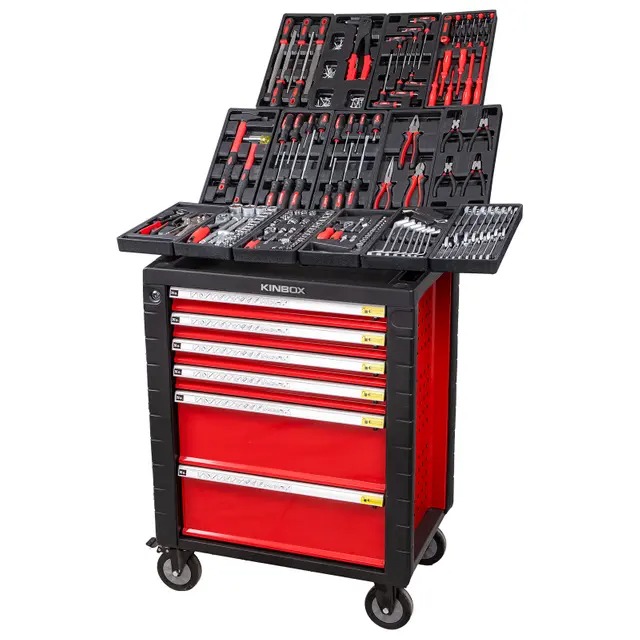
It’s important to understand that a tool cabinet’s overall load capacity isn’t the same as what individual drawers or shelves can handle. For example:
A cabinet might support 2,500 lbs overall, but individual drawers are rated significantly lower — perhaps 100–500 lbs each.
Casters might support up to 2,000 lbs total, while shelves only support 400–800 lbs each.
That means when planning load distribution, you have to consider both the whole structure and the specific-rated parts inside.
When heavier tools are placed unevenly — such as all in the bottom drawers — it affects:
Cabinet stability
Wear on drawer slides
Stress on the frame
Balanced loading helps maintain optimal performance. In professional environments, technicians often organize tools by weight — heavier ones at the bottom — to preserve life expectancy and safety.
In industrial facilities, tool cabinets don’t just hold tools — they sit in environments with fluctuating temperatures, humidity, and chemical exposure.
Environmental factors can affect material strength over time.
Powder-coated finishes and corrosion-resistant materials help cabinets tolerate harsh environments better than untreated ones.
Designing for durability means accounting for these conditions to prevent performance degradation.
Even the best-engineered tool cabinets change slightly over years of use. Load-bearing parts like slides and caster assemblies might wear, which subtly reduces their capacity.
Regular maintenance — like lubrication of slides and inspection of casters — helps preserve original load capacity and ensures safety in everyday use.
Before a tool cabinet ever reaches the showroom floor, it undergoes rigorous testing:
Load testing entire frames and individual components
Assessing drawer slides under repetitive stress
Evaluating caster performance under dynamic loads
These tests aim to simulate real-world scenarios — like a fully loaded drawer pulled open repeatedly — to ensure the cabinet performs as promised throughout its usable life.
When shopping for a tool cabinet, here’s what you should look for:
Rated load capacity for shelves and drawers (not just overall)
Strong drawer slides with load ratings that match your tools
Heavy-duty casters if mobility is needed
Steel construction and reinforced frames for longevity
Environmental protection finishes for tough shop settings
Matching your needs to a cabinet’s engineering ratings — rather than just its looks — ensures you get the right tool storage solution that lasts.
Understanding what really determines the load capacity of a tool cabinet helps you invest wisely. A strong cabinet isn’t defined by appearance alone — it’s the result of thoughtful engineering, quality materials, tested hardware, and smart design choices.
At Ningbo Kinbox Tools Technology Co., Ltd., we apply all of these principles to our professional-grade tool cabinets, tool trolleys, and workshop storage systems. With advanced sheet metal technology, robust load-bearing designs, and quality hardware, our products are built to support the tools you depend on — day in and day out — whether in a factory setting or a busy garage.
Load capacity refers to the maximum weight a tool cabinet can safely support, including both the overall structure and individual components like drawers and shelves.
It depends on material quality, frame design, drawer slides, caster ratings, and overall engineering — heavy-gauge steel and reinforced frames generally support more weight.
Drawer slides have specific weight ratings. Heavy-duty ball-bearing slides support more weight and help ensure smooth operation even under heavy loads.
Yes — if your cabinet is mobile, caster load ratings determine how much weight it can support while being moved.
Over time, corrosion or extreme conditions can weaken parts of the cabinet. Choosing rust-resistant materials and maintenance helps maintain capacity.



