
 English

Views: 0 Author: Site Editor Publish Time: 2026-07-24 Origin: Site


A garage storage cabinet can look excellent in a catalog.
Clean lines. Smooth drawers. A solid worktop. Matching wall cabinets. Everything looks tidy.
But bulk buying is not a catalog decision.
It is a production decision. A shipping decision. A quality-control decision. Later, it may also become an after-sales decision.
That is where the real work begins.
One sample may look perfect. It may open smoothly and arrive without a scratch. That does not mean 300 cabinet sets will perform in exactly the same way.
Colors may vary between production batches. Doors may sit slightly unevenly. Hardware bags may be incomplete. Cartons may look strong but fail after repeated handling.
One small issue does not sound serious. Multiply it across a full container, though, and the cost becomes much harder to ignore.
So, before ordering garage storage cabinets in bulk, buyers need to look beyond appearance and unit price.
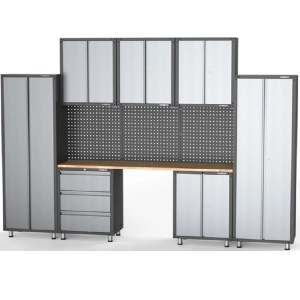 | 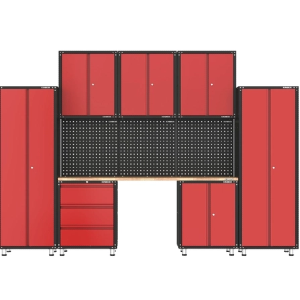 | 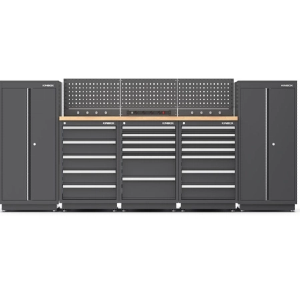 |
This sounds basic. It is still one of the most commonly skipped steps.
A cabinet for a home garage is not the same as a cabinet for a professional repair shop.
Home users may care more about appearance, simple assembly, compact dimensions, and a clean overall layout. Professional users tend to pay closer attention to load capacity, drawer access, worktop strength, locks, and resistance to frequent use.
The sales channel matters too.
Cabinets sold online may pass through several warehouses before reaching the customer. They may be moved, stacked, tilted, or dropped more than once.
Cabinets supplied directly to a workshop have a different journey. Retail packaging may matter less. Fast installation may matter more.
Before requesting a final quotation, buyers should define:
Who the end user is
What will be stored inside
Where the cabinets will be installed
Whether the customer will assemble them
Whether the order is for retail, wholesale, or a project
What price range the finished product must meet
Without this information, the supplier is mostly guessing.
A cabinet may be well made and still be wrong for the market.
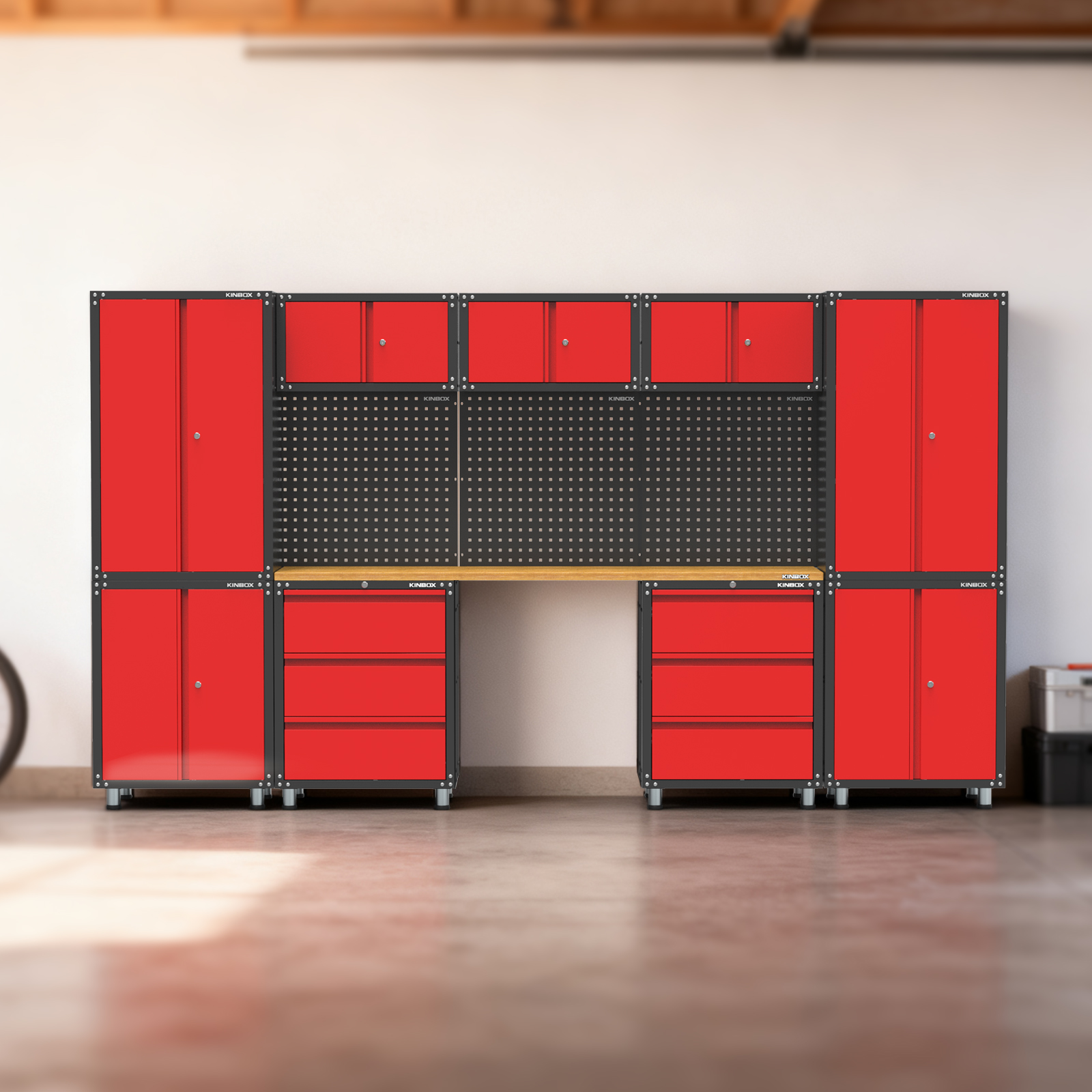
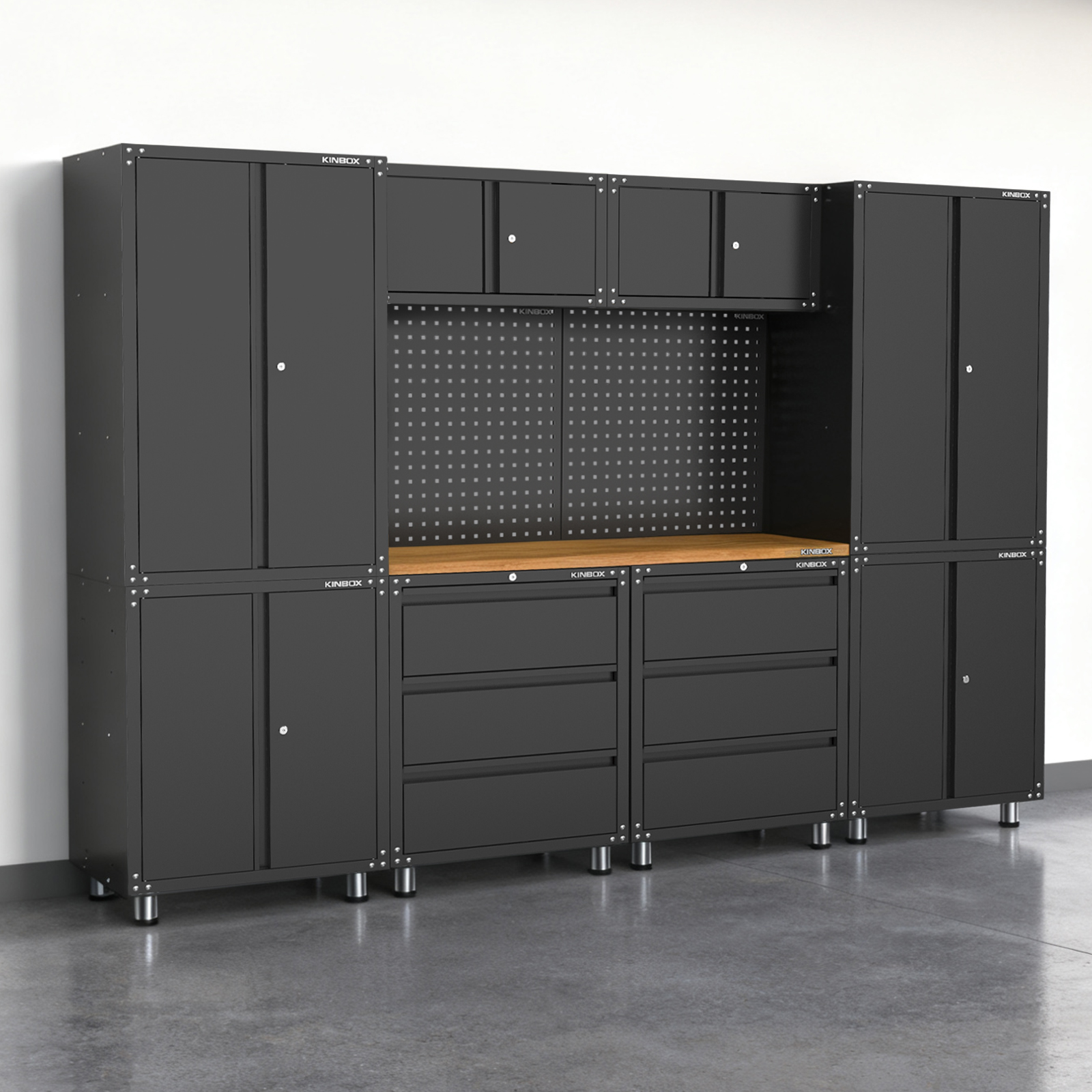
A complete garage storage system looks impressive in a product image.
There may be two tall cabinets, several wall cabinets, drawer units, a worktop, pegboards, hooks, shelves, and decorative side panels.
Here is the catch.
Not everything shown in the image is always included in the quotation.
One supplier may include the worktop. Another may treat it as an optional item. Internal shelves, lights, pegboards, and side panels may also be priced separately.
Buyers should request a complete configuration list.
It should state:
Tall cabinet quantity
Wall cabinet quantity
Base cabinet quantity
Drawer cabinet quantity
Drawer sizes
Shelf quantities
Worktop material and dimensions
Pegboard configuration
Locks and handles
Adjustable feet or casters
Side panels
Mounting hardware
Assembly fittings
Do not compare prices until the product configurations are truly equal.
A lower price is not always a better offer. Sometimes, it is simply a shorter parts list.
Many buyers begin with the same question:
“How thick is the steel?”
It is a fair question. It is not the whole answer.
A cabinet made from thicker steel can still feel unstable if the panels are poorly folded or the main frame lacks reinforcement. Weak connection points can also reduce rigidity.
Cabinet design matters.
Look at the frame. Look at the edges. Check the shelf supports. Check how the rear panel is fixed. Pay attention to the areas around hinges, locks, and drawer slides.
Different parts may use different steel thicknesses. That is normal.
A side panel does not always need the same specification as a loaded shelf or main frame. What matters is whether each component is suitable for its job.
Buyers should ask for the material specification of:
Door panels
Side panels
Back panels
Shelves
Drawer bodies
Main frames
Reinforced sections
Avoid vague descriptions such as “strong steel” or “professional quality.”
They sound reassuring. They are not measurable.
The final specification should be written down. The approved sample should match it.
Both structures can work well.
The right choice depends on the order.
Welded cabinets usually arrive mostly assembled. They often feel solid. Installation is faster. There is also less risk of customers fitting a panel incorrectly.
The disadvantage is shipping volume.
Assembled cabinets take up more container space. They also require more warehouse space.
Knock-down cabinets are packed flat. This can improve container loading and reduce shipping cost per set. Large panels are also easier to move through narrow doors or hallways.
Sounds ideal, right?
Not always.
Flat-packed cabinets create another issue: assembly.
Factory workers already know the structure. They know which screw goes where. They know how to align the doors.
The customer does not.
A proper assembly test should be carried out by someone who has never seen the product before. Give that person the packed sample and the instruction manual. Then see what happens.
Common problems include:
Similar-looking screws
Left and right panels that are hard to identify
Poorly labeled hardware bags
Confusing diagrams
Difficult door adjustment
Holes that do not align easily
Missing assembly steps
A frustrating assembly process can lead to complaints, returns, and poor reviews.
Saving container space is useful. Creating a support problem is not.
Locks are easy to overlook.
Until the first customer loses a key.
Buyers should confirm whether the system uses:
Individual keys
Keyed-alike locks
Different keys for each cabinet
Master-key systems
The right arrangement depends on the customer.
A home user may want one key for the whole cabinet set. A workshop may need better control over different storage areas.
Test the lock on the actual sample.
The key should turn smoothly. The locking bar should move without sticking. The mechanism should not feel loose.
Also ask whether replacement locks and keys will be available later.
Replacing a lock is simple. Replacing a complete cabinet because no spare lock exists is not.
Powder coating can look very different under studio lighting.
Inspect the sample under ordinary office or warehouse lighting.
Place matching cabinets side by side.
This matters.
A small color difference may be difficult to notice when cabinets are viewed separately. It becomes obvious when several doors are installed in one straight line.
Look for:
Color consistency
Gloss consistency
Surface texture
Dust particles
Thin coating around edges
Exposed steel near holes
Marks around welds
Uneven coverage
Easy scratching
Corners and folded edges deserve extra attention. These areas are often more difficult to coat evenly.
For a custom color, do not rely on a phone photo.
Screens display colors differently. Lighting changes the result too.
Use a physical panel, a color standard, or an approved cabinet sample.
“Dark grey” is not a specification.
There are many dark greys.
“Modular” is used in almost every garage cabinet brochure.
Sometimes it means the products are genuinely designed to work together. Sometimes it simply means several cabinets are available in the same color.
Those are not the same thing.
A true modular garage storage system should allow buyers to combine different units without creating obvious alignment problems.
Base cabinets should sit at the same height. Front edges should line up. Worktops should fit the selected cabinet combination. Wall cabinets and pegboards should follow compatible width increments.
The gaps between units matter too.
A small difference may not be noticeable on a single cabinet. Across a five-meter cabinet run, it can make the complete installation look poorly planned.
Ask the supplier to assemble several different configurations, not only the main catalog set.
For example:
Two base cabinets under one worktop
One drawer cabinet beside a door cabinet
A tall cabinet next to a lower cabinet
Wall cabinets above different base units
A system with an end panel on either side
Look at the whole setup from the front.
Does everything line up? Are the gaps consistent? Does the worktop sit flat? Can the doors open without hitting nearby handles?
These details seem small. Customers notice them.
Modularity should also cover future expansion.
A buyer may begin with a compact garage set and add another cabinet one year later. The new unit should still match the previous system.
That means the supplier needs reasonable consistency in:
Cabinet dimensions
Depths and heights
Handle styles
Surface colors
Worktop profiles
Mounting points
Connection hardware
No manufacturer can promise that every component will remain unchanged forever. Still, the buyer should understand how product updates are managed.
Will the supplier give advance notice before changing a handle, lock, hinge, or color? Can older modules still connect with newer versions?
This matters more than it first appears.
A modular system should be flexible after the sale, not only on the first product photo.
The worktop is often treated as a finishing piece.
It is not.
It is one of the most heavily used parts of the system.
Buyers should check the material, thickness, edge treatment, surface finish, and fixing method.
The right choice depends on the market.
A home garage may need a clean surface for light repairs and weekend projects. A professional workshop may need better resistance to impact, oil, metal parts, dirt, and repeated cleaning.
Run a hand along the edge.
Does it feel properly finished? Are the corners protected? Is the surface flat? Does it move when pressure is applied?
Check how several cabinets support one long worktop.
There should not be obvious height differences between the cabinets below. The worktop should not rock or leave large gaps at the rear.
The fixing method also matters.
A worktop that is difficult to secure may shift during use. One that requires too many special tools will slow down installation.
Packaging is another concern.
Long worktops are easy to damage. Corners may chip. Surfaces may scratch. Moisture may affect some materials.
A good cabinet system can still arrive in poor condition because the worktop was not protected properly.
A sample should not be “roughly similar.”
It should represent the final product.
That means the sample should match the agreed:
Dimensions
Steel specification
Hardware
Cabinet structure
Color
Worktop
Logo
Labels
Packaging
Instructions
A showroom sample with better hardware than the mass-production version is not useful.
Neither is a sample made from a different steel thickness.
Once the final sample is approved, it should be kept as the reference unit. Some buyers call this the golden sample.
It gives both sides something physical to compare against.
Every later change should be recorded.
Do not depend on old emails, scattered chat messages, or verbal agreements. Use one final specification file. Add a revision number. Make sure the factory, quality team, and sales team are all working from the same version.
Comments should be specific.
“Improve the door” is not clear.
“Reduce the gap between the two doors and match the approved sample” is clear.
“Strengthen the packaging” is vague.
“Add thicker protection around the bottom corners of the drawer cabinet” is useful.
Clear feedback saves time.
It also reduces arguments.
 |  |  |
Most factories can produce a good sample.
The harder question is whether they can maintain the same standard during full production.
Bulk manufacturing brings more steel batches, more workers, more coating cycles, and tighter schedules.
That is where variation appears.
Buyers should ask how the supplier controls the product while it is being made.
This may include:
Steel thickness checks
Panel dimension checks
Hole-position inspection
Weld inspection
Trial assembly
Drawer alignment
Door-gap checks
Coating inspection
Lock testing
Hardware counting
Packaging verification
The supplier should not wait until the final day to discover a dimensional problem.
Some checks need to happen early.
The first production units deserve special attention.
Not because they are more important than the rest, but because they show whether the drawings, tooling, materials, and assembly process are working together as expected.
A few cabinets should be fully assembled before the whole order moves forward.
Open the doors. Fit the shelves. Install the worktop. Put neighbouring modules together. Check the gaps.
This is the moment to find a hole that sits 3 mm too low or a worktop that does not quite meet the side panel.
At this stage, the issue may affect ten units.
A week later, it may affect three hundred.
That is a very different conversation.
Buyers should ask whether the supplier pauses after the first batch for an internal review. It does not need to become a complicated ceremony. A practical check is enough.
The people responsible for production, assembly, coating, and quality should look at the same finished units.
Often, one department sees what another misses.
The assembly team may notice that a panel takes too much force to fit. The coating team may see that one folded edge is difficult to cover. The packing team may realise that a handle is pressing against the carton wall.
These are useful findings.
Finding them early is not a sign that production has failed. It is a sign that the process is being watched.
No mass-produced cabinet is examined with a microscope by the end user.
A tiny mark inside a closed base cabinet may have no effect on the product. A deep scratch across the front door certainly does.
The difference needs to be understood before inspection begins.
Otherwise, the buyer and supplier may look at the same cabinet and reach completely different conclusions.
The buyer may see a cosmetic defect.
The supplier may see a normal production variation.
Neither side should wait until the goods are ready to ship to discuss this.
Agree on the areas that matter most.
Front doors, drawer faces, worktops, handles, locks, and visible side panels normally deserve tighter control. Hidden internal surfaces may allow a little more tolerance, provided the coating still protects the steel and the cabinet functions correctly.
Door gaps also need a realistic standard.
The doors do not need to be pressed together with no clearance. They do need to look balanced.
One narrow gap and one wide gap will be noticed immediately, especially when several cabinets sit in a straight row.
The same applies to drawers.
They should not scrape. They should not lean to one side. The fronts should follow a reasonably even line.
A written standard helps.
A reference sample helps even more.
People understand “match this cabinet” more quickly than a page full of general quality terms.
When an inspection visit begins, it is tempting to look at the cabinets already arranged neatly near the production office.
They are often clean. Fully assembled. Carefully selected.
That is fine for a first look.
It should not be the whole inspection.
Choose units from different parts of the production run. Open cartons from different stacks. Check cabinets coated on different days.
Variation rarely appears evenly.
One coating batch may look excellent while another has a slightly different gloss. One assembly team may align doors well while another leaves wider gaps. One packing station may include every fitting while another misses a hardware bag.
Random checks give a more honest picture.
The sample size should fit the order.
For a small shipment, several complete sets may be enough. A large order usually needs a broader check across models, colors, and production dates.
There is no need to turn the process into theatre.
The point is simply to avoid inspecting the same perfect cabinet five times.
Some faults disappear from sight once the cabinet is packed.
That makes them harder to find and more expensive to correct.
Before packing, doors should be opened and closed. Drawers should be pulled out. Shelves should be fitted. Locks should be tested.
The inspector should also look inside.
Are the coating edges complete? Are the drawer slides fixed properly? Is the locking bar moving as it should? Are there loose metal shavings or sharp edges?
For knock-down cabinets, the production team may not assemble every unit. That is understandable.
Still, selected units from the production batch should be built completely.
A flat panel can look correct on its own and still fail to align with the panel beside it.
Assembly tells the truth.
It also reveals whether the instruction manual matches the final product.
Sometimes a screw changes during production but the manual still shows the old one. Sometimes a hole is moved but the diagram is not updated.
These are small errors.
They are also exactly the kind of errors that create unnecessary customer messages.
A cabinet should not be packed simply because the carton line is ready.
The unit needs to be complete first.
That means the correct locks, keys, shelves, hardware, labels, manual, and accessories must all be present.
One missing screw bag can stop the customer from completing the installation.
One missing key can make a new cabinet feel unusable.
Before sealing the carton, the packing team should have a clear parts checklist. Pictures can help. So can colour-coded bags or simple part numbers.
The system should be easy to follow on a busy day.
A checklist that only works when the most experienced employee is present is not a strong system.
The buyer should ask how missing parts are prevented.
Is every hardware bag weighed? Is there a final count? Does the carton receive a check mark or inspection label?
There is no single correct method.
The method just needs to work consistently.
A cabinet going directly from a container to a project site follows a fairly controlled route.
An online order does not.
It may be unloaded at a port, moved to a warehouse, transferred to a fulfilment centre, loaded into a delivery vehicle, and carried into a customer’s garage.
Every move adds risk.
For e-commerce orders, the carton may need stronger board, thicker corner protection, better internal fixing, and clearer handling instructions.
Individual parts also need to be easy to identify.
When a customer reports a damaged left door, the service team should know exactly which part is required. “The black panel near the side” is not enough.
Retail orders bring different needs.
The outer packaging may require barcodes, product images, feature information, and market-specific labels.
Project orders may need cabinet numbers that match an installation drawing.
For project orders, packaging should make installation easier, not create another round of sorting.
A large garage storage system may arrive in many cartons. Tall cabinets are packed separately. Wall cabinets have their own boxes. Worktops, side panels, pegboards, shelves, and hardware may all be split apart.
Without clear identification, the installation team has to open boxes just to find out what is inside.
That wastes time.
Each carton should show the cabinet model, module type, carton number, and installation area. For a larger project, those numbers can correspond with the layout drawing.
For example, cabinets marked A1, A2, and A3 may belong to one wall. Cabinets marked B1 and B2 may belong to another area.
Simple labels make a real difference on site.
The installer can move the right cartons to the right position before assembly begins. There is less opening, moving, and repacking. Missing pieces are also easier to identify.
Packaging, then, is doing more than protecting steel panels.
It is helping the buyer receive, store, distribute, and install the product with fewer mistakes.
A supplier may quote one minimum order quantity at the start.
Then the product is customized.
Suddenly, that number changes.
This is not necessarily a warning sign. Different parts of the order may have different production requirements.
The cabinet itself may have one MOQ. The custom powder color may have another. Printed cartons may have their own minimum quantity. Special worktops or handles may also require a separate batch.
Buyers should ask for a clear breakdown.
For example:
MOQ per cabinet model
MOQ per module
MOQ per color
MOQ for printed packaging
MOQ for custom hardware
MOQ for special worktops
Mixed orders need attention too.
Can tall cabinets, wall cabinets, and base cabinets be combined to reach the minimum? Or does every module need to meet its own quantity?
Can standard black cabinets share a container with custom-colored units?
Can two carton designs be used in the same order?
These details affect more than production.
They affect stock planning.
A buyer may want to offer four colors. That sounds good in a catalog. It may also mean holding four separate batches of inventory.
Some colors will sell faster than others.
So be realistic.
A smaller, focused range is often easier to launch and replenish.
More options are useful only when the market actually wants them.
Spare parts are inexpensive when they are packed with the main order.
They become surprisingly expensive when they need to be sent separately by air.
A lost key does not justify an international courier charge.
Neither does one damaged handle.
Before shipment, buyers should discuss a basic spare-parts package with the supplier.
Depending on the cabinet design, it may include:
Locks and keys
Drawer slides
Hinges
Handles
Adjustable feet
Casters
Shelf supports
Screws and fittings
Touch-up paint
Replacement labels
The quantity does not need to be large.
It should simply match the likely needs of the order.
A system with many drawers may need additional slides. A knock-down cabinet order may need more spare hardware bags. Mobile cabinets may need a few extra casters.
Replacement panels are more difficult because they take up space and require protection. Still, for large projects, carrying one or two common door or drawer-front sizes may be worthwhile.
Every part should have a clear code.
This is important.
A buyer should not need to send a blurry photograph and ask for “the small bracket near the bottom.”
The cabinet model, part name, and part number should be enough.
That makes after-sales work much quicker.
Store the spare parts somewhere accessible too.
Putting them at the very back of a full container is not particularly helpful.
Even a well-managed order can have a few problems.
A carton may be damaged during local delivery. A customer may lose a key. An installer may use the wrong screws. One panel may arrive with a dent.
The goal is not to pretend these things never happen.
The goal is to solve them without turning every issue into a long dispute.
The buyer and supplier should agree on what information is needed for a claim.
Usually, this includes:
Product model
Affected part
Quantity
Carton label
Clear photographs
A short video for functional problems
A brief description of what happened
The evidence should be useful, not excessive.
One damaged handle should not require a twenty-page report.
At the same time, the supplier needs enough information to identify the correct part and understand whether the problem came from production, transport, assembly, or use.
Possible solutions may include:
Sending a spare part
Adding replacements to the next shipment
Issuing a credit
Replacing a damaged module
Providing installation guidance
The best solution depends on the situation.
Set a reasonable response process in advance.
When a real problem appears, both sides already know what to do.
That keeps the conversation focused.
A supplier may put extra effort into the first order.
That is normal.
The second and third orders show whether the process is actually stable.
Can the supplier produce the same cabinet dimensions again? Will the powder coating match? Are the original drawer slides still available? Has the handle changed?
For a standalone cabinet, a small component change may not matter much.
For a modular garage storage cabinet system, it matters more.
A customer may add a tall cabinet or wall cabinet to an existing setup. The new module needs to look as though it belongs there.
A different shade of grey will be noticeable.
A new handle shape will be noticeable too.
Buyers should ask how the supplier manages approved specifications.
The factory should keep:
Final drawings
Steel specifications
Color references
Hardware lists
Packaging files
Instruction manuals
Approved sample records
Revision history
The buyer should keep copies as well.
Do not let all the important information exist only in one salesperson’s inbox.
Bulk purchasing garage storage cabinets requires more than choosing a clean design and finding an acceptable unit price.
Buyers need to think about how the cabinets will be produced, packed, loaded, distributed, assembled, and supported after delivery.



