
 English

Views: 0 Author: Site Editor Publish Time: 2026-08-26 Origin: Site


A garage storage system is most commonly associated with automotive repair, but its usefulness goes well beyond the traditional garage. Wherever people work with tools, components, maintenance equipment, or replacement parts, storage eventually becomes an issue.
A small repair shop may start with a toolbox and a simple workbench. That arrangement can work for a while. As the business takes on more jobs, however, the number of tools tends to grow. New diagnostic equipment is added, specialty tools are purchased, spare parts accumulate, and several technicians may begin sharing the same equipment.
At that point, simply finding somewhere to put everything is no longer enough.
The storage needs to fit the way people actually work.
A well-planned Garage Storage System gives tools a defined location, keeps working surfaces available, and makes it easier to separate frequently used equipment from items that are only needed occasionally. Depending on the industry, that system may include steel cabinets, tool chests, workbenches, shelving, mobile cabinets, wall storage, or a combination of several types.
The industries using these systems are therefore much more varied than the name "garage storage" might suggest.

Different industries work with different equipment, but many face the same basic storage problems. Tools need to be accessible without being left in the middle of the workspace, heavy equipment needs somewhere suitable to sit, and smaller components need to be kept from becoming one large pile of unrelated parts.
The storage arrangement changes according to the job.
Automotive repair shops are probably the clearest example.
A professional workshop may contain sockets, ratchets, wrenches, screwdrivers, pliers, torque tools, impact tools, diagnostic scanners, electrical testing equipment, specialty pullers, replacement parts, and consumables.
Not all of these items are used at the same frequency.
Everyday hand tools usually need to stay close to the technician. A specialty tool for a particular repair may only come out once or twice a week. Large equipment may need its own cabinet or shelf.
A steel tool cabinet with different drawer sizes can accommodate these differences. Mobile cabinets can also be useful when technicians work across several vehicle bays.
Instead of carrying individual tools back and forth, the technician can move the cabinet closer to the vehicle and return it to its usual position after the job.
Motorcycle workshops have many similarities to automotive garages, although the equipment and workspace can be different.
Motorcycle technicians often deal with smaller components and may use specialty tools designed for particular models or systems. A compact storage arrangement can therefore be more useful than simply installing the largest possible cabinet.
A workbench with integrated drawers is one practical option. It provides a stable surface for disassembly and inspection while keeping frequently used tools underneath.
Smaller drawers can also be assigned to fasteners, electrical components, or motorcycle-specific tools.
For a workshop with limited floor space, using one area for both storage and repair work can be a considerable advantage.
Companies operating a fleet of vehicles often maintain their own service facilities.
Delivery companies, transportation businesses, rental operators, and other fleet-based organizations may have technicians working on several vehicles at the same time.
The challenge is slightly different from that of a small independent garage. Equipment may be shared by multiple employees, and tools need to remain available across different shifts.
A shared tool can disappear from the usual location without anyone intending to cause a problem.
One technician takes it to another bay. Another employee uses it later and leaves it on a different workbench. By the end of the day, nobody is quite sure where it went.
A Garage Storage System can make this easier to manage.
Tools can be assigned to particular drawers or cabinets. Labels, dividers, and organizers can reinforce the arrangement without making it overly complicated.
This is particularly useful when different technicians work different shifts. The next person coming into the workshop can start with a much clearer idea of where equipment should be.
Fleet maintenance involves more than hand tools.
Filters, belts, fasteners, bulbs, connectors, lubricants, and other consumables may need to be kept on site. These items can occupy a surprising amount of space when they are not organized.
Shelving, cabinets, and small-parts organizers can divide the storage area according to the type of maintenance being performed.
The result does not have to look elaborate. It simply needs to make sense to the people using it.
Industrial maintenance teams usually work with a wider range of equipment than a typical automotive workshop.
A technician may use hand tools for routine adjustments one moment and measuring or electrical equipment for troubleshooting the next. Specialty tools may also be required for particular machines.
Putting everything into the same large drawer quickly becomes inconvenient. Smaller tools can disappear underneath heavier ones, cables become tangled, and specialty equipment takes up space that could otherwise be used for everyday tools.
A better arrangement gives different types of equipment their own storage areas.
Industrial workshops rarely have a single storage product doing every job.
Small hand tools fit naturally into drawers or tool cabinets. Larger replacement parts may require shelving. Long-handled tools can be easier to access from wall-mounted holders or dedicated racks.
Using several storage types also helps the workshop make better use of its available space.
For example, everyday tools can remain near a workbench, while larger components are stored further away. Wall space can be used for equipment that would otherwise occupy valuable floor space.
This kind of arrangement becomes increasingly useful as the number of technicians and machines increases.
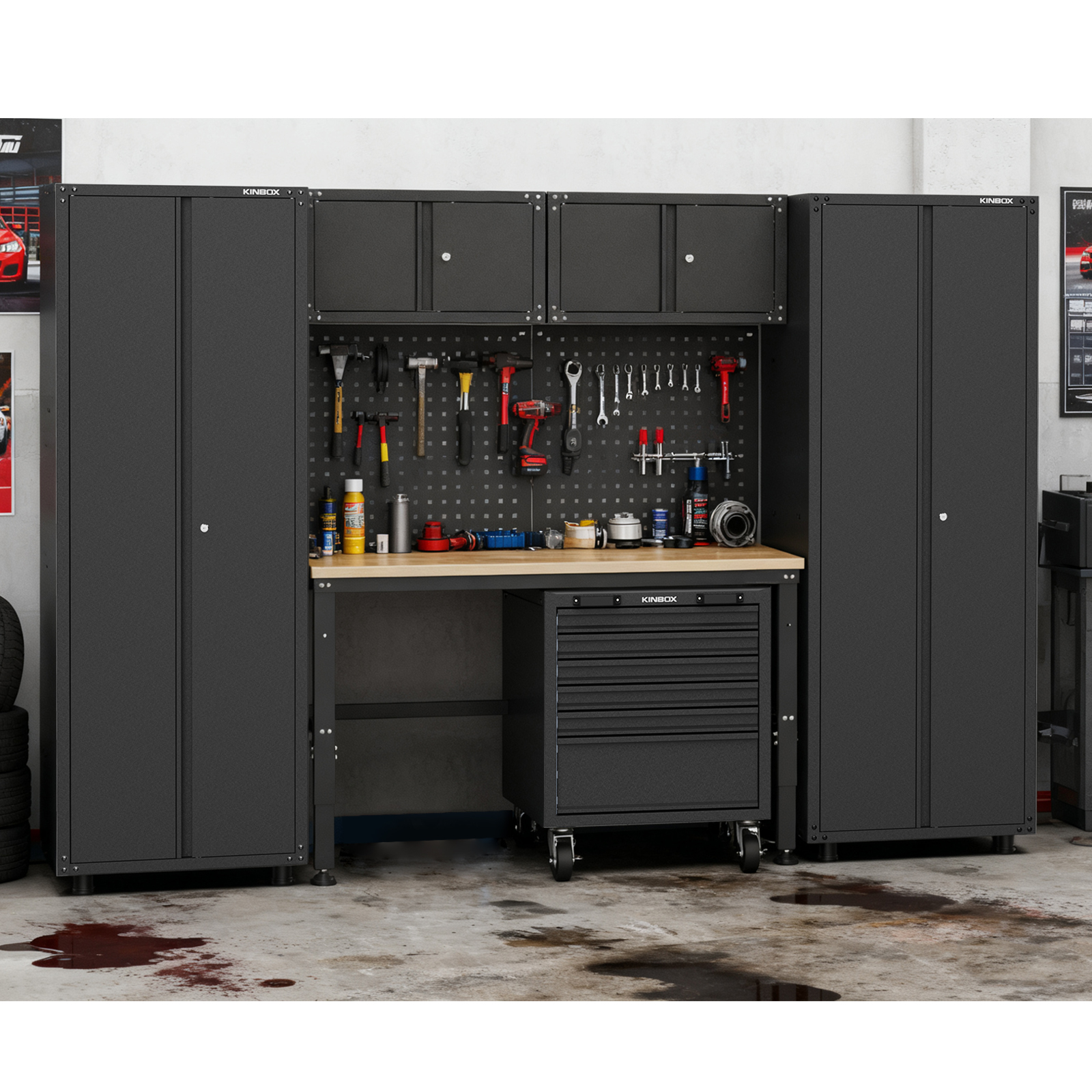
Agricultural machinery workshops have a different rhythm from ordinary automotive garages.
A tractor, combine harvester, sprayer, or tiller can require substantial tools and replacement parts, and maintenance work may become particularly busy during certain periods of the year.
When several machines need attention at the same time, having equipment in predictable locations can save a considerable amount of searching and unnecessary movement.
Tools used on agricultural machinery can be much larger than those found in a passenger-car workshop.
Large wrenches, pullers, impact tools, hydraulic equipment, and replacement components can place significant demands on storage furniture.
Lightweight cabinets may not be appropriate when drawers or shelves are expected to carry heavy loads every day.
Steel cabinets, heavy-duty shelving, and suitable workbenches can provide a stronger foundation for this type of environment.
The storage layout should also reflect seasonal work. Tools and parts that are used heavily during a particular maintenance period can be kept closer to the main service area, while less frequently used equipment can be stored elsewhere.
Agricultural maintenance areas may be exposed to mud, dust, moisture, and outdoor contaminants.
Machinery can arrive directly from the field, bringing dirt into the service area with it.
Leaving tools on the floor or exposed work surfaces increases the chance of unnecessary contamination and damage. Enclosed cabinets give technicians a place to put equipment away after a repair instead of leaving it beside the machine.
This is a fairly simple storage practice, but it becomes more valuable when tools are being used heavily throughout the year.
Construction companies maintain a wide variety of equipment.
Generators, compressors, pumps, power tools, compact machinery, lifting equipment, and jobsite tools all require inspection, adjustment, or repair from time to time.
Some companies operate a dedicated maintenance workshop. Others have a smaller service area attached to an equipment yard.
The storage requirements can be very different from one business to another.
There is little reason to force every item into the same cabinet.
Hand tools can be stored in drawers, electrical equipment can have a separate location, replacement parts can go onto shelving, and bulky components may need floor-level storage.
A modular Garage Storage System gives a business more freedom to combine these different requirements.
For example, a technician might keep everyday tools in a mobile cabinet beside the service bay while larger replacement parts remain on fixed shelving.
Small components can be placed in bins or organizers rather than taking up an entire drawer.
The idea is to give each type of equipment a suitable place rather than trying to make one storage product solve every problem.
Construction equipment is not always serviced in one fixed position.
A mobile tool cabinet can be moved closer to the machine being inspected, reducing repeated trips to a central toolbox.
This can be especially useful in large equipment yards or workshops with several service areas.
However, mobility needs to be considered realistically. A fully loaded cabinet can be heavy, so the casters should be suitable for the total load and the floor conditions. Rough surfaces, thresholds, ramps, and uneven areas can all affect how easily a mobile cabinet can be moved.
HVAC and plumbing businesses also work with a large mixture of tools and small components.
A technician may need hand tools, measuring equipment, fittings, connectors, valves, fasteners, electrical components, seals, and replacement parts during a normal working day.
Small components are easy to underestimate when planning storage.
A box of fittings may not take up much room individually, but several different sizes and types can quickly create a storage problem.
Drawer organizers and small bins can keep these parts separated.
A steel cabinet can provide the main structure, while smaller containers inside handle the individual categories.
This arrangement is also useful when technicians need to identify a particular component quickly rather than searching through one mixed container.
Service companies often need two kinds of storage.
The main workshop can hold larger quantities of tools and replacement parts, while mobile toolboxes or cases can carry equipment to customer sites.
The two systems do not have to compete with each other.
Fixed storage acts as the central equipment base. Mobile storage handles the tools required for individual jobs.
Keeping the two organized can also make it easier to see what needs to be replaced or restocked.
Electrical maintenance and electronics repair have different storage requirements from mechanical workshops, but organization remains important.
Technicians may work with multimeters, test leads, connectors, terminals, cables, soldering equipment, hand tools, and sensitive electronic devices.
Electrical work often involves large quantities of small items.
Fuses, terminals, connectors, fasteners, switches, and other components can easily become mixed together when they are stored in ordinary boxes or open containers.
Small labeled bins and drawer organizers provide a relatively simple solution.
Instead of having one drawer full of unrelated components, each section can be assigned to a particular type or size.
This makes restocking easier as well. When one compartment is empty, it is immediately visible.
Cables create another common problem.
Test leads, adapters, power cords, and extension cables can become tangled when left on a workbench.
Dedicated drawers, hooks, or wall storage can keep them under control.
Testing equipment also deserves a suitable location. A diagnostic meter or other electronic device should not have to share an overcrowded drawer with heavy metal tools.
Separating the equipment reduces the chance of accidental contact and makes the workbench easier to keep clear.
The list does not stop with automotive and industrial businesses.
Small engine repair shops, marine service companies, equipment rental operations, vocational training facilities, motorsport teams, and technical service departments can all have similar storage needs.
The industry itself is not the deciding factor.
The more useful question is whether the business regularly handles tools, equipment, parts, and maintenance materials that need to be kept under control.
Businesses servicing generators, lawn equipment, pumps, and small engines may have a surprisingly large collection of small components.
Spark plugs, filters, belts, carburetor parts, fasteners, connectors, and specialty tools can easily become mixed together.
Compact cabinets and drawer organizers can separate these items without requiring a large workshop footprint.
For smaller businesses, a workbench with integrated storage can be especially useful because the same floor area serves both purposes.
Marine maintenance presents another set of storage considerations.
Tools and components can be exposed to moisture, salt, and other corrosive conditions. Proper cleaning and storage therefore become part of routine equipment care.
Enclosed cabinets can give tools a more protected location when they are not being used.
For demanding marine environments, the construction and surface finish of the storage equipment should also be considered carefully. Depending on the application, corrosion-resistant materials or suitable protective finishes may be appropriate.
There is no single storage material that suits every marine workshop. The choice depends on where the equipment is installed and the conditions it will face.
Motorsport teams often work under considerable time pressure.
During vehicle preparation and event servicing, technicians may need a large number of tools within easy reach. A tool that takes several minutes to locate can become a genuine inconvenience when work is happening against a schedule.
A carefully arranged tool cabinet can make the workflow more predictable.
Frequently used tools can be placed in the easiest-to-reach drawers, while specialty equipment can have dedicated locations. Mobile cabinets can also be moved closer to the vehicle when necessary.
The purpose is not simply to make the workshop look organized. It is to reduce interruptions during work and make it easier for technicians to know where equipment should go after use.
There is no universal storage configuration.
A two-person motorcycle workshop has very different requirements from a large industrial maintenance department. A construction equipment service center may need heavy-duty shelving, while an electronics repair shop may prioritize small drawers and protected storage.
The selection should begin with the equipment rather than the appearance of the cabinet.
Make an inventory of the tools that need to be stored.
Consider the heaviest equipment first. Check the load capacity of drawers, shelves, and cabinets rather than assuming that a larger unit automatically has a higher capacity.
Large tools also need enough internal space.
Trying to force oversized equipment into a shallow drawer is likely to make the storage inconvenient.
Everyday tools should be easy to reach.
There is little practical benefit in putting the most frequently used equipment in a cabinet at the other side of the workshop.
Less frequently used specialty tools can be placed in deeper drawers, upper storage areas, or separate cabinets.
A good layout follows the working habits of the technicians.
Floor space is only one part of the calculation.
Measure walls, work areas, vehicle access routes, doors, lifting equipment, electrical panels, and other fixed installations.
Also look upward.
Tall cabinets and wall storage can make use of vertical space without reducing the amount of floor available for vehicles and technicians.
A business rarely has exactly the same tool collection five years later.
New equipment is purchased, additional technicians may join the team, and the range of services can expand.
If every cabinet is already full on the day it is installed, the storage arrangement may quickly become inadequate.
A modular system can make future changes easier because additional units can be incorporated as requirements develop.
The tools may be different, but the underlying problem is remarkably similar.
Technicians need to find equipment without wasting time. Valuable tools need a place where they are less likely to be damaged or misplaced. Workbenches need to remain available for actual repair work rather than becoming permanent storage surfaces.
A properly arranged Garage Storage System supports all three.
It also gives a workshop a more predictable routine.
A technician knows where a tool belongs. A shared cabinet has a defined purpose. Replacement parts have a known location. Equipment that requires more careful handling can be separated from heavy tools.
These improvements are not dramatic on their own.
Their value comes from repetition.
When the same storage habits are followed every working day, the workshop becomes easier to manage.
A small workshop does not necessarily need a large industrial storage installation.
In fact, installing too much equipment can waste valuable floor space.
A compact steel cabinet, practical workbench, and several drawer organizers may be enough for a small operation.
The key is to make each part of the system useful.
Vertical space can be used for tools that do not need to occupy the floor. A workbench can combine storage and workspace. A mobile cabinet can be added if technicians regularly move between work areas.
As the business grows, additional units can be introduced according to actual requirements rather than trying to predict everything in advance.
The best place to start is not with a catalog.
Start by looking at a normal working day.
Which tools are used repeatedly? Which equipment is shared? Which items are large or heavy? Which parts need to be kept clean or protected? Which tools tend to disappear from the usual location?
Once these questions are answered, the physical layout becomes easier to plan.
Frequently used hand tools can stay near the primary work area. Larger equipment can have deeper storage or shelving. Small components can be placed in bins and organizers. Mobile storage can be used where technicians genuinely need to move equipment.
The available space then determines how these elements fit together.
A Garage Storage System does not need to be complicated to be effective. It needs to reflect the work being performed and remain convenient enough that technicians will actually use it.
Kinbox Tools provides steel tool cabinets, workbenches, garage storage systems, and related workshop storage equipment for professional working environments. Its storage solutions can be used across automotive repair, equipment maintenance, industrial workshops, and other applications where tools and components need to remain accessible and organized. For businesses setting up a new facility or replacing outdated storage, Kinbox Tools offers practical configurations that can be selected around available space, equipment requirements, and everyday workshop use. Building the storage around the way technicians actually work can help businesses make better use of their workspace while keeping valuable tools easier to manage.
Automotive repair shops are among the most common users, but Garage Storage Systems are also suitable for motorcycle repair, fleet maintenance, agricultural equipment servicing, industrial maintenance, construction equipment repair, HVAC, plumbing, electrical work, marine maintenance, motorsport, and small engine repair.
It does not necessarily need a large system. A smaller workshop may start with a tool cabinet, workbench, and a few organizers. What matters is having enough suitable storage for the tools and equipment actually used in daily work.
Heavy equipment should be stored in cabinets, drawers, shelves, or workbenches with load ratings appropriate for the intended weight. Check the specifications of the individual storage unit rather than judging its capacity by size or appearance.
Yes. Fixed drawer locations, labels, and organized tool layouts can make shared equipment easier to locate and return. This is particularly useful in fleet workshops, industrial maintenance departments, and other facilities where several employees use the same tools.
Start with the equipment used during normal operations. Consider tool size, weight, frequency of use, environmental conditions, available floor and wall space, and the number of people sharing the storage. Then select cabinets, workbenches, shelving, mobile units, and organizers that match those requirements rather than choosing a system based only on appearance.



