
 English

Views: 0 Author: Site Editor Publish Time: 2026-05-29 Origin: Site


Walk into any high-end automotive dealership or a bustling independent service center, and the first thing that catches your eye isn't necessarily the high-tech diagnostic monitors or the massive hydraulic lifts. It is the overall organization of the service bays. A pristine, streamlined environment immediately tells a story of precision, efficiency, and deep operational pride. Conversely, a garage where tools are scattered across greasy workbenches, mismatched carts, and plastic bins tells a completely different, chaotic story. In the modern automotive repair industry, where vehicle technology advances by the week and labor rates continue to climb, running a sloppy shop is a luxury nobody can afford.
Many shop owners look at a professional-grade tool cabinet as an expensive piece of industrial furniture—a luxury purchase rather than a core operational asset. That is a massive misconception. A professional storage unit is a vital piece of shop infrastructure that directly influences your daily repair velocity, tech retention, and customer trust. When you consider that a technician can easily spend up to an hour a day just looking for missing sockets, specialized pullers, or diagnostic leads, organization ceases to be about neatness. It becomes a matter of pure, unadulterated profitability. Investing in the right storage setup changes the entire operational dynamic of your facility, transforming your service bays into synchronized, profit-generating workstations.
Time is the ultimate currency in an auto service center. Your revenue is directly tied to flat-rate hours and billable time. If a vehicle stays on a lift longer than estimated because a mechanic is hunting down a specific tool, your shop's efficiency metrics take a nose dive. The frustration of disorganization acts like a slow leak in your bottom line. Technicians lose their focus and rhythm when they have to pause a complex timing belt job or a tricky suspension repair just to dig through a messy drawer. That break in concentration doesn't just waste time; it increases the likelihood of re-work, forgotten bolts, and costly technical errors.
Beyond the clock, there is the literal cost of the equipment itself. Professional automotive tools represent a staggering capital investment. High-performance impact guns, precision torque wrenches, and extensive diagnostic sensor kits cost thousands of dollars out of pocket. When these tools are tossed carelessly into low-grade, flimsy drawers, they knock against each other, leading to premature wear, calibration loss, and physical damage. Worse yet, they vanish. Missing tools require immediate, budget-draining replacements, and if a tool is left behind in a customer’s engine bay, it can cause catastrophic vehicle failure and devastating liability issues for your business.
Furthermore, we cannot ignore the psychological impact of a chaotic workspace. Top-tier mechanics want to work in an environment that respects their trade. If your bays are a mess, your best technicians will look for employment elsewhere. Customers, too, are highly observant. When a car owner peeks into a dirty, disorganized service bay, they instinctively wonder if the actual mechanical repair will be just as sloppy. Providing a premium infrastructure signals to everyone—your staff and your clientele—that you run a world-class operation.
When evaluating options for your facility, it is critical to understand what separates a genuine, industrial-grade tool cabinet from the cheap alternatives found at big-box consumer retailers. A consumer cabinet is designed to hold lightweight residential tools and see use perhaps a few times a month. If you put that same unit into a commercial shop, it will buckle, warp, and jam within a matter of weeks. True professional equipment is over-engineered from the ground up to survive a relentless, multi-shift commercial environment.
The lifespan of your storage investment comes down to the raw material and assembly method. Professional units rely on heavy-gauge cold-rolled steel. This material undergoes a specialized manufacturing process that hardens the metal and creates a incredibly smooth, uniform surface. The cabinet frame must feature double-wall steel construction with welded joints rather than cheap rivets. This rigid, dual-layer design means that even if a heavy floor jack bumps into the side of the cabinet, the internal structural integrity remains completely unaffected, ensuring the drawers continue to glide open and closed perfectly square without binding.
The atmosphere inside an automotive garage is incredibly hostile to raw metal. Your storage cabinets are constantly exposed to highly aggressive chemicals, including brake fluid, motor oil, liquid degreasers, transmission fluid, and corrosive road salt dripping from vehicle undercarriages. Traditional liquid spray paint will quickly scratch, flake off, and allow moisture to rust the steel from the inside out. To counter this, commercial units require a heavy-duty, electrostatically applied powder-coated finish. This powder is baked onto the metal at intense heat, creating an incredibly thick, non-porous, and scratch-resistant barrier. It keeps the cabinet looking brand new for a decade and allows your team to easily wipe off grease and grime at the end of every shift.
The absolute heart of a tool cabinet's daily functionality is its drawer system. If a drawer is difficult to open, feels unstable, or sags when fully loaded, it becomes an active hindrance to your shop's workflow. Technicians need to be able to access their gear instantly, smoothly, and safely hundreds of times a day.
Friction slides have absolutely no place in a commercial auto service center. Professional configurations require heavy-duty, industrial ball-bearing drawer slides. These precision tracks use steel bearings to deliver an effortless glide, regardless of how much weight is packed into the drawer. For standard hand tool sections housing pliers, screwdrivers, and ratchets, a slide rating of 100 to 150 pounds per drawer is standard. However, for deep bottom drawers holding heavy impact sockets, pneumatic air guns, or massive iron pullers, look for cabinets equipped with double sets of ball-bearing slides on each side. This dual-slide engineering bumps the capacity up to 200 pounds or more per drawer, preventing the tracks from bending under extreme weight.
A smart shop layout avoids uniform drawer sizes. Your technicians use an incredibly diverse array of equipment, meaning your storage assets must offer a corresponding mix of drawer dimensions.
Shallow Top Drawers: Ideal for laying out long rows of wrenches, sockets, and screwdrivers in a single, easily scannable layer. This allows a mechanic to grab the exact size they need without digging through layers of metal.
Medium Drawers: Perfect for diagnostic meters, torque wrenches, specialty service kits, and hand-held power tools.
Deep Bottom Drawers: Essential for housing heavy-duty blow-molded cases, heavy air impacts, and large shop equipment that would otherwise clutter the top of the workbench.
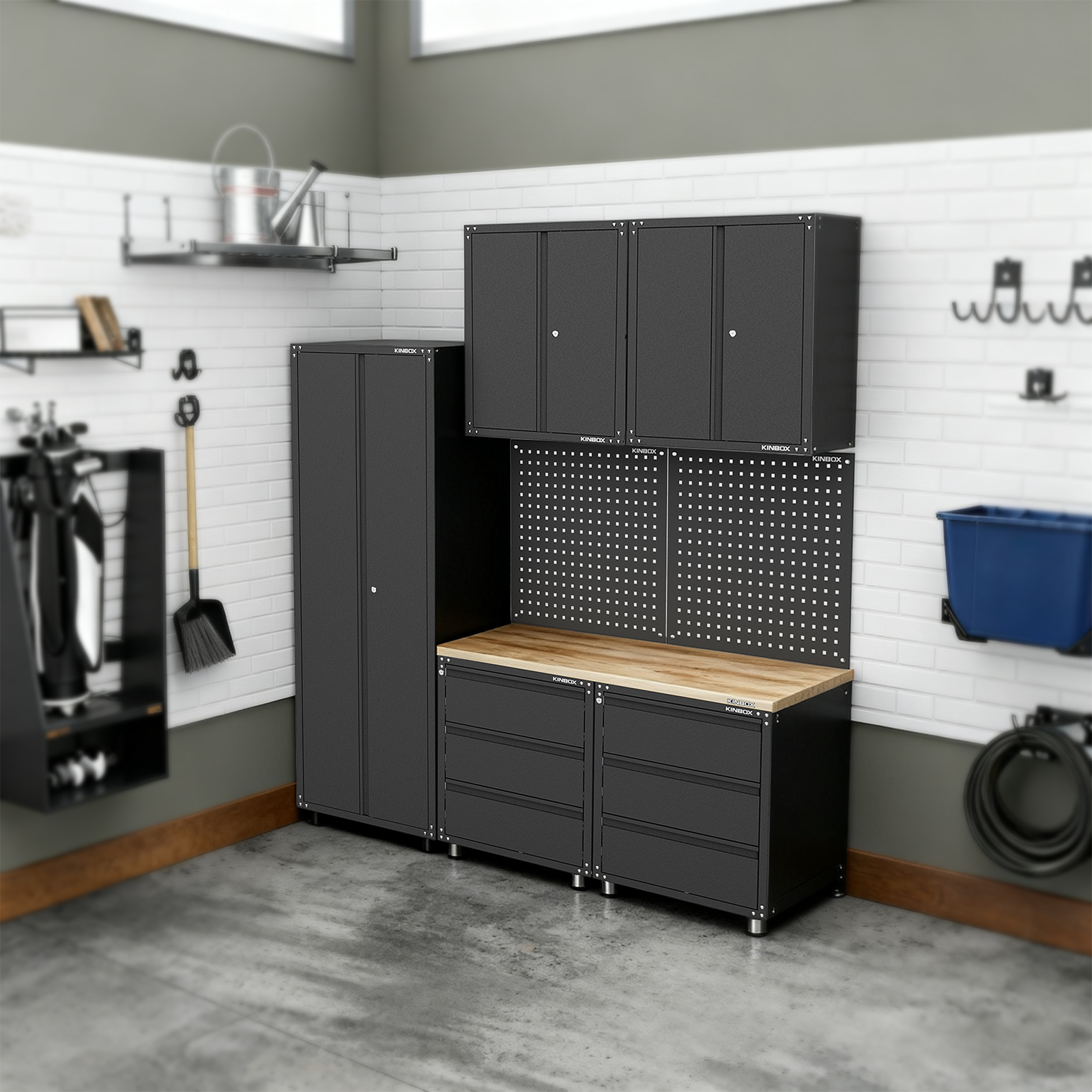
While a standalone rolling tool cabinet is the classic workspace centerpiece, achieving peak operational efficiency often requires a broader, more integrated approach to shop layout. For high-volume service centers, pairing your mobile units with a stationary garage storage cabinet system along the perimeter creates a highly effective, tiered storage strategy.
The mobile tool cabinet acts as the technician’s active tactical workstation. Armed with high-quality polyurethane casters and a robust steering handle, it rolls right up to the front bumper or beneath the vehicle lift. This keeps the exact tools required for the active job within arm's length, eliminating the constant back-and-forth walking across vast concrete shop floors. This reduction in physical fatigue keeps your mechanics energized and focused on billable work.
Meanwhile, a modular garage storage cabinet network mounted to the shop walls functions as the master supply depot. These large, permanent installations are perfect for storing low-frequency items, bulk consumables, clean shop towels, shared diagnostic computers, and seasonal specialty equipment. By moving these larger, less-utilized items off the main shop floor and into dedicated wall storage, you free up valuable floor space around the vehicles. This drastically reduces safety hazards, prevents accidental damage to customer vehicles, and projects an ultra-clean, high-tech image that builds immediate trust with vehicle owners.

In a fast-paced commercial workshop, safety and security are fundamental operational priorities. Because a professional industrial tool cabinet can easily weigh over a thousand pounds when fully loaded with solid steel tools, an un-engineered cabinet presents a severe physical hazard. If a busy mechanic pulls open multiple heavily laden drawers at the same time, the center of gravity shifts forward rapidly, risking a catastrophic cabinet tip-over. Premium commercial units eliminate this danger by utilizing an integrated interlocking drawer system. This internal safety mechanism physically locks all other drawers the moment one drawer is extended, ensuring the unit remains perfectly balanced at all times.
Mobility features also demand strict engineering. Mobile cabinets must be equipped with industrial-grade, heavy-duty casters that can handle massive weight while rolling smoothly over rough shop floors, drains, and fluid spills. The casters should feature a robust dual-locking system that anchors both the wheel rotation and the swivel pivot, ensuring the cabinet stays firmly in place when parked near a vehicle.
Security is another critical pillar. Because professional automotive technicians invest a massive amount of personal capital into building out their tool sets, your shop furniture must offer ironclad protection. A reliable central locking system featuring heavy-duty cylinder locks or digital electronic keypads provides complete peace of mind. It prevents tool theft during shift changes, protects valuable shop diagnostic assets from unauthorized use, and minimizes internal tool shrinkage, safeguarding the investments of both your business and your workforce.
Transforming your auto service center into a high-efficiency facility requires sourcing equipment from a manufacturer that understands the absolute limits of industrial manufacturing precision. Ningbo Kinbox Tools Technology Co., Ltd. is a premier global leader specializing in advanced sheet metal processing and premium workshop storage solutions. Established in 2013 and operating out of a state-of-the-art 50,000 square meter production facility in Ningbo, China, Kinbox engineers heavy-duty products designed specifically to handle the brutal daily realities of commercial automotive and industrial environments.
Our extensive product lineup includes premium industrial tool cabinet units, heavy-duty tool trolleys, modular garage storage cabinet networks, and durable workbenches. By combining advanced automated fabrication technologies with meticulous quality control and cycle testing, Kinbox ensures that every drawer slide, lock, and powder-coated surface delivers smooth, reliable performance under the heaviest loads. We specialize in comprehensive OEM/ODM customization, allowing service centers and global distributors to tailor dimensions, drawer layouts, and custom EVA/EPS tool foam trays to their exact operational needs. When you partner with Kinbox, you are investing in world-class manufacturing scale and robust supply chain expertise, giving your automotive business the rugged structural foundation it needs to maximize workflow efficiency, protect valuable technical assets, and accelerate long-term business profitability.
For professional, high-volume automotive environments, look for cabinets built with a frame thickness of 16 to 18 gauge cold-rolled steel. The drawers should utilize 18 to 20 gauge steel. Lower-quality consumer cabinets often use thin 22 or 24 gauge metal, which will quickly dent, bend, and sag under the weight of heavy professional tools.
Ball-bearing slides use hardened steel bearings to ensure drawers glide open smoothly and effortlessly, even when carrying over 100 pounds of solid metal gear. They prevent the drawers from sticking, catching, or jamming, which saves valuable time during busy repairs and eliminates physical strain for the technician.
By mounting a garage storage cabinet system along your shop walls, you move bulk equipment, diagnostic tools, and fluid supplies off the active floor. This clears up the walking zones around vehicle lifts, dramatically reducing dangerous trip-and-fall hazards, and keeps the immediate workspace clean and streamlined.
An anti-tip interlocking system is an essential internal safety mechanism. When a technician opens one drawer, the system automatically locks all other drawers in the cabinet. This prevents multiple heavy drawers from being extended at the same time, keeping the center of gravity stable and preventing a dangerous cabinet tip-over.
Industrial powder coating involves electrostatically applying a dry powder that is cured under intense heat to form a thick, non-porous skin over the steel. Unlike traditional liquid paint, this specialized finish is highly resistant to impact chipping and completely impervious to harsh, corrosive garage chemicals like brake fluid, degreasers, and motor oil.



