
 English

Views: 0 Author: Site Editor Publish Time: 2026-08-26 Origin: Site


For a professional repair workshop, storage is not just about keeping tools off the floor. It affects how technicians work, how quickly they can complete a job, and how much usable space remains around the vehicle or equipment being repaired.
A typical workshop can contain hundreds of hand tools, power tools, spare parts, fasteners, diagnostic equipment, lubricants, and other supplies. Some tools may be used dozens of times a day, while others are only needed for a particular repair. When all of these items are stored without a clear system, the workshop can become difficult to manage surprisingly quickly.
This is where a Garage Storage System becomes useful. Rather than treating cabinets, workbenches, and shelves as separate pieces of furniture, a professional workshop can use them together to create a more practical working environment.
Good storage does not necessarily mean having more cabinets. It means putting the right equipment in the right place so that technicians can work without constantly stopping to search for tools or move things out of the way.
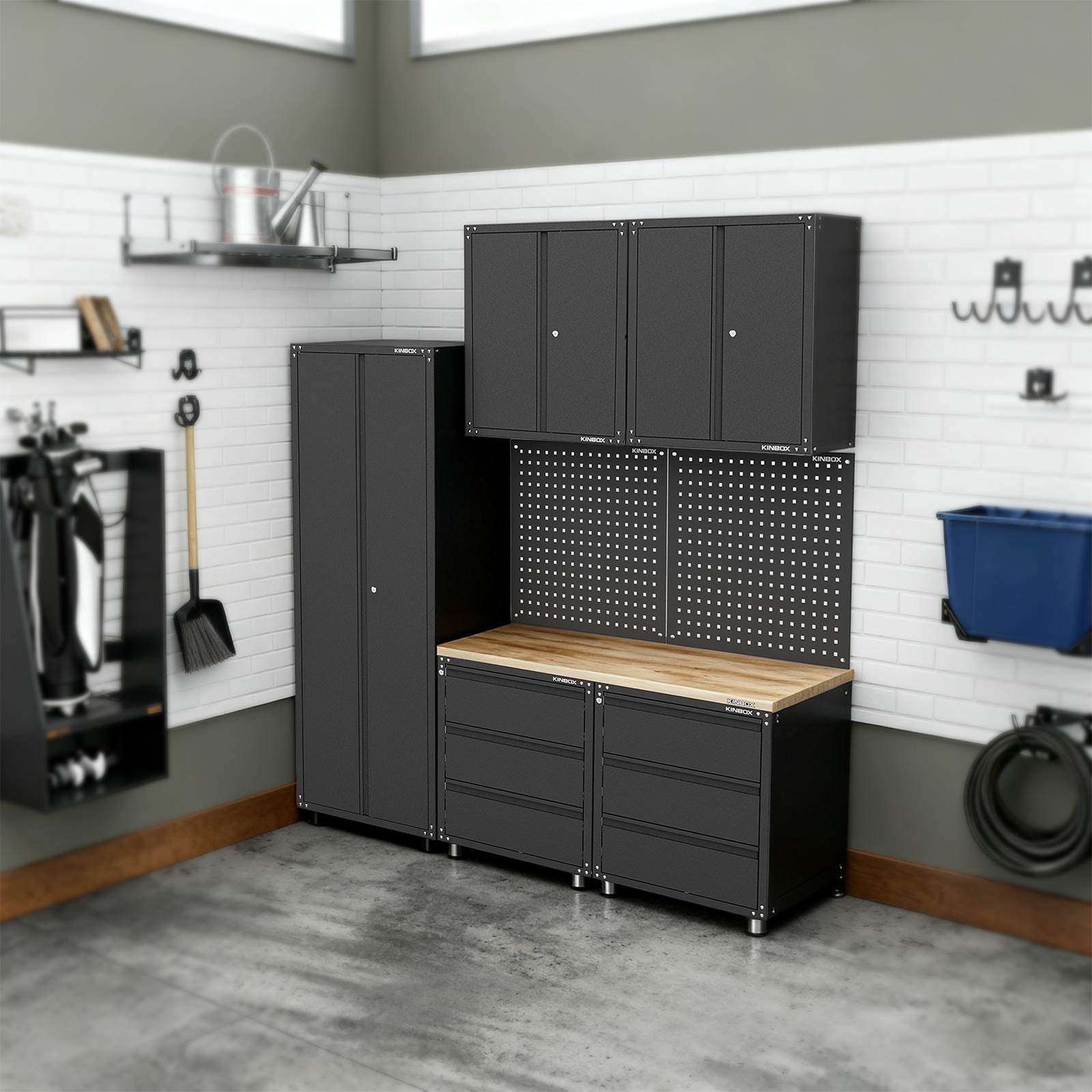
A professional repair shop operates under very different conditions from a home garage. Several technicians may be working at the same time, multiple vehicles may be in the workshop, and equipment is being moved in and out throughout the day.
Under these conditions, even small organizational problems tend to become repetitive.
A technician looking for a socket may lose only a minute or two. Finding a misplaced diagnostic cable might take five minutes. Moving tools from one work area to another may seem insignificant. But when these interruptions happen throughout an eight- or ten-hour working day, they start to affect the workshop's overall productivity.
A sensible storage layout removes some of that friction.
Most technicians have a group of tools they reach for repeatedly. Sockets, ratchets, screwdrivers, pliers, wrenches, measuring tools, and other common equipment rarely need to be hidden away in a remote storage area.
Keeping these tools in dedicated drawers, tool cabinets, or wall-mounted storage close to the main work area makes them much easier to access.
There is also a psychological advantage to having a fixed location for each tool. Once technicians know where a particular tool belongs, they no longer have to think about where to look for it. They simply open the appropriate drawer or reach toward the designated storage area.
That may sound like a small improvement, but it becomes valuable when the same process is repeated dozens of times every day.
Workshop efficiency is not only about how quickly a technician can perform a repair. It is also about everything that happens between individual repair steps.
If a technician has to walk across the workshop several times during a single job to collect tools, the extra movement adds up. The same problem occurs when frequently used parts are stored far away from the workbench.
A well-planned Garage Storage System can shorten these trips.
For instance, a workbench with integrated drawers can keep everyday tools and small parts directly beside the working surface. Larger cabinets can be positioned nearby for equipment that is used less often. This creates a natural workflow without trying to put every item within arm's reach.
The objective is fairly simple: technicians should spend their time repairing vehicles, not walking around looking for equipment.
Keeping a workshop organized becomes harder as the number of tools and jobs increases. A small collection of equipment can be managed fairly easily. A professional shop with several technicians is another matter.
Tools move from one work area to another. Parts are opened and temporarily placed on benches. New equipment is added over time. Without an agreed storage arrangement, the original organization can gradually disappear.
One of the most useful rules in a professional workshop is also one of the simplest: a tool should have a specific place to go when the job is finished.
Tool cabinets and drawer systems make this practical. Different drawers can be assigned to sockets, screwdrivers, electrical tools, pliers, measuring equipment, or specialty tools. Smaller compartments can be used for fasteners and other loose items.
This also makes missing equipment easier to spot.
If a particular drawer normally contains a complete set of tools, an empty space is immediately noticeable. When tools are simply thrown into a large toolbox, a missing item may not be discovered until somebody needs it.
Storage is useful for more than tools.
Repair workshops also need to manage many small items that are easy to overlook, including clips, connectors, washers, bolts, seals, fittings, and other consumables.
A cabinet with labeled drawers or bins gives these items a predictable location. Technicians can see what is available without opening several boxes or searching through different shelves.
For a busy workshop, this can make restocking much easier as well. When a particular drawer or bin is nearly empty, the shortage is visible instead of becoming a problem halfway through a repair.
A cluttered workshop creates more than an organizational problem. It can also make routine work less safe.
Loose tools on the floor, parts left in walkways, overloaded shelves, and poorly positioned equipment all create unnecessary obstacles. In a workshop where people are constantly moving around vehicles and machinery, these seemingly minor issues deserve attention.
Good storage gives tools and equipment a proper location and keeps working areas available for their intended purpose.
Floor space is valuable in a repair workshop. Vehicles need to enter and leave, technicians need room to move, and lifting equipment requires clear operating areas.
When boxes, tools, spare parts, or equipment begin accumulating on the floor, the available space disappears quickly.
Wall-mounted tool storage, cabinets, shelving, and other vertical solutions can move many of these items away from the floor. This is particularly useful in smaller workshops where every square meter matters.
The point is not to make the workshop look perfectly empty. It is to keep important working and walking areas free from objects that do not need to be there.
Heavy tools require a different approach from small hand tools.
A large piece of equipment that is difficult to lift should not be stored in a position where a technician has to reach awkwardly above shoulder height to retrieve it. Likewise, shelves should not be loaded beyond their intended capacity.
Storage should take the weight, size, and frequency of use of each item into account. Heavy equipment can be kept in lower cabinets or suitable storage positions, while lighter and frequently accessed tools can occupy more accessible areas.
In practical terms, safe storage is about more than preventing things from falling. It is about making everyday handling easier and more predictable.
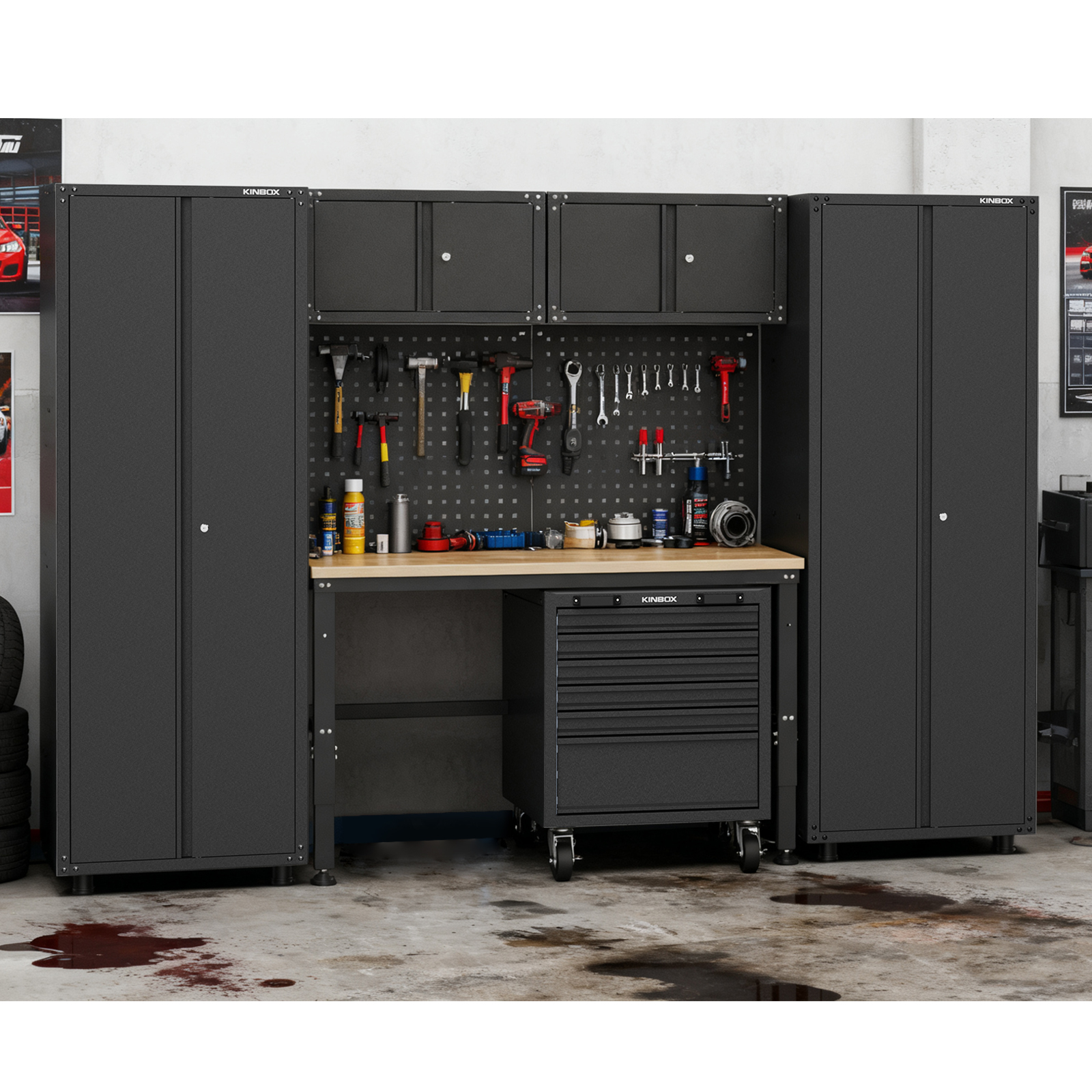
Professional workshops spend a considerable amount of money on equipment. A basic set of hand tools may represent a significant investment, while diagnostic equipment, specialty tools, and professional power tools can cost considerably more.
These tools are also exposed to a fairly rough environment. Dust, metal particles, oil, moisture, and repeated handling are all normal parts of workshop life.
Leaving expensive equipment wherever there happens to be space is therefore not an ideal long-term solution.
Enclosed cabinets give technicians somewhere to put equipment once a job is finished.
This is particularly useful for tools that are not needed continuously. Instead of remaining on a workbench where they can be knocked onto the floor or covered with debris, they can be returned to a protected drawer or cabinet.
The quality of the storage unit matters too. Workshop cabinets are opened and closed repeatedly and may carry substantial loads. Weak drawers or poorly constructed cabinets can become inconvenient very quickly in a professional environment.
For that reason, durability should be considered alongside storage capacity when choosing workshop furniture.
Tools can also be damaged simply because they are stored badly.
When heavy tools are placed on top of smaller ones, equipment can become scratched, bent, or difficult to retrieve. Loose tools thrown into the same drawer can knock against each other every time the drawer is opened.
Dividers and dedicated compartments solve part of this problem. A socket set, for example, can remain together rather than being mixed with unrelated tools. Sensitive equipment can have its own protected location instead of sharing a drawer with heavy metal tools.
It is a straightforward approach, but it makes daily handling easier and reduces avoidable wear on equipment.
A technician may spend most of the working day standing, bending, reaching, lifting, and moving around vehicles. Storage therefore needs to be considered from a practical working position, not just from a capacity perspective.
A cabinet can hold a large number of tools and still be poorly positioned.
If a technician has to bend repeatedly to reach everyday tools, stretch across a vehicle, or walk to the other side of the workshop for basic equipment, the storage layout is creating unnecessary work.
Not every tool needs to be stored in the same place.
Tools that are used throughout the day should generally be positioned where technicians can reach them without interrupting their work. Less frequently used specialty equipment can be kept in larger cabinets or secondary storage areas.
Consider a technician working at a workbench. Having a socket set and commonly used screwdrivers in the drawers underneath the bench makes sense. A specialty puller that may only be used once a week does not necessarily need the same prime position.
This kind of arrangement makes the storage system follow the workflow of the workshop.
A workbench is one of the more useful pieces of workshop furniture because it provides both a working surface and storage.
The top can be used for inspection, disassembly, assembly, testing, or smaller repair tasks. Drawers underneath can hold hand tools, fasteners, measuring equipment, and other items needed during the job.
This combination is particularly useful where floor space is limited.
Instead of having one table for working and another set of cabinets several meters away, a technician can keep much of the equipment directly below or beside the working surface.
A customer does not need to be a mechanic to notice whether a workshop is organized.
When tools are neatly stored, work areas are reasonably clear, and equipment has an obvious place, the entire workshop tends to look more controlled. In contrast, piles of tools and parts around a vehicle can make even a technically capable workshop appear disorganized.
Appearance alone should not determine a storage investment, of course. Productivity and safety are more important. But the visual impression is still relevant, particularly for workshops where customers regularly visit the premises.
There is another side to this as well: organization helps employees maintain consistent working habits.
When everyone uses the same storage arrangement, a tool borrowed from one workstation can be returned to the same location. Over time, that reduces the tendency for equipment to gradually spread across the workshop.
There is no single storage layout that works for every repair business.
A small independent garage may have limited floor space and need a combination of wall storage, compact cabinets, and a workbench. A larger service center may have enough room for multiple tool cabinets, workstations, shelving units, and dedicated equipment storage.
Before purchasing storage, it is worth looking at how the workshop actually operates.
Start with the physical layout rather than the storage products themselves.
Measure the available wall and floor space, but also consider vehicle entrances, lifts, doors, electrical equipment, work areas, and the routes technicians normally use.
Vertical space can be particularly valuable. A wall that is barely being used can provide considerable additional storage without taking more floor area.
At the same time, cabinets should not be positioned simply because there is an empty wall. Storage that blocks access or makes it difficult to move around a vehicle will create a new problem instead of solving the original one.
Think about what will actually be stored.
A drawer containing screwdrivers and small hand tools has very different requirements from a cabinet holding heavy power tools or mechanical equipment.
The expected load, drawer size, cabinet dimensions, and construction should all match the intended use. It is also worth leaving some spare capacity. A workshop rarely ends up with fewer tools five years after installation.
Workshop equipment changes over time.
A shop may add new diagnostic equipment, introduce additional repair services, or hire more technicians. Storage that works today may become restrictive later.
Modular storage can make expansion easier because additional cabinets, workbenches, shelving, or related components can be added as requirements change.
This is one reason it can be useful to think about the storage system as a long-term workshop investment rather than simply buying individual cabinets whenever a shortage appears.
Workshop storage receives much heavier use than ordinary household furniture.
Drawers may be opened dozens of times a day. Cabinets may carry substantial loads, and surfaces can come into contact with oil, grease, dust, and metal parts.
For a professional repair business, construction quality matters because storage equipment is part of the daily working environment. A cheaper unit that becomes difficult to use after a short period may cost more in the long run than a suitable professional-grade solution.
The value of a Garage Storage System is not simply measured by how many tools can fit inside it.
The more useful question is whether the storage arrangement makes daily work easier.
Can technicians find common tools quickly? Can heavy equipment be stored without creating handling problems? Are work areas kept reasonably clear? Can new equipment be accommodated when the workshop expands?
If the answer to these questions is yes, the storage system is doing its job.
There is also a long-term operational benefit. Once tools have assigned locations, maintaining order becomes much less difficult. Technicians do not have to completely reorganize the workshop at the end of every day because the basic structure is already there.
The best approach is not necessarily to fill every available wall with storage. Too much storage can be just as impractical as too little if cabinets and equipment interfere with the working area.
Instead, look at the workshop from the technician's point of view.
Which tools are used every day? Which equipment needs to stay close to the workbench? Which items can be stored further away? Where do parts tend to accumulate? Which areas become cluttered first?
The answers to these questions provide a much better starting point for planning storage than simply counting the number of cabinets needed.
From there, the workshop can be divided into practical zones for everyday hand tools, specialty equipment, spare parts, consumables, larger equipment, and dedicated work areas.
The system should feel natural to use. If technicians need to think too much about where something belongs, the arrangement probably needs to be simplified.
For a professional repair workshop, a Garage Storage System is ultimately part of the working infrastructure. It supports the people, tools, and processes that keep the business operating every day.
Kinbox Tools provides professional workshop storage solutions for businesses that need practical, durable, and well-organized equipment. Its product range includes garage storage equipment, tool cabinets, workbenches, and related workshop organization solutions designed for professional working environments. Whether a repair shop is setting up a new workspace or replacing an outdated storage arrangement, a properly planned solution can help make better use of available space while keeping tools and equipment easier to access.
A Garage Storage System is a group of storage products used to organize tools, parts, equipment, and workshop supplies. Depending on the workshop, it may include tool cabinets, workbenches, drawers, shelving, wall-mounted storage, and other components.
Professional technicians use a large number of tools and parts during their daily work. Without a consistent storage arrangement, time can be lost searching for equipment or moving between different areas of the workshop. A suitable storage system gives commonly used tools a predictable location and helps keep the working area under control.
A workshop cabinet can be used for hand tools, power tools, sockets, specialty equipment, measuring devices, fasteners, spare parts, and various workshop supplies. The contents should generally be arranged according to size, weight, and frequency of use.
Start with the workshop layout and the type of work being performed. Consider available floor and wall space, the number and weight of tools, how often equipment is used, required storage capacity, cabinet durability, and the possibility of future expansion. Storage should support the technician's workflow rather than simply occupy unused space.
It can. When commonly used tools and equipment have fixed, accessible locations, technicians spend less time searching for them or walking around the workshop. A well-organized system can also make it easier to return tools after use, keep work areas clearer, and maintain a more consistent workflow.



