
 English

Views: 0 Author: Site Editor Publish Time: 2026-06-19 Origin: Site


A tool cabinet can look solid in a showroom and still disappoint the first week it enters a real workshop.
The paint may look clean. The drawers may line up nicely. The wheels may roll well enough when the cabinet is empty. But once the drawers are loaded with sockets, spanners, screwdrivers, pullers, cordless tools, measuring instruments, and loose hardware, the weak point becomes obvious very quickly.
Most of the time, that weak point is not the outer shell. It is the drawer slide.
For buyers comparing a Tool Cabinet, drawer slides are easy to overlook because they are hidden between the drawer and the cabinet frame. They do not photograph as well as a glossy front panel. They do not sound as impressive as “heavy-duty steel” or “large storage capacity.” Yet in daily use, the slide system decides whether the cabinet feels professional or cheap.
A drawer is not just a container. In a workshop, it is opened, loaded, pulled sideways, pushed back with one hand, sometimes closed in a hurry, and often used by people who are focused on the job rather than the cabinet. If the slide is not built for that rhythm, the whole cabinet becomes frustrating.
Many tool cabinets slide well when empty. That tells buyers almost nothing.
The real question is what happens after the drawer is loaded. A shallow top drawer full of small hand tools may not cause much stress, but a deeper drawer packed with sockets, hammers, power tool batteries, or metal parts will expose the quality of the slide immediately. If the slide feels rough, dips at the front, or twists slightly when extended, the cabinet will not feel reliable for professional use.
This is especially important in automotive repair shops and maintenance rooms. Mechanics do not open drawers politely all day. They pull, grab, close, move, and return to the work. A good Tool Cabinet has to keep up with that tempo.
Smooth drawer movement affects workflow. When a drawer opens fully and evenly, users can see the whole tool layout. When it stops short or feels unstable, tools at the back become harder to reach. Over time, users start placing frequently used items in the wrong drawer simply because access is easier. That defeats the whole purpose of organized storage.
For B2B buyers, this point matters because customers rarely complain in technical language. They may not say, “The drawer slide tolerance is poor.” They will say, “The cabinet feels bad,” or “The drawer is not smooth.” In the tool storage business, that kind of user feedback damages repeat sales.
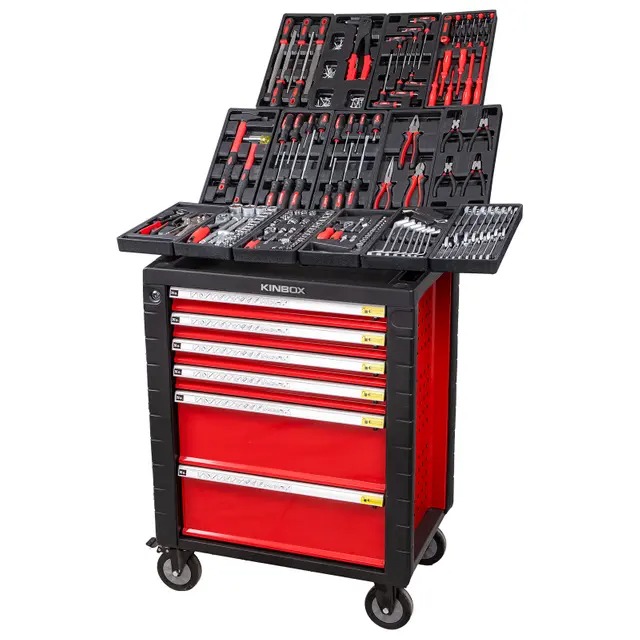
In professional tool storage, ball bearing slides are often preferred because they provide smoother movement and better support than basic friction slides. They are particularly important when the cabinet has multiple drawers intended for regular workshop use.
Several Kinbox rolling tool cabinet products use ball bearing slides, and some models are specified with 100% drawer extension. That combination is worth paying attention to because full extension makes the back of the drawer easier to access, while ball bearing movement helps the drawer operate more smoothly under normal load.
A full-extension drawer may look like a small detail, but in a crowded repair shop it matters. If a mechanic has to dig around blindly at the back of a half-open drawer, the cabinet is not saving time. It is only hiding tools in a neater way.
A slide system should be judged together with drawer size and intended load. A wide drawer needs better lateral stability. A deep drawer needs stronger support when loaded. A narrow drawer for small tools can use a lighter-duty slide, but it still needs clean alignment.
This is where many low-cost cabinets fall short. The catalog may show enough drawers, but the slide quality does not match the drawer layout. The result is a cabinet that seems practical on paper but feels weak once users start loading it.
When comparing suppliers, buyers should ask practical questions:
How far does the drawer extend?
Does the drawer remain level when fully opened?
Does the slide feel stable with weight inside?
Is the movement still smooth after repeated use?
Can the slide system support the target tool load?
Is the same slide quality used consistently across production batches?
These are not decorative questions. They are the difference between a cabinet that sells once and a cabinet that earns reorder confidence.
A drawer slide cannot perform well if the cabinet body is poorly made.
The slide is fixed to the cabinet frame. If the frame is not square, if the side panels flex, or if the mounting points are inaccurate, even a decent slide will not feel smooth. This is why drawer performance should be connected to sheet metal processing quality.
Kinbox Tools was established in 2013 and is positioned around iron and sheet metal product processing, with products including tool trolleys, tool cabinets, tool carts, garage storage systems, and workbenches. That background is relevant because a Tool Cabinet is not only an assembled product. It is a formed metal structure where cutting, bending, punching, welding, coating, and assembly all affect final drawer alignment.
A cabinet with poor frame accuracy often shows small but annoying signs. The drawer gap looks slightly uneven. One drawer closes harder than the others. A loaded drawer rubs on one side. The lock system does not engage smoothly. None of these problems may look dramatic at first, but they tell the same story: the slide and frame are not working as one system.
A good drawer should not only open smoothly for the first few centimeters. It should feel controlled from start to finish. The motion should be predictable. The drawer should not wobble at full extension. It should close without needing a hard push.
In sample evaluation, buyers should test every drawer, not only the top one. Lower drawers are often deeper and may carry heavier items. If a cabinet includes a drawer blocking system or self-locking function, that system should also be tested together with the slides. Safety features are useful only when they do not make daily operation awkward.
Some Kinbox tool cabinet models mention a drawer feature that allows one drawer to be opened at a time. In a loaded roller cabinet, this type of function can help reduce tipping risk, especially when users are working fast and do not think about weight distribution. But again, the detail has to be judged in actual operation. A safety feature should support the user, not fight against the user.
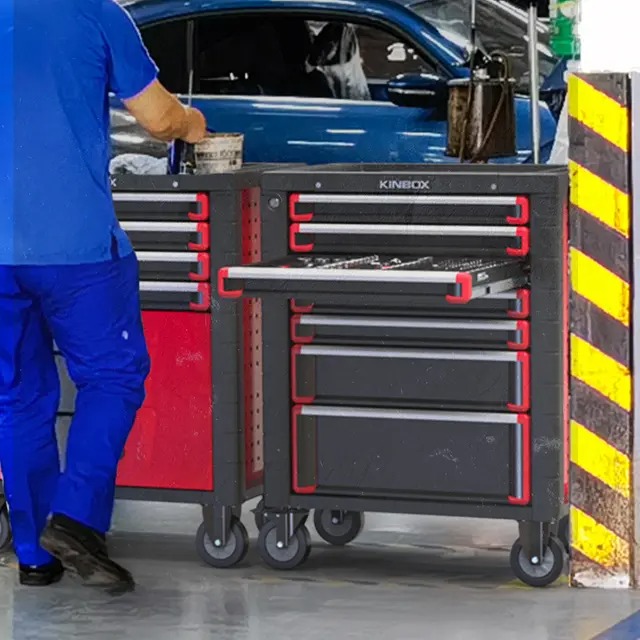
A tool cabinet is only useful if tools stay easy to find. Drawer slides influence that more than many buyers expect.
If a drawer opens fully and feels stable, users can arrange tools properly across the whole drawer. Foam trays, socket rails, hand tool sets, measuring tools, and small accessories can all be placed with intention. If the drawer opens only partway, the back section becomes less useful. People start stacking tools or leaving empty space where access is poor.
This is especially important for cabinets sold with tool sets. Kinbox offers tool cabinets and trolleys with EVA trays, BMC trays, and other organized tool configurations. In these products, the drawer and tray are part of the same user experience. A well-cut foam tray loses value if the drawer does not slide smoothly or extend far enough for the user to see the full layout.
Foam trays do more than make the cabinet look organized. They stop tools from shifting during movement, help users identify missing tools, and make a tool set feel more complete. But they work best when the drawer itself is stable.
If a drawer shakes or dips at the front, tools can still move. If the drawer does not extend fully, some tools may be harder to remove from fitted foam positions. For OEM projects, this should be considered during product development, not after the cabinet design is finished.
A buyer planning a private-label Tool Cabinet should confirm drawer dimensions, extension style, foam tray depth, and tool layout together. Treating the tray as a separate accessory often leads to a cabinet that looks customized but does not feel carefully engineered.
A stationary garage storage cabinet and a rolling tool cabinet do not face the same stresses. Once a cabinet is moved around the workshop, the drawers and slides must deal with vibration, small bumps, turning force, and sudden stops.
A mobile Tool Cabinet should not allow drawers to open by themselves during movement. Push-in latch systems, central locks, self-lock systems, and stable slides all play a role here. Some Kinbox rolling tool cabinet products combine ball bearing slides with lock systems and 5-inch casters, which makes sense for cabinets designed to move within garages or workspaces.
In real use, movement creates small shocks. A cabinet may cross a floor joint, roll over a rough patch, or be pushed from one bay to another. If the drawer slide is loose or the latch is weak, the drawer can rattle or shift. That sound alone can make users distrust the product.
Noise is not only a comfort issue. Excessive rattling can suggest poor fit, loose hardware, or inadequate drawer control. A professional cabinet should sound controlled when drawers open, close, and move with the cabinet. It does not have to be silent, but it should not feel hollow or unstable.
For distributors and tool brands, this is one of the details that affects product reviews. A buyer may accept a minor cosmetic issue more easily than a drawer that feels unstable every single day.
Drawer slides are mechanical parts, but their long-term performance also depends on the environment around them. Dust, oil, metal particles, humidity, and rough handling can all shorten service life. A good cabinet design should reduce unnecessary exposure and keep the slide mounted securely.
Surface finish also matters. Powder coating or epoxy powder coating helps protect the steel cabinet body and gives the product a cleaner appearance. Kinbox garage storage and cabinet products include epoxy powder coated finishes on some models, while its manufacturing background includes sheet metal working and treatment. For the buyer, the point is not simply that the cabinet is coated. It is whether the finish is consistent around edges, drawer fronts, side panels, and mounting areas.
If coating buildup is uneven around slide mounting points, or if assembly is not controlled carefully, drawer alignment can be affected. A cabinet does not need to have luxury detailing to be good, but it does need consistency. In tool storage, consistency is often more valuable than a long feature list.
For OEM and ODM projects, drawer slides should not be left as a vague “standard part.” They should be part of the buying discussion from the start.
Kinbox accepts OEM orders and supports customized logos and featured designs. For brands, importers, and distributors, customization should go beyond color and branding. Drawer slide selection, drawer extension, cabinet layout, tray design, locking system, caster selection, surface finish, and packaging all shape the final product.
A cabinet designed for entry-level garage users may not need the same slide specification as a cabinet aimed at professional mechanics. A promotional tool set may need cost control. A premium roller cabinet may need smoother slides, stronger drawer support, full extension, and a more refined closing feel.
A retail product sold online must photograph well, but it also has to survive reviews. A cabinet sold through a tool distributor may be judged by people who understand workshop equipment. A cabinet used in an industrial maintenance department may be evaluated almost entirely by durability.
The drawer slide decision should follow the customer, not only the price target.
For example, a DIY garage cabinet can focus on neat organization and moderate load capacity. A professional automotive cabinet should prioritize heavier drawer use, smoother operation, locking stability, and a structure that remains aligned. A tool cabinet with a full tool set should place extra attention on how the drawers work with foam trays and tool positions.
This is where an experienced manufacturer can help buyers avoid mismatches. A lower-cost slide may be acceptable for a lighter cabinet. It may become a problem in a wide, deep, fully loaded drawer. The cheapest specification is not always the best commercial decision if it leads to complaints, returns, or weak customer loyalty.
A sample cabinet should be tested in a way that reflects real use. Looking at the front panel and checking the color is not enough.
Open every drawer.
Load the deeper drawers with realistic weight.
Pull the drawer to full extension and check front-end stability.
Push it closed with one hand and feel whether the motion stays even.
Move the cabinet if it has casters, then check whether the drawers remain secure.
Test the lock system after loading the drawers.
Check whether drawer gaps remain consistent.
Place foam trays or tool sets inside and see if the layout remains easy to access.
These tests do not require complicated equipment. They require patience. A good Tool Cabinet should make these small tests feel uneventful. That is the goal. The drawer should work so naturally that the user stops thinking about it.
Drawer slides are not the most visible part of a tool cabinet, but they are one of the parts users experience most often. Every opening and closing movement tells the user something about the product.
A strong steel body matters. A durable finish matters. A reliable lock matters. Good casters matter on mobile cabinets. But if the drawer slides feel rough, weak, or poorly aligned, the whole cabinet loses credibility.
For buyers comparing Tool Cabinet suppliers, drawer slide quality should be treated as a core specification, not a small accessory. It affects storage efficiency, tool access, safety, perceived quality, and long-term satisfaction. It also influences how well the cabinet works with foam trays, tool sets, OEM design, and garage storage systems.
Kinbox Tools’ focus on tool cabinets, tool trolleys, tool carts, workbenches, and garage storage systems makes this detail especially relevant. A cabinet is not just a steel box with drawers. It is a working product that has to perform through repeated use.
The best drawer slide is the one users do not notice after a few months. It still moves cleanly. It still supports the load. It still keeps tools accessible. And it still makes the cabinet feel like a dependable part of the workshop rather than another thing that needs fixing.



