
 English

Views: 0 Author: Site Editor Publish Time: 2026-02-09 Origin: Site


When we think of a tool cabinet, most of us focus on storage — the number of drawers, overall capacity, or even the finish. But there’s one factor that actually plays a much bigger role in daily performance and long-term durability than many people realize: the structure of the drawers themselves.
It’s easy to underestimate something that seems so straightforward, yet how drawers are built has a huge impact on weight capacity, smooth operation, longevity, safety, and even how efficient a workspace becomes. In this paper, we’ll explore why drawer design matters so much in industrial tool cabinets and uncover the engineering decisions that make some cabinets outperform others in demanding environments.
When talking about industrial tool cabinets, “drawer structure” refers to much more than the drawer box that holds tools. It includes:
The drawer itself (material strength, reinforcements)
The internal frame supporting drawers
The drawer slides and hardware
How drawers integrate with the cabinet body
Together, these components determine how well drawers handle heavy loads, repeated use, and rough shop conditions. A drawer that looks fine on paper can still sag, jam, or fail if any part of this system is under-engineered.
By far, the most common material used in industrial tool cabinet drawers is thick steel. Thicker, cold-rolled steel delivers rigidity and resistance to bending — essential when storing heavy power tools or weighty gear. Cabinets with thinner metal panels may save cost, but they sacrifice long-term performance and capacity.
Additionally, well-designed drawers often include:
Reinforced corners and edges — which prevent the drawer sides from deforming under load
Internal supports — that distribute weight and reduce stress on slide mechanisms
These enhancements make a noticeable difference in how a drawer responds when filled with tools and pulled out hundreds of times.
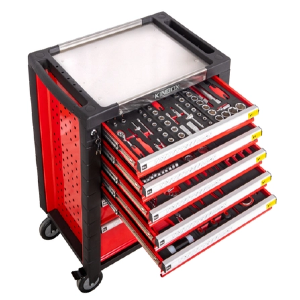
One of the biggest insights in quality tool cabinet design is this: the drawer slide often determines practical load capacity more than the cabinet body itself. A high-quality industrial drawer slide supports heavy loads without sagging, binding, or sticking, even after thousands of cycles.
Two slide characteristics matter most:
Industrial-grade drawer slides are engineered to support significant weight — often 100+ pounds per drawer — without bending or losing alignment.
Higher rated slides reduce internal friction and provide a smoother operation, even when drawers are full. In contrast, cheap slides may start binding or bending as soon as they’re loaded, leading to wear or failure.
There are several slide types, but for industrial tool cabinets the most common high-performance options are:
Ball-bearing slides — which use ball bearings to ensure smooth movement and high load capacity
Telescopic slides — often allowing full extension of the drawer so you can reach tools all the way in the back without strain
Slides like these provide not only strength, but ease of access — which translates directly to safer and faster work.
A drawer can be strong on its own, but if it isn’t supported correctly by the cabinet framework, issues arise. The internal structure that supports drawers — often called the web frame in cabinetry — stabilizes the loading and ensures the whole system behaves as one piece.
Poorly integrated drawers may twist, bind, or wear unevenly. A robust framework keeps drawers aligned, allows even distribution of weight across the cabinet, and ensures smooth performance over time.
It’s tempting to assume that a cabinet with more drawers equals greater capacity. In reality, cabinets with fewer but deeper and well-engineered drawers often outperform units with many shallow drawers in terms of usable storage space and structural reliability.
When tools are heavy or oddly shaped, deep drawers with strong slides handle these loads better and reduce the risk of overstuffing — which can stress both slides and the cabinet frame.
Drawer design directly impacts usability. A drawer that’s easy to open and close — even when fully loaded — saves time and reduces the mental friction of organizing tools. Industrial slides that glide smoothly help maintain this ease of use, even after repeated cycles.
On the other hand, drawers that stick, bang, or misalign under load slow you down and can eventually fail.
Drawers that are engineered for heavy loads also improve workplace safety. Well-balanced weight distribution and reliable hardware reduce the chance of drawer tipping or unexpected opening — both common causes of slips or injuries in busy workshops.
Good industrial tool cabinets often include features like:
Drawer stops to prevent accidental full removal
Integrated locks to secure expensive tools
Soft-close hardware to reduce noise and shock
Each of these features enhances the usability and long-term durability of drawer systems, especially in environments where tools are accessed frequently throughout the day.
Even the best-designed drawer systems benefit from a bit of maintenance. Regular cleaning, occasional lubrication of slides, and periodic inspection help maintain smooth performance. This not only extends the life of drawer components but ensures consistent load-carrying ability over time.
When evaluating a tool cabinet, pay special attention to drawer structure:
Material thickness and reinforcement of drawer boxes
Load ratings and slide type — are they industrial-grade?
Internal cabinet framework — is it designed to support heavy use?
Depth and practical layout — does it match your tool collection?
Engineered drawers make daily use effortless and protect your investment in tools by providing reliable access and storage.
The structure of drawers in industrial tool cabinets isn’t a detail — it’s one of the defining elements that influence everyday performance, durability, and value. From slide quality to frame design, each aspect works together to ensure the cabinet performs reliably under heavy use, year after year.
At Ningbo Kinbox Tools Technology Co., Ltd., we understand the importance of quality drawer engineering in tool cabinets. Our products feature reinforced drawer boxes, industrial-grade slides, and robust cabinet frameworks developed through years of manufacturing experience and feedback from professional workshops. Whether you need storage for a busy industrial facility or a well-organized garage, our team can help you find a solution that lasts and performs.
Durable drawers combine thick, reinforced materials with high-load slides. Industrial-grade ball-bearing slides and solid drawer construction help prevent sagging or binding under heavy loads.
Slides determine how smoothly drawers operate and how much weight they can support. Quality slides improve performance and longevity, especially when loaded with heavy tools.
Yes — deeper drawers offer more usable space and can better accommodate bulky tools, reducing stress on slides and improving storage efficiency.
No. Drawer design varies by cabinet type and intended use. Industrial models use reinforced structures and higher-rated hardware compared to basic consumer units.
In some cases, you can upgrade slides or add reinforcements, but often the best performance comes from cabinets engineered with high-quality drawer systems from the start.



