
 English

Views: 0 Author: Site Editor Publish Time: 2026-08-26 Origin: Site


A single storage cabinet can solve a simple problem: tools need a place to be kept when they are not being used.
Professional workshops, however, rarely have such a simple storage requirement. As a business grows, the number of tools increases, more technicians may share the same equipment, and different types of repair work call for different storage arrangements. A cabinet that seemed large enough at first can become crowded surprisingly quickly.
That is where the difference between individual cabinets and a complete Garage Storage System becomes more noticeable.
Buying cabinets one at a time can work for a small workshop. But once several storage units, workbenches, mobile tool cabinets, and shelves are involved, treating each item as a separate purchase can make the workshop harder to organize.
A complete system allows the storage to be considered as part of the workshop layout. The objective is not simply to add more drawers. It is to decide where tools should go, how technicians move around the workspace, and how different storage units can work together.
For professional repair businesses, this approach can make everyday work more convenient while also making better use of the available space.
A complete Garage Storage System is usually a combination of several storage products rather than one oversized cabinet.
Depending on the workshop, it may include steel tool cabinets, workbenches, mobile tool cabinets, shelving, wall storage, drawers, organizers, and other workshop equipment.
The combination will vary according to the type of work being performed.
An automotive repair shop may need several tool cabinets positioned around work areas. An industrial maintenance department might require more shelving for replacement parts and heavy components. A smaller workshop may get more value from a workbench with integrated drawers and one mobile cabinet.
The important point is that these products are considered together.

There is nothing wrong with buying a cabinet whenever a storage problem appears.
For a workshop that is just getting started, this may be the most practical way to build up its equipment.
The difficulty tends to appear later.
A new cabinet may be a different height from the existing one. Its drawers may have different dimensions. It may not fit neatly beside the workbench. Another cabinet might be placed against a different wall simply because that is where space happens to be available.
Each cabinet can still function perfectly well, yet the workshop as a whole may become difficult to navigate.
Planning the storage together changes the starting point.
Instead of asking, "Where can we fit another cabinet?" the better question is, "What storage does this work area actually need?"
That means looking at the jobs being performed, the tools technicians use most often, the location of the workbench, and the amount of space required for vehicles or machinery.
A coordinated Garage Storage System can then be arranged around those requirements rather than forcing the workshop to adapt to whatever furniture was purchased first.
Professional workshops often have several storage units, particularly when more than one technician is working in the same facility.
If every cabinet has a completely different layout, people have to remember which unit contains which tools. One may have mostly shallow drawers, another may have deeper storage, and another may be used mainly for parts.
There is nothing inherently wrong with using different products. The problem is that too much variation can make the workspace harder to understand.
Tools do not need to be arranged identically in every workshop.
What matters is that the arrangement makes sense to the people using it.
Everyday hand tools can stay together. Electrical testing equipment can have its own section. Specialty tools can be separated because they are used less frequently.
Once technicians become familiar with the arrangement, they no longer need to stop and think about where a particular tool belongs.
They simply go to the usual drawer, take it out, and return it when the job is finished.
That may save only a few seconds each time, but a technician can repeat the same action dozens of times during a working day.
There is also a practical advantage when the workshop needs additional storage later.
If the existing cabinets and workbenches come from a coordinated range, adding another unit is less likely to create awkward differences in height, depth, or overall layout.
The appearance will usually be more consistent as well, although that is secondary to how the equipment works.
For a professional workshop, storage should be judged primarily by accessibility, capacity, durability, and suitability for the work being performed.
The internal layout matters just as much as the number of drawers.
A cabinet can have plenty of storage capacity and still be inconvenient if the tools are placed in unsuitable drawers.
Shallow drawers are generally convenient for hand tools such as wrenches, screwdrivers, sockets, and pliers.
Deeper drawers are more appropriate for power tools, larger accessories, measuring equipment, and other bulky items.
The reason is straightforward. A deep drawer filled with small tools tends to become difficult to sort through. On the other hand, large equipment may not fit comfortably in a shallow drawer.
Using drawer space according to tool size makes the cabinet easier to maintain.
It also reduces the temptation to put unrelated equipment into whichever drawer happens to have room.
The tools used on almost every job should not be stored at the far end of the workshop.
For an automotive technician, this might include sockets, ratchets, screwdrivers, pliers, and torque tools.
For an electrical technician, the priority might be multimeters, test leads, cutters, and connectors.
The exact arrangement depends on the work.
The principle is simply to keep the equipment that gets used most often closest to the area where it is needed.
Less frequently used tools can be placed in another cabinet or a less accessible section.
Storage cannot replace proper equipment maintenance, but it can reduce some unnecessary exposure.
Professional workshops often own expensive diagnostic equipment, measuring instruments, specialty tools, and power tools. Leaving this equipment on an open workbench exposes it to the general activity of the workshop.
A tool can be knocked over, covered by dust, or buried underneath other equipment.
These incidents may not happen every day, but there is little reason to create unnecessary opportunities for them.
A closed drawer or cabinet gives expensive equipment somewhere to go when the job is finished.
Instead of leaving a diagnostic device beside a vehicle, a technician can return it to the same location.
The same applies to cables, adapters, and accessories.
Keeping these items together is particularly useful when a piece of equipment has several attachments. The technician does not need to search through different drawers to find the correct cable the next time the equipment is required.
Some workshops have equipment that should not remain freely accessible outside normal working hours.
Lockable drawers and cabinets can provide an additional level of control for valuable tools and equipment.
This does not replace the workshop's overall security measures. Whether it is necessary depends on the value of the equipment, the number of employees using the facility, and the existing security arrangements.
The storage material itself does not automatically make a workshop safer.
A cabinet can still become an obstacle if it is installed in the wrong location. A drawer can still be difficult to handle if it is overloaded. Heavy equipment can still create a problem if it is stored too high.
The layout and daily use of the storage are therefore important.
Cabinets should not simply be pushed into every empty space.
Technicians need enough room to open drawers fully, move around the storage, carry equipment, and work without blocking other people.
This becomes particularly important in automotive and machinery workshops where vehicles, lifts, and large equipment are also moving through the same area.
Measuring the workshop before installation can prevent many of these problems.
Heavy tools and components should be stored according to their weight and the load rating of the cabinet.
Lower drawers are often more convenient for heavy items because the equipment can be removed without reaching overhead.
The storage unit itself must also be suitable for the expected load.
A large cabinet is not automatically a heavy-duty cabinet, so manufacturers' load specifications should be checked before purchase.
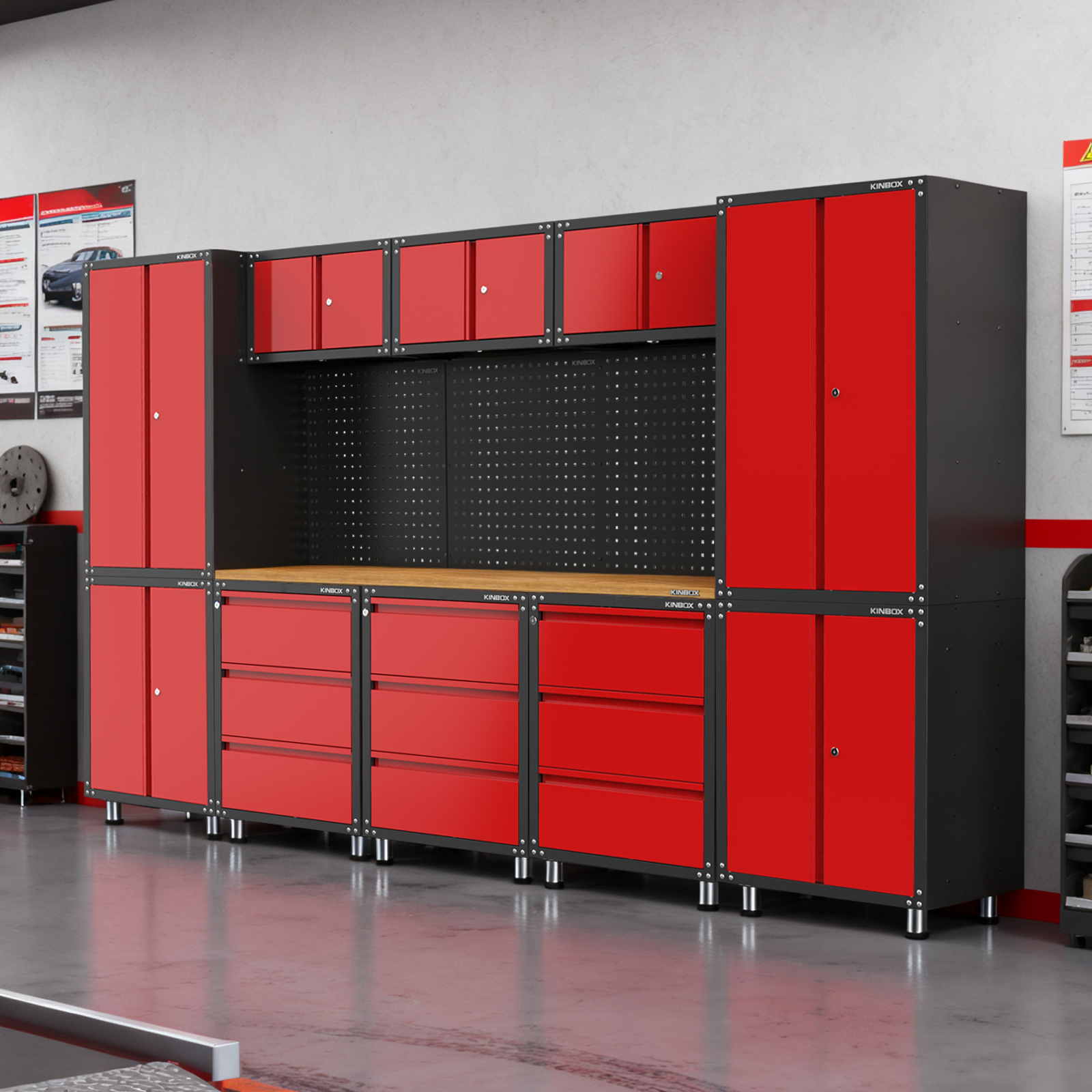
Buying individual cabinets can be a perfectly reasonable approach when a workshop has limited requirements.
The problem is that storage needs tend to change.
One cabinet is purchased for hand tools. Later, another is added for specialty equipment. A workbench is installed somewhere else. Then additional shelving is needed for parts.
Each purchase solves an immediate problem, but the final arrangement may not have much relationship to the original workshop layout.
Planning several storage components together allows the business to decide what it actually needs before making multiple purchases.
For example, a workshop may determine that it needs two tool cabinets, one workbench, a mobile cabinet, and shelving for larger parts.
Another workshop may discover that one large cabinet, a workbench, and wall storage are enough.
There is no universal configuration.
The advantage of planning first is that the business can select equipment based on actual requirements instead of buying another cabinet simply because it is available.
A complete system is not automatically the right choice for every business.
A small workshop with one technician and a modest tool collection may not need several coordinated units.
Buying storage gradually can also make sense when the business is still changing its layout or deciding which services it will provide.
The important distinction is that a complete system does not necessarily mean purchasing everything at once.
It means thinking about the storage as one arrangement, even if individual components are added over time.
There are situations where individual cabinets are more practical.
A small repair business may have relatively few tools and plenty of available space. In that case, a good tool cabinet and a suitable workbench may cover most of its requirements.
Budget can also influence the decision.
A new business may prefer to purchase essential storage first and add more equipment after its operations become established.
Even then, it is worth considering the future layout.
The first cabinet should not be positioned in a way that prevents a second cabinet, workbench, or shelving unit from being added later.
The planning process should begin with the work rather than the furniture.
Look at where technicians spend most of their time.
Which tools are used repeatedly? Which equipment is shared? Which components are difficult to store? Which items need to remain close to the workbench?
Once those questions are answered, measure the available space.
Take account of walls, doors, vehicle positions, lifts, machinery, electrical installations, and normal walking routes.
Only then should the storage configuration be decided.
A cabinet near the main work area can hold everyday tools. A deeper cabinet can handle larger equipment. Shelving can be used for replacement parts and consumables. A mobile cabinet can be useful when technicians regularly move between service bays.
There is no requirement for every workshop to use the same combination.
The useful arrangement is the one that fits the work being performed.
In a small workshop, a misplaced tool is usually an inconvenience.
In a larger facility, the same problem can happen repeatedly because more technicians are using the equipment.
One employee takes a tool to another bay. Someone else uses it later. The tool gets left on a different workbench, and the next technician assumes somebody else has borrowed it.
A clear storage arrangement cannot prevent every mistake, but it gives everyone a common reference point.
This becomes particularly valuable when several technicians, shifts, or departments share equipment.
Storage does not repair vehicles or operate machinery, but it can affect how efficiently technicians spend their working time.
Consider a common repair.
The technician needs several hand tools, a measuring device, a replacement part, and perhaps a specialty tool. If each item is stored in a different part of the workshop, the technician has to keep leaving the work area.
When the same equipment is positioned logically, much of that movement disappears.
The improvement is not dramatic enough to notice after one job.
Over hundreds or thousands of jobs, however, small reductions in unnecessary movement can add up.
A well-planned system can also make cleanup easier because tools have known locations. Once the repair is complete, returning equipment becomes part of the normal routine rather than a separate organizational task.
For a professional workshop, the value of organized storage is usually found in everyday use rather than one obvious moment of return.
A technician finds a tool without searching through several drawers.
A workbench stays available for repair work instead of becoming a permanent storage surface.
A heavy component remains on suitable shelving rather than sitting on the floor.
A diagnostic device goes back into its cabinet after use.
A new employee can understand the basic storage arrangement without having to ask where every item is located.
None of these improvements is particularly dramatic on its own.
Together, they can make the workshop easier to operate.
That is the main reason to consider a complete Garage Storage System. The objective is not to fill an entire wall with matching cabinets. It is to create a practical relationship between tools, storage, workbenches, and the areas where technicians actually work.
For professional workshops looking for coordinated storage solutions, Kinbox Tools provides steel tool cabinets, workbenches, garage storage systems, and related workshop organization equipment. Its range is intended for working environments where storage is used regularly and needs to accommodate different types of tools and equipment. Businesses can select configurations according to available space, tool quantities, working habits, and future requirements rather than being limited to a single fixed arrangement. Whether setting up a new repair facility or replacing older storage, Kinbox Tools can help workshops create a more practical and organized storage layout that supports everyday work.
Not always. A small workshop with limited equipment may only need one cabinet and a workbench. A complete system becomes more useful when several storage units are required and the business wants them to work together as part of one layout.
Yes. A workshop can begin with essential cabinets or a workbench and add other components later. It is useful to consider the future layout before making the first purchase so that later additions do not create unnecessary space problems.
Start with how often each tool is used and how much space it requires. Everyday hand tools should be easy to reach, larger equipment should go into suitably sized drawers or cabinets, and specialty tools can be kept separately. Small parts can be organized with dividers, bins, or dedicated compartments.
It can help make better use of available space because cabinets, workbenches, shelving, mobile units, and wall storage can be planned together. The actual result depends on the workshop's dimensions and the storage products selected.
Consider the size of the workshop, tool quantities, equipment weight, drawer dimensions, load capacity, frequency of use, mobility, security, and possible future expansion. Most importantly, consider how technicians move through the workshop during a normal working day. The storage should support that workflow rather than simply fill an available wall.



