
 English

Views: 0 Author: Site Editor Publish Time: 2026-06-26 Origin: Site


Nobody really tests a tool cabinet when it is clean.
The first look usually happens in a catalog, on a product page, or in a sample room. The drawer fronts line up. The paint looks even. The wheels are new. Nothing has been dropped on the top yet. No one has filled the lower drawer with impact sockets and then pulled it open in a hurry.
That is not the life of a cabinet in a working shop.
In a repair bay, storage has to put up with habits that are not always gentle. A mechanic opens a drawer while holding a part in the other hand. A wrench goes back harder than it came out. The cabinet gets pushed closer to a vehicle and then left near the lift because the next job has already started. Dust, oil, metal chips, rubber marks, and handprints become part of the background.
This is where steel tool cabinets have kept their place. Not because steel is a fashionable material. It is the opposite. Steel is chosen because it is ordinary, practical, and hard to argue with when the environment is rough.
A Tool Cabinet in a professional workshop has to do one thing well: stay useful after the new-product feeling is gone.
If a workshop owner wants to understand a cabinet quickly, opening a loaded drawer is more useful than reading ten lines of specifications.
A drawer with only a few tools inside does not say much. A drawer filled with sockets, ratchets, extensions, pliers, and metal accessories is different. It pulls on the cabinet frame. It tests the slide. It shows whether the front dips slightly when extended. It also shows whether the cabinet feels steady or nervous.
That is where steel construction starts to matter.
The outer body is not only a shell. It carries the drawer system. If the cabinet frame is weak or slightly out of square, the slides cannot perform properly. A ball bearing slide needs a stable side panel. A full-extension drawer needs the cabinet body to hold its shape. A central lock needs the drawers to sit where they are supposed to sit.
On paper, many cabinets look similar. In a workshop, they begin to separate after weight is added.
Some buyers ask about steel thickness first. That is reasonable, but it can be too narrow.
A thicker panel does not help much if the bending is poor, the mounting holes are inconsistent, or the drawer supports are not well aligned. A Tool Cabinet is really a sheet metal product with moving parts. Cutting, bending, punching, welding, coating, and assembly all show up later in drawer feel.
Kinbox Tools works in tool cabinets, tool carts, tool trolleys, garage storage cabinets, garage storage systems, workbenches, and related sheet metal storage products. For a buyer sourcing workshop storage, that production background is more relevant than a simple “steel cabinet” label. The value is in whether the steel is processed into a cabinet that stays accurate after use.
A good cabinet does not need to feel heavy for the sake of feeling heavy. It needs to feel settled.
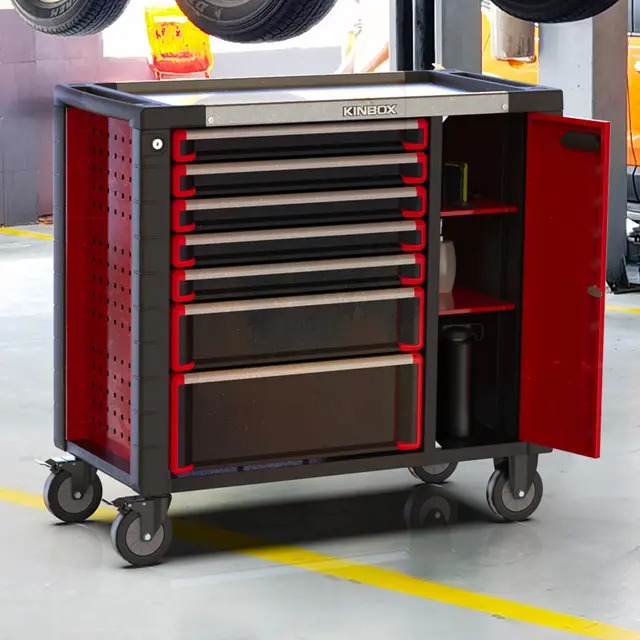
Professional workshops rarely destroy equipment in one dramatic moment. More often, damage comes from small contacts repeated over time.
A screwdriver hits the drawer front. A metal part is placed on the top surface. A cabinet brushes against another unit. A wheel crosses a rough patch in the floor. Someone closes a drawer with a knee because both hands are full.
This is normal use, not misuse.
Steel cabinets are preferred because they are more tolerant of that kind of daily contact. They feel more appropriate in spaces where tools, parts, and equipment are constantly moving. Plastic or lighter storage may be fine for some garage users, but in a commercial workshop, the cabinet has to look and feel like it belongs beside lifts, compressors, workbenches, and tool carts.
The cabinet becomes part of the workshop’s working furniture.
A steel cabinet still needs a good surface finish. Without it, the body may be strong, but the product will start looking tired too soon.
In real use, finish problems usually show first at the corners, drawer edges, handle area, and bottom section. The broad front panel may still look clean, while the contact points already show scratches or rubbed paint. This matters because users judge the whole cabinet by the areas they touch most.
Powder coating or epoxy powder coating is common for workshop storage, but the term alone is not enough. The coating has to be consistent. Edges need attention. Packaging needs to protect the finish before the user ever sees the cabinet.
For tool brands and distributors, this is not a small cosmetic issue. A damaged corner in the first shipment can create the same reaction as a weak drawer: the customer starts doubting the whole product.
Every workshop has the same problem sooner or later. Tools drift.
A socket set starts in one drawer and ends up split between three places. Pliers stay on the bench because the drawer is inconvenient. A torque wrench gets placed under heavier tools because there is no protected space for it. Small parts collect in the top drawer until no one knows what belongs there.
A good Tool Cabinet slows that down.
Steel cabinets can support stronger drawer structures, fitted trays, deeper lower storage, and lockable sections. That means the cabinet can be planned around how mechanics actually use tools. Frequently used tools can sit higher. Heavy tools can stay low. Expensive or delicate items can be separated. Small tools can be held in foam trays instead of sliding around.
This is not about making the shop look perfect. It is about making it easier to put the tool back where it belongs.
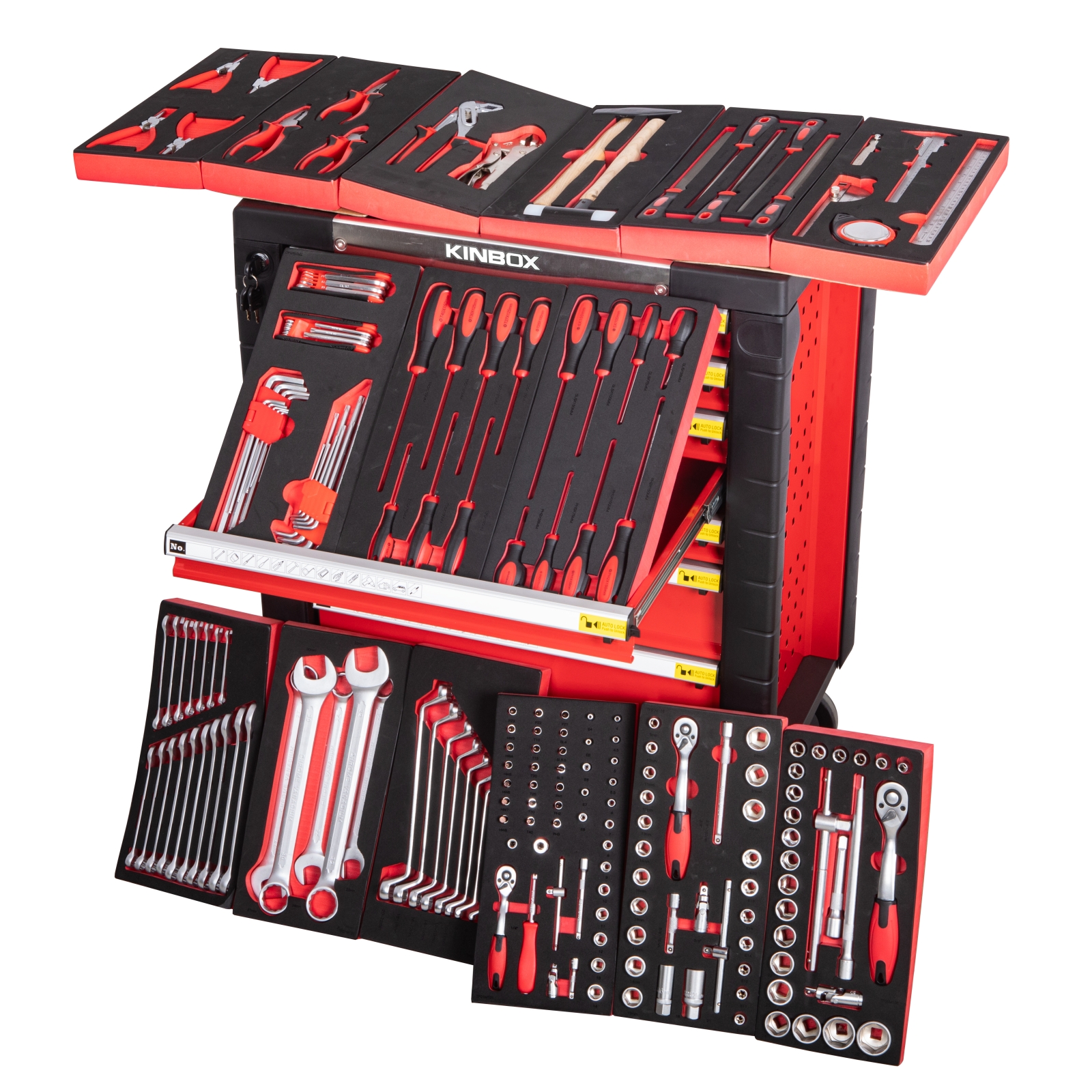
Foam trays are often treated as a visual upgrade, especially in product photos. In a real workshop, their value is more practical. A missing tool is visible. Tools do not shift as much when the cabinet moves. A drawer can be checked quickly at the end of the day.
Kinbox offers customized foam tray options such as EVA, EPS, BMC, and blow molding trays for tool storage products. For OEM Tool Cabinet projects, that can be useful when a buyer wants to sell a cabinet with a tool set instead of an empty storage unit.
But the drawer has to support the tray. If the drawer does not open far enough, the back of the tray is awkward to use. If the slide feels weak when loaded, the organized layout loses its value. If the drawer height is wrong, the tray may look forced.
Good tool storage is rarely one detail. It is the drawer, the frame, the tray, and the user’s habit working together.
A fixed cabinet against the wall has a simpler job. A rolling cabinet has to carry tools and move.
That changes everything.
Once the cabinet is pushed across the floor, the base structure, caster mounting, side handle, drawer latches, and frame all start working together. A mobile Tool Cabinet that feels smooth when empty may behave differently after the drawers are loaded. It may rattle. It may lean slightly when turned. It may feel harder to stop. The drawers may shift if the latch system is weak.
Steel is preferred in mobile workshop storage because it gives the cabinet a stronger base for these stresses. But again, material alone is not enough. The cabinet still needs proper caster selection, good balance, and drawer control.
Mechanics notice this quickly.
A good rolling cabinet does not have to glide like office furniture. It should feel controlled. It should turn without making the user nervous. The drawers should stay closed. The handle should not flex in a way that makes the cabinet feel cheap. The brakes should work in the environment where the cabinet will actually be used.
A professional workshop may have concrete floors, small floor joints, lift areas, oil spots, or narrow working spaces. A cabinet that cannot move confidently in that environment will soon be left in one place, even if it was sold as mobile storage.
When a steel cabinet is well built, it gives the user more confidence to move tools to the work instead of moving back and forth to a wall cabinet all day.
Workshops care about function first, but appearance is not irrelevant.
A clean line of steel tool cabinets changes how a workshop feels. Tools look managed. The space looks more professional. Customers walking through a service area notice that. So do technicians. A shop that looks organized often works with fewer small interruptions.
Steel fits the visual language of professional work. It does not look temporary. It sits naturally beside workbenches, garage storage cabinets, wall units, tool carts, and industrial equipment.
For distributors and tool brands, that visual quality becomes part of the product’s selling point. A steel cabinet can be colored, branded, fitted with different handles, paired with a worktop, or matched with garage storage units in the same product family. It can serve a mechanic’s shop, a home garage, a racing team, or a maintenance department with changes in layout and specification.
That flexibility is one reason steel cabinets remain strong in B2B tool storage.
It would be too simple to say workshops choose steel because steel is stronger.
What they really choose is a storage product that can be trusted with daily use. Steel happens to be the material that supports that expectation best when it is formed, finished, and assembled properly.
The right Tool Cabinet depends on the market. A small garage cabinet does not need the same specification as a mechanic’s roller cabinet. A cabinet sold with a complete hand tool set needs different planning from an empty storage cabinet. An industrial maintenance room may value lockable drawers and stable structure more than a fashionable color.
For OEM and wholesale buyers, this is where supplier discussion matters. Drawer layout, steel processing, slide quality, surface finish, caster choice, locking method, foam tray design, packaging, and logo customization all affect the final product. A cabinet is not improved by adding every possible feature. It is improved by matching the target user correctly.
A professional workshop is a harsh editor. It removes weak claims quickly.
If the drawer feels poor, people notice.
If the cabinet rattles under load, people notice.
If the finish chips early, people notice.
If tools are hard to return to their place, the bench becomes messy again.
Steel tool cabinets remain popular because they handle these ordinary problems better than lighter storage options. They support heavier tools, keep drawer systems more stable, tolerate workshop contact, and fit into larger storage layouts.
A Tool Cabinet is not proven when it arrives clean and empty. It is proven after the drawers have been opened a few hundred times, after the cabinet has carried real tools, after the finish has met oily hands and rough corners, and after the user stops thinking about the cabinet because it simply works.
That is the quiet reason professional workshops continue to prefer steel.



