
 English


When you look at a tool cabinet, you might first notice how many drawers it has, the finish on the steel, or whether it looks “professional.” But here’s a detail that most people — even seasoned DIYers and workshop pros — don’t always think about: how well it’s welded together.
Welding isn’t just about connecting pieces of metal; it’s the foundation that gives a tool cabinet its strength, reliability, and long-term stability. Think of every weld as a tiny bridge holding parts of the cabinet together. If those bridges are weak or poorly formed, the cabinet’s overall performance suffers — especially under heavy use or when loaded with tools and equipment.
In this article, I’ll break down exactly why welding quality matters — not just in engineering textbooks, but in real workshops where tool cabinets are opened, slammed, and loaded several times a day.
What Welding Quality Actually Means
More Than Just a Seam
At its core, welding is the process of fusing two pieces of metal together. But good welding isn’t just about melting metal at a joint — it’s about creating a bond that is as strong, or even stronger, than the original material itself. That requires not only the right equipment and technique but also sound preparation, proper materials, and quality control at each step. Poor welding can have cracks, gaps, or inconsistent fusion, which may not be obvious at first sight but can seriously undermine the cabinet’s stability under load.
Why Welding Quality Is So Important in a Tool Cabinet
1. Structural Strength and Load Distribution
A tool cabinet is expected to support a significant amount of weight — not just from tools inside the drawers, but also from items placed on top and forces from opening and closing drawers repeatedly. Strong, consistent welds help spread these stresses evenly across the cabinet’s frame and panels.
If welds are weak or inconsistent, stress becomes concentrated in smaller areas, which can lead to bending, warping, or even joint failure over time. In larger steel structures (like industrial buildings), welding defects are a top reason for structural weakness — and the same concept applies to cabinets, just at a smaller scale.
2. Resistance to Everyday Wear and Movement
Workshops are busy places. Cabinets get bumped with carts, jostled by moving equipment, and subjected to vibrations from machinery. Every impact and vibration sends loads through the cabinet’s welds. Good quality welds can absorb and redistribute these forces, helping the structure maintain its shape and alignment. Poor welds, on the other hand, can develop cracks or loosening under repeated stress.
In fact, even in large-scale metal fabrication, vibration and stress are well-known factors that can expose weak welds — which is why quality welding practices are so rigorously enforced in engineering projects.
3. Preventing Long-Term Deformation and Failure
Welds that are too shallow, inconsistent, or improperly prepared can become the first points of failure in a cabinet. Over time, these weak points can lead to:
Misaligned doors or drawers
Warped frames
Loose panels that rattle or shift
Those results aren’t just annoying — they reduce the cabinet’s usable life and can make it unsafe to use under heavier loads.
In structural welding contexts, careful control of heat and penetration is critical to avoid these kinds of defects. The same attention to detail should apply to tool cabinets if stability and lifespan matter.
How Welding Quality Is Ensured
Material Preparation and Fit-Up
Good welding starts before the torch ever lights up. Surfaces need to be clean, free of rust or grease, and fit together precisely. Misaligned pieces or dirty surfaces can lead to hidden flaws in the weld — things like pores, weak bonds, or incomplete fusion.
Use of Proper Welding Techniques
Different weld processes (such as MIG, TIG, or stick welding) and the way heat is managed have a real impact on weld quality. A weld that’s too cold may not fully fuse the metals, while one that’s too hot can weaken the base material. Choosing the right technique and controlling heat input are part of what makes a weld good, not just “done.”
Equipment and Skill Matter
Even with perfect materials and design, the quality of welding equipment and the skill of the operator still matter a lot. Precision welding tools with stable current, appropriate shielding gas, and solid consumables help produce cleaner, stronger, more consistent joints. In professional fabrication, experts emphasize that poor equipment or untrained operators are two of the biggest causes of weak welds.
Quality Assurance and Inspection
Welding isn’t complete until it’s checked. In engineered products, this might include visual inspection and sometimes even more advanced checks for internal flaws. In critical steel structures, tests like ultrasonic or X-ray inspection are used to reveal defects that visual checks miss. While tool cabinets aren’t usually tested to those extremes, similar principles of quality control still apply — companies interested in long-lasting cabinets often perform systematic checks as part of their manufacturing process.
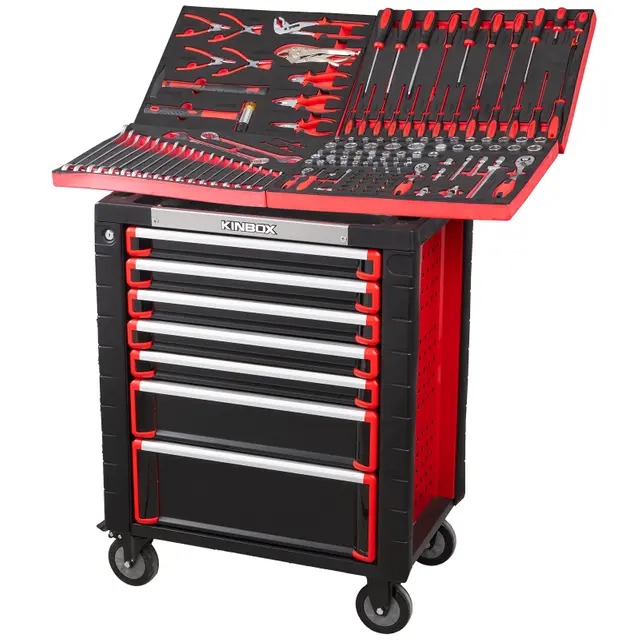
How Poor Welding Weakens a Tool Cabinet
Warping and Misalignment
When welds are inconsistent or too thin, the heat they introduce into the metal can cause panels to warp as they cool. That distortion can create uneven seams, which in a workshop means drawers that don’t slide right or doors that don’t align — annoying, but also signs the structure isn’t supporting loads evenly anymore.
Risk of Cracks and Fractures
Welding defects like cracks, voids, or incomplete fusion make certain parts of the cabinet more vulnerable when stress is applied. Even small flaws can grow over time under load, eventually leading to more serious failure.
Corrosion and Environmental Vulnerability
A good weld creates a smooth, tight joint. Poor welds can have microscopic gaps where moisture can settle and corrosion can start. Rust at a weld joint weakens the metal around it and accelerates failure — a problem very familiar in fabrication and steel work contexts.
Practical Effects in Everyday Use
Load Bearing and Heavy Tools
In daily workshop use, a tool cabinet often holds sockets, impact guns, wrenches, and other heavy gear. Every time you open a drawer loaded with weight, that force travels through the cabinet body and into the welded joints. Strong welds mean the cabinet doesn’t flex or deform — weak welds allow movement, which eventually undermines stability.
Repetitive Opening and Closing
Cabinets in professional spaces may be opened dozens of times per day. The cumulative effect of repetitive use puts cyclical load on welds. Good welding resists fatigue from these repetitive stresses much better than poorly formed joints.
Final Thoughts — The Difference Quality Welding Makes
At the end of the day, a tool cabinet isn’t just metal panels stacked together — it’s a system where every connection, angle, and joint plays a role in how stable and durable it will be. Welding quality isn’t a detail; it’s a foundational characteristic that shapes the real-world performance of the cabinet for years to come.
At Ningbo Kinbox Tools Technology Co., Ltd., we know that the strength of a tool cabinet is only as good as the welds holding it together. That’s why we emphasize strict welding standards, precise fabrication practices, and careful inspection throughout our manufacturing process. Whether you’re equipping a professional garage, workshop, or industrial facility, our cabinets are built to deliver the stability and longevity your workspace deserves — from the very first day to years down the line.
FAQ
1. Why does welding quality affect tool cabinet stability?
Good welding creates strong, continuous metal joints that evenly distribute load and resist deformation and fatigue, which is crucial for long-term stability.
2. Can poor welding cause a tool cabinet to fail?
Yes — defects like cracks, improper fusion, or weak joints can become failure points under stress and frequent use.
3. What factors influence welding quality?
Equipment condition, material preparation, welding technique, and operator skill all play major roles.
4. How can welding quality be tested in metal products?
In advanced fabrication, methods like ultrasonic and X-ray inspection are used to detect internal defects; visual checks catch surface issues.



